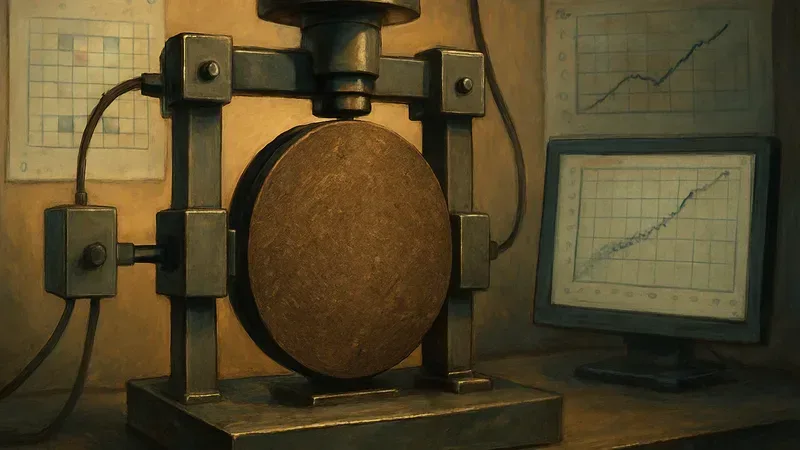
Durability results for friction facings in field applications vary widely. The usual explanation is the material, but the honest answer is that nobody knows: in most cases there is very little information about the conditions under which the vehicle was operated.
🔍 The problem
Without operating history, field wear data cannot be interpreted. A facing that wore quickly might have been driven hard, driven hot, or simply driven in traffic. Comparing two materials on field returns therefore compares usage patterns as much as it compares materials.
⚠️Field wear data without operating history is not comparable between materials — it reflects usage as much as the facing itself.
🧪 The approach
The response was to develop a test procedure capable of containing all the different operating conditions of a vehicle within a controlled bench test. Rather than sampling real-world usage after the fact, the range of usage is built into the test matrix from the start.
Reliability methods and design of experiments provide the structure: DOE to lay out the conditions efficiently, and reliability analysis to handle the scatter that remains in wear data even under controlled conditions.
- ✅ DOE to lay out the operating conditions efficiently
- ✅ Reliability analysis to handle the scatter that remains in wear data
📐 What came out of it
The procedure establishes a controlled basis for studying facing durability — one where the operating conditions are known by construction rather than reconstructed by guesswork.
🎯 Why it matters
This is the groundwork for correlating bench wear with vehicle mileage. The correlation and the Weibull reliability treatment were developed and reported in the extended version of this work, but they depend entirely on having a test procedure that spans the conditions a vehicle actually sees.
Known conditions by construction, not by guesswork — that is what makes bench-to-vehicle correlation possible.
📄 Full publication
Gregori, I. R. S. — Definition of the Relationship Between Clutch Facing on Vehicle and Bench Testing Using Reliability and DOE. SAE Technical Papers, November 2004.

Comentários (0)
Deixe um Comentário
Seja o primeiro a comentar!