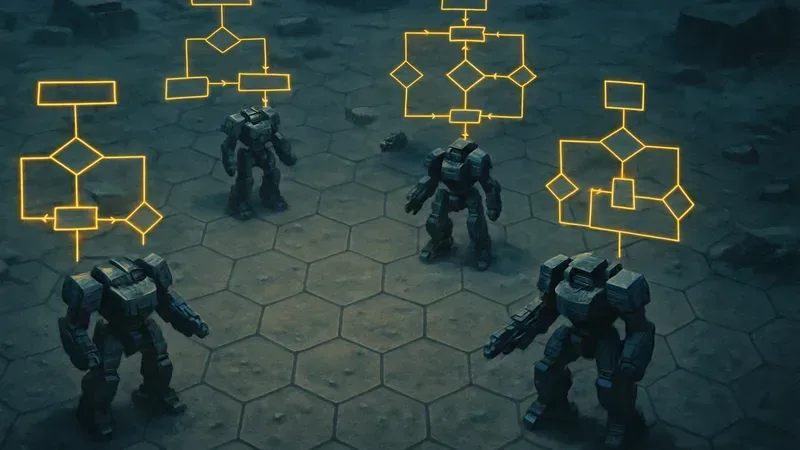
You command fleets of mechs on a distant planet, but you don't fight directly—you program their actions. It arrived in the mid-90s when PlayStation was pushing 3D, yet it chose cerebral strategy over spectacle.
🎮 About the game
- Release: 1995 (Japan), 1997 (elsewhere)
- Developer: Artdink
- Publisher: Sony Computer Entertainment (outside Japan)
- Platform: PlayStation
- Genre: Turn-based tactics
🧠 The experience
Carnage Heart feels like a chess match played with robots you've built from logic. The battlefield is a grid of hexes, viewed from above, with units moving in turn-based bursts. The mood is cold and mechanical, fitting a war fought by machines. You're not a pilot; you're a tactician and programmer, watching your creations execute your will. It's tense, deliberate, and oddly satisfying when your plans unfold.
⚙️ How it plays
You design mechs by choosing chassis, weapons, and armor, then write a program for each using a visual flowchart language. These programs dictate movement, targeting, and special actions. In battle, you issue orders, but units act on their own based on their programming. Victory comes from out-thinking opponents through better code and positioning, not twitch reflexes.
ℹ️The key concept here is the flowchart language—a visual way to script AI behavior, making the game a unique blend of strategy and coding.
✨ What makes it special
- ✅ Programming mechs via flowcharts is unique—you're debugging your strategy, not just clicking buttons.
- ✅ Autonomous units create a sense of watching your plans unfold, like a real battlefield commander.
- ✅ Deep customization lets you tweak every detail, from weapon loadouts to AI behavior.
- ✅ Turn-based combat with real-time execution of programs adds a layer of unpredictability.
🕹️ The retro charm
It's unmistakably 1990s: polygonal mechs rendered with early 3D, low-resolution textures, and a menu-heavy interface. The flowchart editor is clunky by today's standards, but that's part of its charm—it feels like using an old programming tool. The game demands patience, and its visuals are dated, but they carry a certain utilitarian appeal.
It's more about the hum of your own thoughts than dramatic music.
🔊 Sound & atmosphere
The soundtrack is sparse and electronic, fitting the sterile war setting. Sound effects are functional—mech movements, gunfire, explosions—but not memorable. The audio doesn't drive the mood; the quiet tension of planning and watching does.
🔄 Then vs. now
- Still works: the programming mechanic is genuinely original and offers a deep, thoughtful challenge.
- Feels dated: the interface is clunky, and the learning curve is steep without tutorials.
- Modern players may find the lack of direct control frustrating, but that's the point.
- Graphics are primitive, but the strategic depth remains engaging for patient players.
💡If you appreciate deep strategy and don't mind a steep learning curve, Carnage Heart offers a rewarding experience that's worth seeking out.
💡 Curiosities
- Artdink later made a sequel, Carnage Heart EXA, but the original remains the cult favorite.
- The game was one of the first to let players program AI for units, predating similar features in later strategy games.
🏁 Why remember it?
Carnage Heart is a forgotten gem that dared to make programming fun. It's for strategy fans who love tinkering and thinking. In PC gaming history, it stands as a bold experiment in merging coding with tactics—a quiet pioneer worth remembering.
📚 Source
Carnage Heart Wikipedia

Comentários (0)
Deixe um Comentário
Seja o primeiro a comentar!