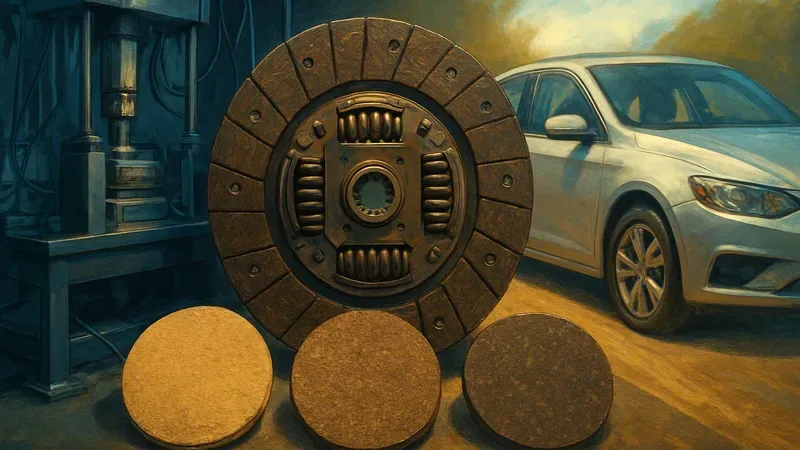
Vehicle judder — low-frequency, high-amplitude vibration during clutch engagement — can make driving uncomfortable when it is severe enough. A bench test exists specifically to measure the judder sensitivity of the friction material used on clutch discs, which means the measurement problem is solved. The characterization problem is not.
🎯 The problem
Having a bench test is not the same as having a methodology. To classify facings by judder sensitivity you need to know what the bench test predicts, how reliable that prediction is, and how it maps to what a driver experiences in a car.
🛠️ The approach
The study was divided into two parts. In the first, an alternative was developed by running a numerical simulation of the judder bench test, using three different facing materials as the basis. Simulating the bench rather than running it is what saves the test time.
In the second part, an experimental judder test was carried out in a passenger car. This served two purposes at once: to validate the efficiency of the numerical simulation, and to independently classify the judder sensitivity of the same three materials.
🔗 What came out of it
The pairing is the point. The vehicle test is not merely a demonstration — it is the reference that tells you whether the simulation is worth trusting, and the simulation is what makes the classification cheap enough to apply broadly once trust is established.
📌 Why it matters
This methodology sits upstream of the later sub-scale bench work. It establishes the validation discipline that the subsequent papers depend on: a laboratory method only earns the right to replace a vehicle test after the vehicle test has confirmed it.
📄 Full publication
Gregori, I. R. S. — Methodology to Determine the Clutch Facing Sensitivity Regarding Judder in the Vehicle. SAE Technical Papers, October 2010. Full text available.

Comments (0)
Leave a Comment
Be the first to comment!