Cube (1997): The Meaningless Maze and the Human Search for a Way Out
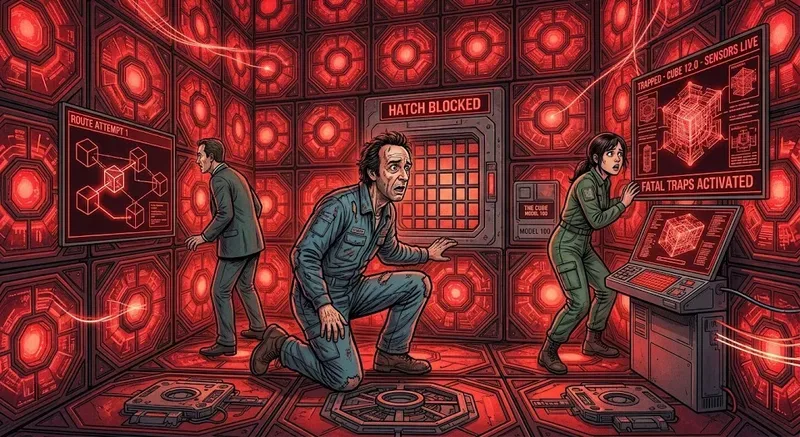
In Cube (1997), directed by Vincenzo Natali, a group of people wakes up inside an apparently infinite structure made up of cubic rooms. Some offer temporary safety. Others hide mechanisms capable of instantly killing anyone who enters.
There are no clear explanations.
There is no visible authority.
There is no manual.
And, perhaps most importantly, there is no guarantee that anyone is in control.
It is precisely in this void of answers that Cube stops being just a science fiction or psychological horror film and becomes something far more disturbing: a philosophical experience about the human condition.
The cube can be a prison. It can be an organization. It can be a metaphor for capitalism, for modern society, for bureaucracy, or for existence itself.
But perhaps the most unsettling interpretation is another:
the cube does not represent something that is outside of us. It represents the world in which we are already trapped.
The system: a machine too big to be understood
One of the most interesting interpretations presented about Cube compares its structure to large human organizations.
Companies.
Governments.
Institutions.
Bureaucratic systems.
Social structures.
Within them, each individual has a limited function. Each person understands only a small part of the mechanism. Someone builds a piece without knowing the final goal. Another administers a section without understanding how the whole works. Another just follows procedures established by people they may never have met.
The result is a gigantic system that seems to possess intelligence.
But does it?
That is one of the big questions of Cube.
We are used to believing that, behind complex systems, there is someone who knows what is happening.
A leader.
A government.
An elite.
A secret group.
An architect.
The film, however, suggests something far more uncomfortable: maybe no one knows.
Maybe the system continues to exist simply because millions of people perform small functions without any of them having a complete view.
That possibility destroys one of the greatest sources of psychological comfort for human beings: the belief that there is someone in charge.
The human need to believe there is a plan
The character Worth expresses one of the film's most philosophically important ideas.
When the others desperately look for who built the cube and why, he presents a different possibility.
Maybe there is no conspiracy.
Maybe there is no purpose.
Maybe there is no mastermind.
Maybe the system simply exists.
That idea may seem deeply nihilistic.
But there is something paradoxically liberating in it.
If there is a grand plan, then we are pieces within it.
If there is a perfect architect, then perhaps our choices are already anticipated.
But if there is no plan, a different possibility arises:
the responsibility for meaning returns to us.
The universe does not have to have been built for a purpose.
Life does not have to possess a hidden script.
Existence does not necessarily have to lead to an answer.
The human being, then, stops being someone trying to discover a previously established meaning and becomes someone who needs to create meaning within the unknown.
It is an anguishing vision.
But it is also a radical form of freedom.
The cube as a metaphor for existence
The characters in Cube do not know why they are there.
They do not know who put them in that place.
They do not know which rooms are safe.
They do not know how many rooms there are.
They do not even know if there is a way out.
Still, they need to make decisions.
They need to move forward.
They need to trust someone.
They need to choose.
That is perhaps the most direct metaphor for the human experience.
No one is born receiving a complete map of reality.
We do not know exactly why we exist.
We do not know if there is a universal purpose.
We do not know all the consequences of our decisions.
We do not know how many "rooms" are still ahead of us.
Even so, we need to choose a door.
Every day.
Life can be understood as a sequence of decisions made with incomplete information.
And perhaps that is what makes Cube so disturbing.
The terror is not just in the traps.
The real terror is in the absence of knowledge.
The obsession with understanding everything
Inside the cube, the characters try to turn chaos into something comprehensible.
They observe.
They calculate.
They measure.
They create theories.
They look for patterns.
They try to apply logic to an apparently absurd reality.
That is also one of the fundamental characteristics of the human mind.
When we encounter something unknown, we want to classify it.
When we face chaos, we look for patterns.
When something does not make sense, we invent explanations.
Science was born out of this extraordinary need to understand the world.
But Cube presents an important philosophical problem:
what if reality is bigger than the models we use to understand it?
The characters believe that if they discover the logic of the system, they can master it.
But perhaps that is exactly the problem.
Perhaps they are trying to understand a multidimensional reality using only the mental tools they know.
The analysis inspired by the ideas of Jacques Lacan suggests that our perception is never simply a direct copy of reality. We interpret the world through mental structures, language, symbols, and concepts.
We do not necessarily see the world as it is.
We see the world through what we are capable of understanding.
The cube, in that sense, can represent what always escapes human comprehension.
Reality beyond our model.
The unknown.
The impossible to be completely translated into words.
Kazan and transcendence through what we call limitation
Among all the characters, Kazan is perhaps the most intriguing.
He is seen by others as someone unable to function fully within conventional social standards. His communication is limited. His behavior is unusual. He seems not to participate in the psychological and intellectual disputes in the same way as the others.
But it is precisely he who has a special relationship with the cube's mathematical structure.
While the other characters are trapped in their personalities, fears, prejudices, and ambitions, Kazan seems to interact with reality in another way.
This creates an interesting inversion.
Those considered more intelligent do not necessarily manage to escape.
Those considered more prepared for the rational world do not necessarily understand the system.
And the one considered "limited" perhaps possesses a form of perception inaccessible to the others.
This idea has an almost spiritual depth.
Perhaps many of the limitations we see in people are only limitations within a given system.
And perhaps what we call intelligence is just the ability to function well within the rules we created.
Kazan does not seem interested in understanding the political, psychological, or philosophical meaning of the cube.
He simply exists within it.
And perhaps it is precisely because he does not carry the same symbolic weight as the other characters that he manages to get close to the exit.
The prison built by the mind itself
Throughout the film, it becomes evident that the characters are not only trapped inside a physical structure.
They are also trapped inside themselves.
The cop carries the need to control.
The doctor carries the need to explain.
The architect carries the guilt of having participated in the construction of structures he did not fully understand.
Each character enters the cube carrying their own prison.
And when pressure increases, these internal prisons become as dangerous as the physical traps.
That is perhaps one of the most profound messages of Cube.
We may believe that our greatest obstacles are outside of us:
in society,
in government,
in companies,
in the economy,
in circumstances.
But we often carry invisible structures within our own minds.
Fears.
Ideologies.
Traumas.
Ego.
Need for control.
Need to be right.
The inability to accept the unknown.
The external cube may be impossible to understand.
But the internal cube may be even harder to abandon.
What if there is no answer?
Cinema often conditions us to expect explanations.
We want to know who built the cube.
We want to know why the characters were chosen.
We want to discover who is watching.
We want to find the person responsible.
But Cube refuses to offer the comfort of a definitive explanation.
And perhaps that is its greatest quality.
Because life also does not deliver final answers.
Perhaps we will never discover why we are here.
Perhaps there will never be a complete explanation for suffering.
Perhaps there is no control room where someone can explain everything that happened.
The search for an answer may be part of the human condition.
But maturity perhaps begins when we realize that not having an answer does not mean we cannot keep walking.
In the end, Cube is not just about finding a way out.
It is about something harder:
continuing to look for a way out even when we do not know if it exists.
Perhaps that is the true human experience.
We cross rooms.
We make choices.
We lose people.
We create theories.
We make mistakes.
We try to understand.
And we move forward.
Never completely sure we are heading in the right direction.
The true horror of Cube
The most frightening aspect of Cube is not imagining that one day we might wake up trapped inside a giant machine full of traps.
The true horror is realizing that we might already live inside systems we do not fully understand.
Complex economic systems.
Gigantic institutions.
Social networks.
Algorithms.
Companies.
Governments.
Bureaucratic structures.
We all participate in mechanisms larger than our individual capacity to understand.
We perform functions.
We follow rules.
We make decisions.
And we often believe that someone, somewhere, has a complete view.
But perhaps no one does.
Perhaps the system keeps working because each person moves a small gear.
And perhaps the most unsettling of all is realizing that we desperately look for someone to blame because it is easier to believe in a controller than to accept the possibility that a giant machine might continue to exist without anyone really being in charge.
Cube remains relevant precisely because that question remains open.
Who built the system?
Why?
Who is in control?
Or are we looking for an architect simply because we are afraid to accept that sometimes there is no one?
Perhaps we will never find out.
Perhaps the only thing we can do is look at the next door.
Breathe.
Calculate the risk.
And choose.
Because, in the end, regardless of whether we understand the cube or not, one thing remains inevitable:
to keep living, we must cross the next room.

Comments (0)
Leave a Comment
Be the first to comment!