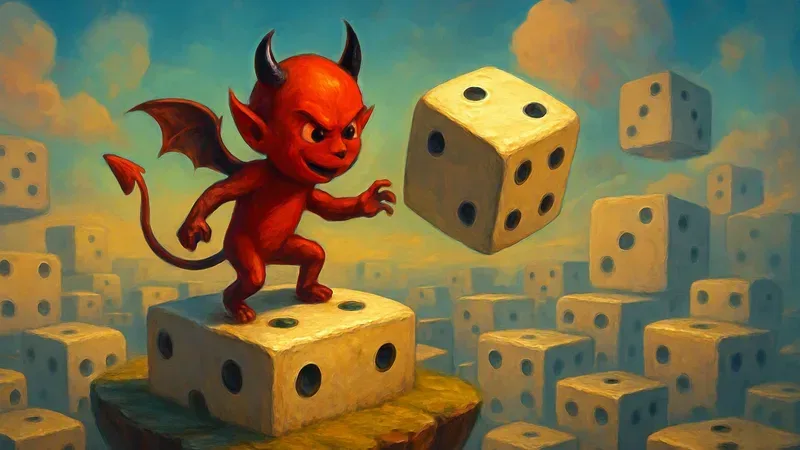
Devil Dice, known in Japan as XI, is a puzzle game that dropped onto the PlayStation in 1998. It asked players to think in three dimensions, a fresh twist for a genre usually stuck on flat grids.
🎮 Game overview
- Release: 1998
- Developer: Shift
- Publisher: Sony Computer Entertainment
- Platform: PlayStation
- Genre: Puzzle
🎲 The experience
Imagine a floating island of dice, each face showing a number. You control a tiny devil, hopping from one die to another. The world feels playful and slightly mischievous, with a lighthearted tone that matches the devilish theme.
The camera can be tricky, but once you get used to it, the game pulls you into a calm, focused rhythm. It's less about speed and more about careful planning.
🧩 How it plays
Your goal is to match dice with the same number by rolling them onto each other. Rolling a die changes its top face, so you must think about how each move alters the numbers. You can also push dice off edges to create new stacks.
The challenge ramps up as boards get more complex, demanding spatial reasoning and foresight. It's a pure puzzle experience with no combat or story—just you, the dice, and your brain.
✨ What makes it special
- ✅ True 3D movement: Dice roll in any direction, not just on a flat grid, making every move a spatial puzzle.
- ✅ Unique mechanic: Matching numbers by rolling adds a layer of strategy—you're not just swapping tiles.
- ✅ Devilish charm: The little devil character and floating islands give it personality rarely seen in puzzle games.
- ✅ Million-seller status: It sold over a million copies, proving its appeal beyond hardcore puzzle fans.
ℹ️Devil Dice was a million-seller, a rare feat for a puzzle game on the original PlayStation.
🕹️ The retro charm
This is pure late-90s PlayStation: polygonal graphics with simple textures, a fixed camera that sometimes fights you, and a menu system that feels clunky by today's standards. The low-poly devil and dice have a charming blockiness that screams the era.
Loading times between levels remind you of the hardware's limits, but they also give you a moment to plan your next move.
🎵 Sound & atmosphere
The music is light and bouncy, matching the playful tone. Sound effects—like the clatter of dice and the devil's little hops—add to the tactile feel. Without a known composer, the audio still does its job: keeping you relaxed but alert as you solve each puzzle.
⌛ Then vs. now
- Still works: The core puzzle mechanic is timeless—rolling dice to match numbers remains a clever, engaging challenge.
- Feels dated: The camera control and low-resolution graphics may frustrate modern players used to smooth 3D.
- Demands patience: There's no hand-holding; you must figure out the rules and strategies yourself.
- Modern players might miss a tutorial or hints, but the pure puzzle design holds up.
Devil Dice stands out as a puzzle game that dared to use 3D space in a way few others did.
🔍 Curiosities
- The Japanese title XI is pronounced like the Greek letter 'xi', adding a cryptic touch.
- A demo version was released as a PlayStation Classic for PS3 and PSP in 2007, giving new players a taste.
- It was a million-seller, a rare feat for a puzzle game on the original PlayStation.
🏁 Why remember it?
Devil Dice stands out as a puzzle game that dared to use 3D space in a way few others did. Today, it's a hidden gem for anyone who enjoys brain-teasers with a twist. If you like thinking sideways, it's worth a roll.
📚 Source
Devil Dice Wikipedia

Comments (0)
Leave a Comment
Be the first to comment!