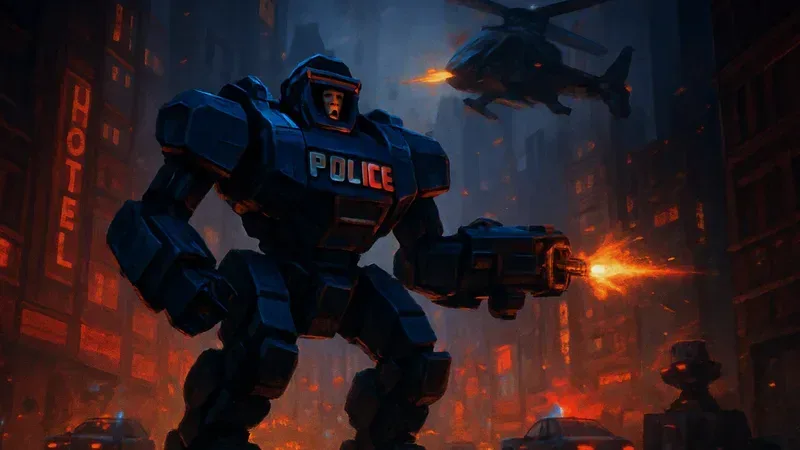
In a near-future Los Angeles, you pilot a police assault walker to stop crime. Originally planned as a Strike series game, it spun off into its own thing, arriving at the tail end of the 90s mecha craze.
🎮 About the game
- Release: 1998
- Developer: EA Redwood Shores
- Publisher: Electronic Arts
- Platform: PlayStation, Mac OS, Windows
- Genre: Third-person shooter
You're a one-person police force in a giant robot. The city is gritty, neon-lit, and always under threat. The pace is steady—you stomp through streets, blast enemies, and feel the weight of your machine.
It's a power fantasy with a badge, mixing cop drama with sci-fi action.
🕹️ How it plays
You move through levels, targeting enemy vehicles and turrets with a crosshair. You can lock on and fire missiles or use a rapid-fire gun. Between missions, you get briefings.
The core loop is simple: advance, shoot, survive. Some levels have objectives like protecting civilians or destroying specific targets.
ℹ️Originally a Strike game, it became its own mecha shooter, giving it a unique identity.
🌟 What makes it special
- ✅ You play as a police walker, not a soldier—rare for the genre.
- ✅ It features a two-player mode where one controls the walker and the other a gunship, a novel split.
- ✅ The setting blends cyberpunk with law enforcement, a twist on typical sci-fi shooters.
🕰️ The retro charm
For its time, it used 3D polygonal graphics that look blocky now. The interface is classic late-90s: health bars, radar, and simple menus.
The low resolution and limited draw distance are reminders of the era, but they add to the gritty, mechanical feel.
🔊 Sound & atmosphere
The audio is heavy on industrial beats and electronic effects, fitting the futuristic cop theme. Explosions and gunfire have a satisfying punch.
While no composer is credited in the source, the music drives tension and makes you feel like you're in an action movie.
⏳ Then vs. now
- Still works: the straightforward shooting and mecha fantasy are fun without modern complexity.
- Feels dated: the camera controls and targeting can be clunky by today's standards.
- Demands patience: missions can be long, and checkpoints are rare, testing your endurance.
- Modern players might see the premise as a precursor to games like Titanfall or Hawken.
⚠️Be prepared for a challenge: with rare checkpoints and long missions, patience is key.
🔍 Curiosities
- It was originally intended as a Strike series game, but evolved into a standalone title.
- The PlayStation version had a two-player mode that was split-screen, a rarity for the genre then.
💡 Why remember it?
Future Cop: LAPD is a forgotten gem that let you be a mecha cop. It's worth remembering for its unique twist on the shooter and its place in the 90s mecha wave.
If you like retro action, give it a try—it's a blast from the past that still packs a punch.
📚 Source
Future Cop: LAPD Wikipedia

Kommentare (0)
Kommentar hinterlassen
Schreiben Sie den ersten Kommentar!