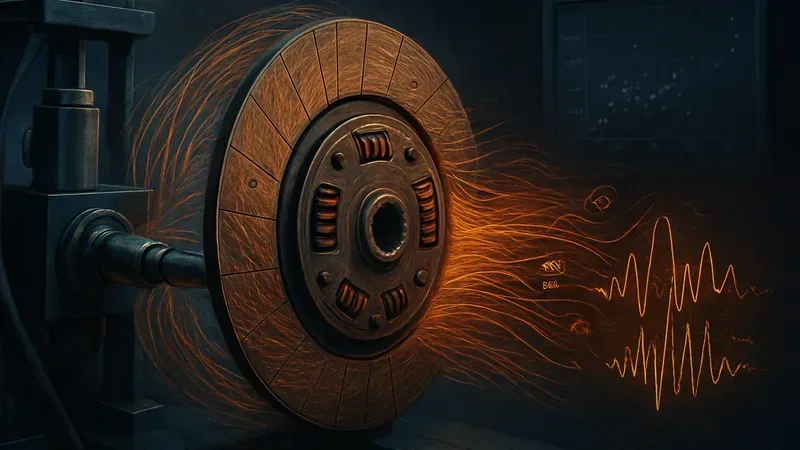
Driver comfort is a moving target, and judder — the low-frequency shudder during clutch engagement — is one of the things that has to be engineered out of it. Judder is genuinely complex, with contributions from engine excitation, misalignment, temperature and geometry. This work narrows the field deliberately and looks at one variable: the clutch facing.
🔍 The problem
If several facings are run through the same bench test, an engineer can see that they behave differently. What is much harder is to say how they differ in a way that connects back to how the material was made, and to do it without falling back on subjective judgement of the torque trace.
🧪 The approach
The study applies multivariate statistical analysis directly to the torque signal from a real bench test. Instead of reducing the signal to a single derived number, the whole signal is treated as the observation, and the statistical structure across facings is allowed to emerge from the data.
📊 What came out of it
The analysis separates the facings along two axes at once: their judder performance and their manufacturing characteristics. That dual separation is what makes the result actionable — a difference in judder behaviour can be traced back to something that was done differently on the production line.
Most importantly, the analysis establishes a gold standard behaviour for torque: a reference signature that a well-behaved facing produces. Having a target signature rather than a target score changes how a development programme is run.
Having a target signature rather than a target score changes how a development programme is run.
💡 Why it matters
A gold standard torque behaviour gives friction material development a consistent reference to aim at, and a consistent way to understand judder rather than simply measure it. New formulations can be compared against the reference instead of against each other, which makes results comparable across programmes and over time.
💡Compare new formulations against the reference signature, not against each other — that keeps results comparable across programmes and over time.
📄 Full publication
Gregori, I. R. S.; Thomaz, C. E.; Martins, C. G. — Multivariate Judder Behavior Analysis of Dry Clutches Based on Torque Signal and Friction Material, January 2015.

Kommentare (0)
Kommentar hinterlassen
Schreiben Sie den ersten Kommentar!