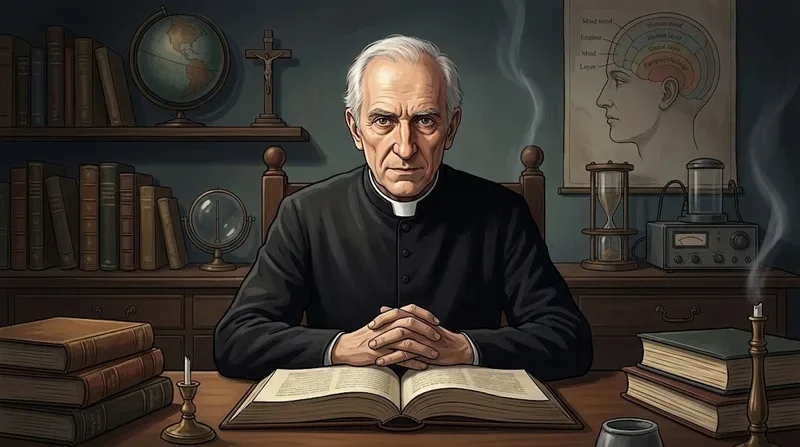
Padre Quevedo on Miracles, Premonitions and Faith: Why We Should Not Use God to Solve Our Problems
Can we predict the future?
Do miracles exist to solve our personal problems?
Was the September 11 attack predicted centuries ago?
And if God can perform miracles, why doesn't faith guarantee wealth, employment, health, or success?
These are some of the questions explored in an interview with Padre Oscar González-Quevedo, one of Brazil's most recognizable researchers and popularizers of parapsychology.
Known for his skepticism toward superstition and paranormal charlatanism, Padre Quevedo spent much of his life investigating alleged supernatural phenomena. His perspective was unusual because he combined religious faith with a constant demand for critical analysis.
Rather than accepting every mysterious event as supernatural, Quevedo repeatedly argued that many extraordinary claims could be explained by psychology, illusion, fraud, misunderstanding, or natural phenomena.
But perhaps the most interesting idea presented in this interview is not about ghosts, predictions, Nostradamus, or even miracles.
It is about the relationship between human beings and God.
According to Quevedo, faith should not be treated as a tool for obtaining everything we want.
Instead, human beings should seek to serve God, do good to others, and orient their lives toward something greater than immediate personal desires.
Premonition or Precognition?
One of the first subjects discussed is the idea of predicting future events.
Padre Quevedo rejects the popular use of the word premonition, which is often associated with superstition, fear, mystical intuition, and professional fortune telling.
Instead, he uses the concept of precognition.
In the context of his understanding of parapsychology, precognition refers to the possible perception of information about events that have not yet happened.
However, this does not mean that a person can simply decide to predict tomorrow's lottery numbers or accurately forecast disasters whenever they want.
This distinction is important.
Quevedo argues that if such phenomena exist, they would be limited and uncontrollable. The moment someone claims to possess a reliable supernatural ability to predict the future on demand, especially in exchange for money, skepticism becomes necessary.
This reflects one of Quevedo's central ideas throughout his career: extraordinary claims should not automatically be interpreted as evidence of supernatural power.
Human beings are remarkably capable of creating explanations after events have already occurred.
We remember the prediction that seemed correct and forget the hundreds that were wrong.
The Problem With Predictions After a Tragedy
Major disasters often generate a strange phenomenon.
After something dramatic happens, people begin searching for evidence that it was predicted.
This happened after the September 11 attacks.
Suddenly, people searched through ancient prophecies, religious texts, books, movies, and the writings of Nostradamus, trying to find references to the tragedy.
But Quevedo was highly critical of this process.
The problem with vague prophecies is that they are often interpreted after the event.
A sentence describing fire, destruction, towers, war, or death can potentially be connected to countless historical events.
Once people already know what happened, they begin searching for words that can be made to fit reality.
This creates the illusion that the prediction was precise.
Nostradamus is perhaps one of the most famous examples.
His writings have been repeatedly connected to wars, political events, disasters, and assassinations. But in many cases, the supposed connection only becomes convincing after interpreters already know what they are trying to explain.
The human brain is extremely good at finding patterns.
Sometimes, perhaps too good.
We can connect vague information to reality and create meaning where there may have originally been none.
The Third Secret of Fátima and the Search for Hidden Predictions
The interview also touches on the Third Secret of Fátima.
For many people, religious secrets and prophecies are fascinating because they seem to offer something humans desperately want: access to hidden knowledge.
We want to know what will happen.
We want certainty.
We want to know whether disasters can be predicted before they occur.
But Quevedo rejects the idea that every major historical event must have been predicted somewhere in a hidden religious message.
His position reflects a broader principle:
Not every mystery is a message about the future.
Humans often interpret history backwards.
After a tragedy, we search for warnings.
After a political event, we search for prophecies.
After a disaster, we search for predictions.
But the existence of a vague statement that can be connected to an event does not necessarily prove that the event was genuinely predicted.
The Most Interesting Idea: What Is a Miracle Actually For?
Perhaps the strongest part of Quevedo's argument concerns miracles.
In modern religious culture, miracles are frequently presented as solutions to individual problems.
Pray and get a job.
Believe and become wealthy.
Have enough faith and your financial problems will disappear.
Make a donation and receive prosperity.
But Quevedo strongly challenges this interpretation.
According to his theological perspective, a miracle is not primarily a service designed to solve our personal problems.
Instead, he describes miracles as something closer to a confirmation or "signature" associated with religious revelation.
The purpose is not necessarily:
"How can God give me everything I want?"
The more important question may be:
"What should I do with the life I have?"
This changes the relationship between faith and personal desire.
Are We Serving God, or Trying to Use God?
This may be the deepest question raised by the interview.
There is a significant difference between believing in God and trying to use God.
A person can pray only when they need something.
When they are unemployed.
When they are sick.
When they need money.
When they want success.
When everything is going well, however, the relationship may disappear.
In this model, God becomes a kind of emergency service.
Someone we call only when life becomes difficult.
Quevedo's perspective suggests something very different.
Faith should not exist simply because we expect something in return.
The purpose of spiritual life is not necessarily to manipulate reality in our favor.
It is to transform ourselves.
This idea can be uncomfortable because it removes the transactional relationship many people unconsciously create with religion.
"I will believe if God gives me what I want."
"I will pray if my problem is solved."
"I will follow God if my life becomes successful."
But perhaps genuine faith begins when belief is no longer a transaction.
Doing Good Without Expecting a Miracle in Return
One of the strongest lessons that can be extracted from the interview is the importance of doing good to others.
If faith becomes exclusively focused on personal gain, spirituality can become another form of selfishness.
We pray for our success.
Our money.
Our health.
Our career.
Our problems.
But how much attention do we give to the problems of other people?
Quevedo's broader message suggests that religion should not be reduced to a system for obtaining personal benefits.
Instead, faith should influence how we live.
How we treat other people.
How we use our time.
How we respond to suffering.
How much good we leave behind.
This creates a more challenging definition of spirituality.
It is easier to ask God for success than to become someone who genuinely serves others.
It is easier to pray for a miracle than to become part of the solution to someone else's problem.
The Difference Between Comfort and Meaning
Many people seek religion because they are looking for comfort.
And there is nothing inherently wrong with that.
Life is difficult.
People experience illness, loss, uncertainty, fear, and death.
But comfort and meaning are not necessarily the same thing.
A belief system that promises that every problem will disappear can provide temporary comfort.
But it can also create disappointment.
What happens when the miracle does not happen?
Did the person not believe strongly enough?
Did they pray incorrectly?
Were they not worthy?
This can become psychologically destructive.
Quevedo's perspective offers a different possibility.
Perhaps faith does not exist to guarantee that life will be easy.
Perhaps faith exists to help us understand what we should do with a difficult life.
That is a much more demanding idea.
But perhaps also a deeper one.
Projecting Life Beyond Immediate Problems
The phrase that best summarizes the philosophical message of the interview may be this:
We should project eternity instead of living exclusively for immediate problems.
Human life is often dominated by short-term concerns.
Money.
Work.
Status.
Possessions.
Recognition.
Comfort.
None of these things are necessarily bad.
The problem begins when they become the only purpose.
From a religious perspective, life has a longer horizon.
Our actions are not meaningful only because of what they give us today.
They matter because of what they transform us into.
Helping someone may not make us rich.
Doing the right thing may not always make life easier.
Serving others may not provide immediate rewards.
But meaning and reward are not always the same thing.
A life focused exclusively on personal advantage may be comfortable while remaining spiritually empty.
Padre Quevedo's Legacy: Faith Does Not Require Superstition
One reason Padre Quevedo became such a distinctive figure in Brazil was his willingness to challenge superstition.
He investigated alleged paranormal phenomena while maintaining a religious worldview, but he did not believe that religion required accepting every extraordinary claim.
In fact, he frequently argued the opposite.
Faith and superstition are not the same thing.
A person can believe in God while remaining skeptical about:
- Professional fortune tellers.
- Paranormal predictions.
- Supposed supernatural powers.
- Miraculous promises of financial success.
- Vague prophecies interpreted after events occur.
- Religious manipulation based on fear.
This distinction is still highly relevant today.
In the age of social media, extraordinary claims spread faster than ever.
A mysterious video can reach millions of people.
A prediction can be reposted thousands of times.
A supposed miracle can become viral before anyone investigates what actually happened.
Critical thinking is therefore not necessarily the enemy of faith.
Perhaps it can protect faith from manipulation.
Conclusion: Faith Is Not a Machine for Granting Wishes
The most powerful idea in this interview is surprisingly simple.
We should not approach God merely because we want something.
If faith becomes a transaction, then God becomes a tool.
And according to the philosophical and theological perspective expressed by Padre Quevedo, this reverses the relationship.
Human beings should not attempt to use God.
Instead, they should ask how they can use their lives.
How can we help others?
How can we become better people?
How can we serve something greater than our immediate desires?
How can we create meaning that survives beyond temporary success or failure?
Miracles, predictions, and mysteries may continue to fascinate us.
But perhaps the greatest challenge is much less mysterious.
It is waking up every day and asking:
What good can I do with the life I have?
Perhaps that question is more important than knowing what will happen tomorrow.

Comentários (0)
Deixe um Comentário
Seja o primeiro a comentar!