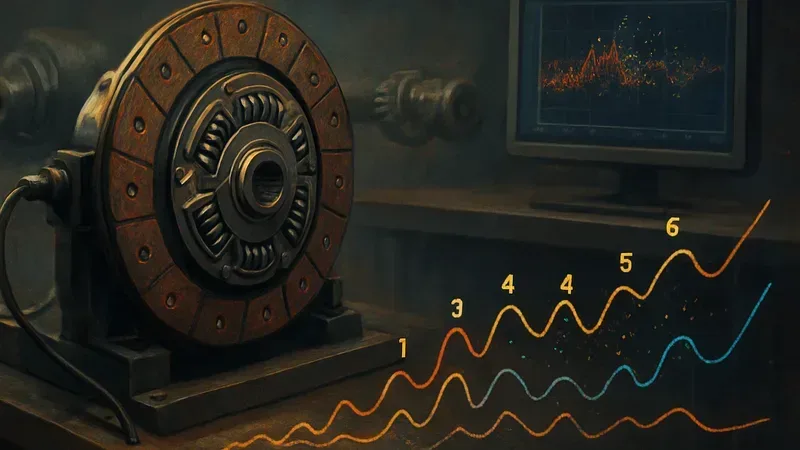
Judder is the word the automotive industry uses for the longitudinal shudder you feel when a clutch engages. It is a comfort problem, but it is also a development problem: finding out whether a new friction material judders normally means putting it in a car and driving it.
🔍 The problem
Earlier research had shown that judder can be explained through the behaviour of slip speed and temperature, both of which are captured inside the clutch torque signal. The signal carries the answer — the difficulty is extracting it in a way that is repeatable, cheap, and works before a facing ever reaches a vehicle.
🧪 The approach
This work proposes a learning system built on a multivariate, data-driven analysis of torque signals. The experimental base was deliberately broad:
- a dry clutch system,
- a passenger car,
- a test bench,
- and six different organic facing materials.
Rather than model judder analytically, the method treats each torque signal as a high-dimensional observation and applies a regularized version of a standard linear classifier. The regularization matters — it is what keeps the model stable when there are far more signal samples than there are test runs.
📊 What came out of it
The resulting model is computationally efficient and highly accurate at discriminating torque signals from different facings, and it does so using only a handful of features. That compactness is the practical win: it means the classification can run quickly and be interpreted by an engineer.
The second result is the more useful one. By calculating the correlation pair-wise against a known gold material, it becomes possible to predict a judder problem in the vehicle from a standard bench test in the laboratory.
The bench stops being a proxy measurement and becomes a prediction.
💡 Why it matters
Every judder evaluation that can be settled on a bench is a vehicle test that does not need to be run. Applied across a material development programme, that reduces both the time to develop a new friction material and the cost of qualifying it for judder-free performance.
📄 Full publication
Gregori, I. R. S.; Sanches, I.; Thomaz, C. E. — Clutch Judder Classification and Prediction: A Multivariate Statistical Analysis Based on Torque Signals. IEEE Transactions on Industrial Electronics, 64(5):4287–4295, November 2016. DOI: 10.1109/TIE.2016.2630666.

Comments (0)
Leave a Comment
Be the first to comment!