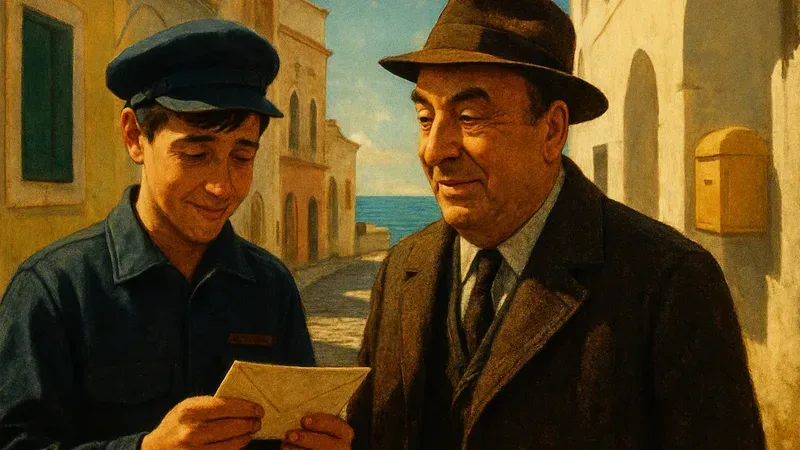
Massimo Troisi, the film's star and co-writer, reportedly postponed life-saving heart surgery to finish this movie. He died the day after filming wrapped. That knowledge shadows every frame of Il Postino, turning a gentle comedy about poetry and love into something unexpectedly moving. You watch a man who gave his last breath to tell a story about finding your voice.
📋 At a Glance
- Year: 1994
- Director: Michael Radford
- Country: Italy
- Language: Italian
- Genre: Comedy-Drama
- Main cast: Massimo Troisi, Philippe Noiret, Maria Grazia Cucinotta
- Runtime: 108 minutes
📬 A Postman's Education
The film is set on Procida, a small island off Naples, where the famous Chilean poet Pablo Neruda is living in political exile. Mario, a shy and barely literate postman, is assigned to deliver Neruda's mail. Mario has never read a poem and doesn't understand why anyone would. But as he watches the poet receive letters from adoring women, he realizes poetry might be a way to win the heart of Beatrice, the beautiful barmaid he loves.
What follows is not a story about great art. It is a story about how art can give a shy person the courage to speak. Mario asks Neruda to teach him metaphors, and the poet, amused and a little touched, becomes an accidental mentor. Their friendship grows through small, funny moments — Neruda is grumpy, Mario is earnest, and the island's slow rhythm makes their exchanges feel like a secret.
🪞 The Poet as a Mirror
Neruda is not really the main character. He is a mirror that reflects Mario's longing. Mario does not want to become a poet; he wants to become someone worthy of love. When he asks Neruda to explain metaphors, he is really asking how to say what he feels. The poet's fame matters less than his presence — the fact that he is a man who has found words for everything.
Philippe Noiret plays Neruda with a warm, weary dignity. He is not a grand figure but a man who has lived and is tired of being admired. He sees in Mario something genuine, and that recognition is what gives Mario confidence. The film understands that we often need someone else to believe in us before we can believe in ourselves.
💔 Troisi's Tender Performance
Massimo Troisi is the heart of the film. His Mario is not a comic fool but a quiet, observant man whose face reveals every flicker of hope and doubt. Troisi's own health was failing during the shoot, and you can see a fragility in his movements that makes Mario feel real. He is not performing shyness; he seems to inhabit it.
Troisi also co-wrote the screenplay, and his love for the material is evident. He treats Mario with affection but never mocks him. When Mario stumbles over a metaphor or mispronounces a word, it is funny, but it is also touching. Troisi makes you root for this man not because he is special, but because he is so ordinary.
ℹ️Massimo Troisi was a beloved Italian actor and director whose final performance is immortalized in this film. His decision to prioritize art over health speaks volumes about his dedication.
🏝️ An Island of Simplicity
Procida is not a postcard backdrop. It is a character. The film lingers on the sea, the narrow streets, the sound of waves and the chatter of neighbors. This is a world where nothing much happens, and that is exactly the point. Mario's transformation is quiet, like the island itself. The cinematography uses soft light and long takes, letting you breathe in the atmosphere.
The film's pacing is deliberate, almost lazy. Some modern viewers might find it slow, but that slowness is a choice. It gives the friendship time to grow and gives Troisi's performance room to breathe. The island's timelessness makes the story feel like a fable — a simple tale with a deep truth.
❓ The Question Behind the Movie
What does poetry actually do? The film asks this in a scene where Mario, now a little more confident, recites a poem to Beatrice. The words are Neruda's, but the feeling is Mario's. The poem does not magically make her love him, but it changes how he sees himself. He is no longer a postman who delivers other people's words; he is a man who can speak his own.
The film suggests that art is not an escape from life but a way into it. Mario does not become a famous poet or leave the island. He becomes more present in his own life. That is a quiet idea, but a radical one: beauty is not something you admire from afar; it is something you can use to shape who you are.
“The film suggests that art is not an escape from life but a way into it.”
🏁 Final Thought
Il Postino is a film about the power of words, made by a man who gave up his last words to tell it. Troisi's death is not the story, but it gives the film an extra layer of poignancy. Every time Mario smiles, you remember that joy is fragile. And every time he speaks a poem, you feel the courage it takes to say what is in your heart.
📚 Source
Il Postino: The Postman Wikipedia

Kommentare (0)
Kommentar hinterlassen
Schreiben Sie den ersten Kommentar!