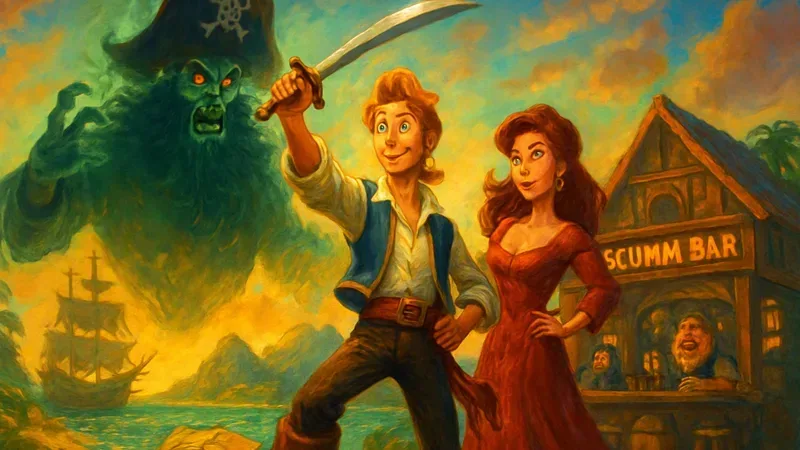
Set in a fictional Caribbean during the golden age of piracy, you play Guybrush Threepwood, a young man with a dream: to become a pirate. It arrived at the dawn of the 90s, when adventure games were king and Lucasfilm was refining the genre they helped define.
🏴☠️ Game overview
- Release: 1990
- Developer: Lucasfilm Games
- Platform: PC (MS-DOS)
- Genre: Point-and-click adventure
🎭 The experience
From the moment Guybrush stumbles into the Scumm Bar, you're wrapped in a world that's both silly and swashbuckling. The islands feel alive with quirky characters, from the ghostly LeChuck to the sharp-tongued Elaine.
The mood is light and comedic, but there's a real sense of adventure as you sail between islands, each with its own personality. You're not just solving puzzles; you're living a pirate fantasy, complete with insults, treasure maps, and a dash of romance. The game never takes itself too seriously, and that charm is what keeps you exploring.
🕹️ How it plays
You guide Guybrush by clicking on objects and people, using a simple verb menu to look, talk, use, and pick up. The core loop is classic adventure: explore a scene, gather items, and figure out how to combine them to overcome obstacles.
Conversations are often branching, and you'll need to win insult sword-fights by choosing the right retort. Progression is gated by puzzles, not combat, so your brain is your main weapon.
💡The game rewards creative thinking and experimentation. Don't be afraid to try the silliest ideas—they might just work!
✨ What makes it special
- ✅ Insult sword-fighting: A unique combat system where you win by trading witty barbs, not blades.
- ✅ Humor woven into every puzzle: Even the most absurd solution feels logical in this world.
- ✅ Memorable characters: Guybrush's bumbling charm and Elaine's competence break pirate stereotypes.
- ✅ Lucasfilm's Scumm engine: A technical feat that allowed smooth dialogue and animation, setting a new standard.
🖥️ The retro charm
Playing it today, you're greeted by 256-color VGA graphics that are colorful but pixelated, and a point-and-click interface that feels deliberate and slow. The low resolution gives characters a charming, cartoonish look, and the text-based dialogue requires reading, a reminder of a time when games expected patience.
🎵 Sound & atmosphere
The music, composed by Michael Land, uses the MIDI sound of the era to create a jaunty, Caribbean-inspired score that perfectly matches the mood. Sound effects are simple but effective, from the clink of coins to the creak of a ship. The audio, though limited by hardware, adds a layer of immersion that makes the world feel more real.
⏳ Then vs. now
- Still works: The humor and puzzle logic remain sharp, and the story is genuinely engaging.
- Feels dated: The interface is clunky by modern standards, requiring many clicks for simple actions.
- Demands patience: Puzzles are often obscure, and there's no in-game hint system.
- Reads differently: Modern players may notice the lack of diversity, but the strong female lead is still refreshing.
⚠️If you're used to modern conveniences like quest markers and built-in hints, be prepared to think old-school. The game gives you no hand-holding—but that's part of its charm.
🔍 Curiosities
- The game was originally designed to be more serious, but the team leaned into comedy after seeing the humor in early tests.
- Guybrush's name was chosen to sound silly, and his full name is a running joke in the series.
- The Scumm engine was later reused for other Lucasfilm classics, showing its versatility.
🏁 Why remember it?
The Secret of Monkey Island is a cornerstone of adventure gaming, proving that stories and humor could carry a game. It's a joy for anyone who loves witty writing and clever puzzles, and it holds a special place as a pioneer of the genre. A true gem that still makes you smile.
📚 Source
The Secret of Monkey Island Wikipedia

Comentários (0)
Deixe um Comentário
Seja o primeiro a comentar!