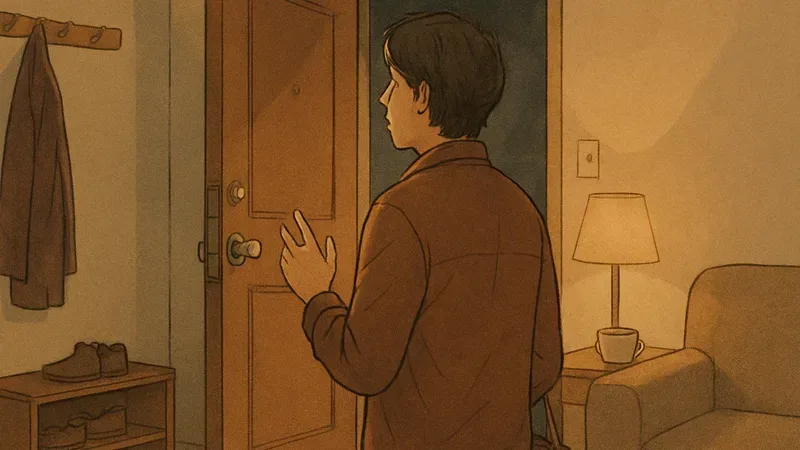
You are halfway out the door, keys already in hand, when you turn back and say it: "Just popping out for milk." Nobody asked. Nobody needs the milk but you. The door clicks shut, and you walk to the shop and back, and the whole trip takes eleven minutes. But you said the sentence. You almost always say the sentence.
🚪 Why we announce errands
Nobody announces a shower. Nobody announces that they are going to sit on the sofa and read for an hour. But leaving the house — even for a five-minute errand — seems to require a small verbal note.
Not a request for permission. Not really a report. More like a marker placed on the floor: I was here, and now I am briefly elsewhere, and I will be back. The announcement is not about the milk. It is about the hinge of the door.
📋 Which errands get said
Some departures get announced and some don't. Leaving for work in the morning is often silent — it is expected, it is part of the daily shape. But the odd errand, the one that breaks the pattern, gets a sentence.
- "I'm just running to the pharmacy."
- "Back in ten."
The announcement seems to attach to the unexpected departure, the one that might make someone look up and wonder where you went. It is a courtesy, but it is also a small confession: I am breaking the quiet of this room, and I want you to know it was me.
❓ What the sentence asks for
Listen to the tone. It is rarely flat. There is often a slight lift at the end, a question mark hidden inside a statement.
The sentence asks for something small: acknowledgment. A nod. A "okay." Not permission, exactly, but recognition.
The person staying behind gets to say something, even if it is just "mm-hmm," and in that exchange the two of you confirm that you are still sharing a day. The errand is trivial. The confirmation is not.
🔄 Maybe it's just habit
There is a simpler explanation. People talk. We narrate. We say "I'm going to take a shower now" to an empty room, or "let me just check the mail" to nobody in particular. The announcement before leaving might be no more meaningful than that — a verbal tic, a way of filling the silence between two people who have run out of things to say.
ℹ️If that is true, then reading meaning into it is a mistake. It is not a small act of care. It is just noise. And maybe that is fine too. Not every sentence needs to carry weight.
🧵 The hinge of the door
Still, when someone says "just popping out" and you say "okay," something tiny passes between you. Not a promise, not a contract. Just a thread. The door closes. The errand happens. The thread stays.
When they come back, they might not even mention the milk. But the sentence was said, and you heard it, and for a moment the house was not empty — it was waiting.

Comentários (0)
Deixe um Comentário
Seja o primeiro a comentar!