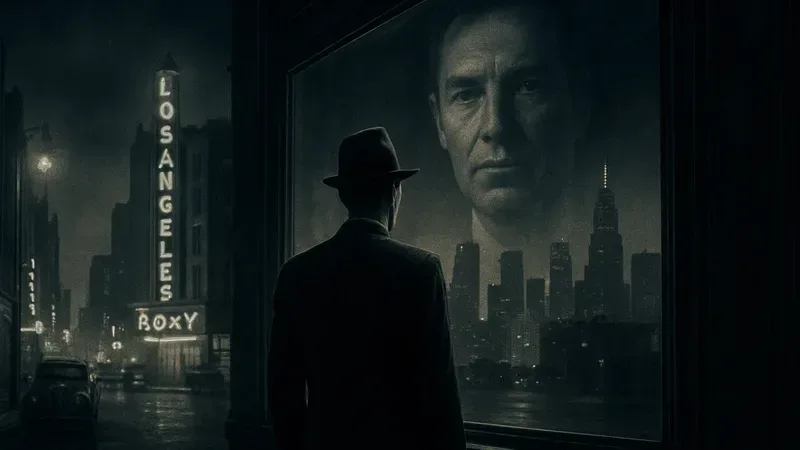
In 1999, two films asked audiences to unplug from reality. One was The Matrix. The other, released the same year, was The Thirteenth Floor — a quieter, stranger puzzle that never got the same glory. It begins with a simple idea: what if the world you live in is a simulation? Then it pushes further, asking who is simulating whom, and whether that even matters.
🎬 At a Glance
- Year: 1999
- Director: Josef Rusnak
- Country: USA
- Language: English
- Genre: Science Fiction Thriller
- Main cast: Craig Bierko, Gretchen Mol, Armin Mueller-Stahl, Vincent D'Onofrio
- Runtime: 100 minutes
🕵️ The Setup
Douglas Hall (Craig Bierko) is a software developer in 1999 Los Angeles. He and his mentor, Hannon Fuller, have built a perfectly detailed virtual recreation of 1937 Los Angeles — a world so convincing that people can enter it and live as their chosen avatars. When Fuller is murdered, Hall becomes the prime suspect. The only clue points into the simulation itself. To clear his name, he has to follow a trail that leads through a world that is not his own, and into questions he is not ready to answer.
🌀 Layers Within Layers
The film's title hints at its structure. A building's thirteenth floor is often skipped, hidden, or nonexistent — and here, reality itself seems to have a floor you can fall through. The 1937 world is not a backdrop; it is a character, populated by people who believe they are real.
The film plays with the vertigo of that idea: if you can step out of your world, how do you know you are not someone else's simulation? It is a puzzle box that keeps opening, and the film is patient enough to let you feel each unsettling shift.
ℹ️The simulation hypothesis is not new, but The Thirteenth Floor makes it visceral by letting you live inside the layers.
🌆 A Tangible Past
Where many sci-fi films imagine the future, The Thirteenth Floor builds a past. The virtual 1930s Los Angeles is all smoky jazz clubs, neon signs, and fedoras — a world that feels more solid than the sterile, rain-slicked present of 1999. That contrast is the film's visual genius.
The past is warm and alive; the present is cold and digital. You begin to understand why someone might prefer to live in a simulation, even knowing it is false. The production design makes that temptation feel real.
❓ Who Is Real?
The murder mystery is really a question of identity. If memories can be implanted, if your entire sense of self can be written by someone else, what makes you you? The film explores this through characters who may be more than they appear — especially Vincent D'Onofrio, who plays two very different roles with unsettling precision.
His performance anchors the film's unease: you never quite trust what you see, because you are never sure who is looking back.
If you can step out of your world, how do you know you are not someone else's simulation?
✅ What Still Works
The premise remains genuinely thought-provoking, and the film's atmosphere — a mix of noir and existential dread — holds up well. The central twist, when it comes, is earned and satisfying.
- ✅ Deliberate pacing that lets the mystery breathe.
- ✅ A 1930s world so well realised you almost wish the film spent more time there.
- ✅ Ideas that have not aged a day, even if the CGI has.
⚠️ What Aged
The visual effects, particularly the digital recreations of Los Angeles, show their age. The computer interfaces are pure late-90s kitsch, with clunky monitors and dated graphics.
Some of the acting, especially in the present-day scenes, feels stiff compared to the warmth of the period sequences. But these are minor flaws in a film that was always more interested in ideas than spectacle.
⚠️Don't let the dated visuals fool you — the film's questions are more relevant than ever in our age of VR and deepfakes.
💭 The Question Behind the Movie
At its heart, The Thirteenth Floor asks: if you discover your world is a simulation, does it stop being real? The question is not abstract — it is grounded in the film's images. A man stands in a rain-soaked street, wondering if the rain is just code. A woman in a 1930s dress wonders why she feels nostalgia for a time she never lived.
The film does not answer easily. Instead, it suggests that reality may be less important than connection. If you love someone, if you feel pain, if you make a choice — does it matter that the world around you is artificial? The film leaves you with that question, and it lingers long after the credits roll.
💡For viewers who enjoy philosophical sci-fi, The Thirteenth Floor pairs well with films like Dark City and eXistenZ.
🏁 Final Thought
The Thirteenth Floor is not the slickest or most famous film of its year, but it may be the one that stays with you. It takes a familiar sci-fi trope and turns it into a meditation on memory, identity, and the stories we tell ourselves.
In a world where we already spend hours inside digital realities, its questions feel more urgent than ever. It is a film that rewards patience — and makes you wonder, just for a moment, which floor you are standing on.
📚 Source
The Thirteenth Floor Wikipedia

Comentários (0)
Deixe um Comentário
Seja o primeiro a comentar!