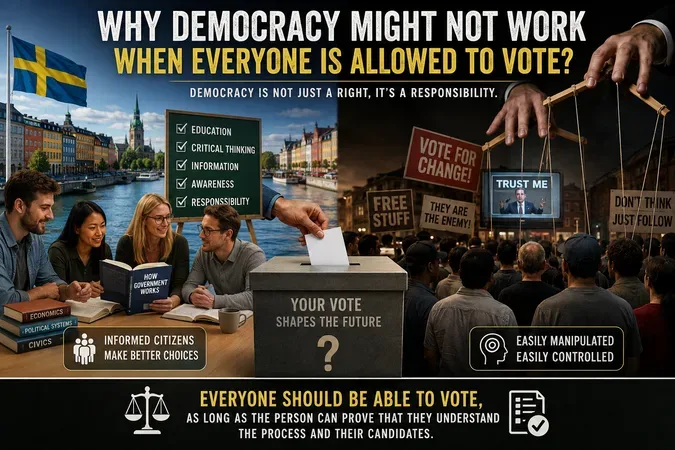
Democracy Depends on the Quality of Its Voters
Democracy is often presented as the best political system because it gives every citizen an equal voice. In theory, this sounds fair and reasonable. However, democracy only works as intended when voters are capable of understanding the consequences of their choices.
Why Some Countries Make Democracy Work Better
Many Northern European countries are examples of democracies that function relatively well. Citizens generally have access to quality education, reliable information, and strong public institutions.
When most people can evaluate policies, question political promises, and understand economic and social issues, democracy becomes a powerful tool for collective decision-making.
In these environments, voters are less likely to be influenced by misinformation, emotional manipulation, or unrealistic promises.
The Problem of Manipulation
In poorer countries, the situation can be very different.
Large portions of the population may have limited access to education or may struggle to understand complex political and economic issues. This does not make them bad people, but it makes them more vulnerable to manipulation.
Politicians can exploit emotions, spread misinformation, make impossible promises, or use short-term benefits to gain votes.
As a result, elections can become contests of popularity rather than informed decision-making.
Voting Is a Responsibility
Driving a car requires proving competence. Practicing certain professions requires exams and certifications. Even simple activities often require demonstrating some level of understanding.
Yet one of the most important decisions in society choosing the people who will govern millions of citizens requires no proof of political knowledge or civic understanding.
This raises an important question: should voting be treated only as a right, or also as a responsibility?
My opinion is that everyone in a democracy has the right to vote. However, they also have the responsibility to educate themselves and understand their vote by learning the basics, such as each party's plans.
A Different Approach
The goal should never be to exclude people because they are poor, belong to a particular group, or hold different opinions.
Instead, participation in elections could be tied to demonstrating a basic understanding of how government works, what candidates are proposing, and how political decisions affect society.
Such a system would focus on informed participation rather than unrestricted participation.
Conclusion
Democracy works best when voters are informed and capable of making rational decisions. Allowing everyone to vote regardless of their understanding of the political process may create opportunities for manipulation and poor governance.
Every citizen should have the opportunity to vote, but voting should come with the responsibility of proving a basic understanding of the democratic process, public institutions, and the candidates seeking office.
A healthy democracy is not simply one where everyone votes. It is one where citizens understand what they are voting for and why.

Comentários (0)
Deixe um Comentário
Seja o primeiro a comentar!