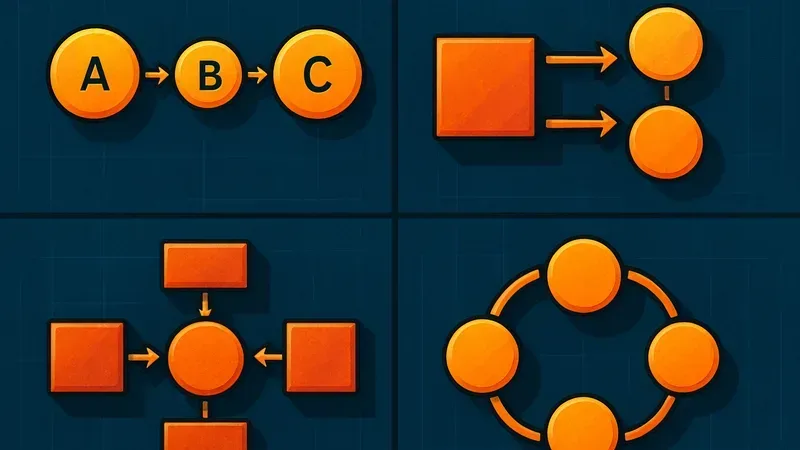
When we start building agentic applications, one of the first things we learn is that having multiple agents is not enough.
The real question is:
How should these agents work together?
A multi-agent system needs an orchestration strategy.
Some tasks are predictable and should follow a fixed sequence. Others can run in parallel. Some require a central agent making decisions dynamically, while others benefit from agents reviewing and criticizing each other.
In practice, there are four very useful orchestration patterns that cover a large number of agentic applications:
- Sequential
- Concurrent / Parallel
- Magentic Router
- Group Chat / Debate
The important part is not choosing one pattern for the whole system. A real enterprise solution can combine several of them depending on the problem.
🔀 Sequential Pattern
The sequential pattern is probably the easiest one to understand. It works like an assembly line. One agent performs a task, passes the result forward, and then the next agent continues the work.
For example:
Research Agent
      ↓
Summary Agent
      ↓
Email Agent
The Research Agent first collects information. The Summary Agent receives the research result and creates a concise summary. Finally, the Email Agent receives the summary and prepares or sends the final message.
The important characteristic here is that the order is predefined.
A → B → CAgent B depends on the output of Agent A, and Agent C depends on the result produced by Agent B. This pattern works very well when the business process is predictable and each step naturally depends on the previous one.
The disadvantage is that there is not much adaptability. If step A takes five seconds, step B takes five seconds, and step C takes five seconds, the total execution can take around fifteen seconds because each operation waits for the previous one. This is why Sequential is a good pattern for dependent tasks, but not necessarily for independent work.
⚡ Concurrent / Parallel Pattern
The Concurrent pattern is useful when multiple agents can perform independent tasks at the same time. Imagine that an agent needs information from three different sources:
              ┌─ Web Search Agent
User Query ───┼─ Database Agent
              └─ Document Search Agent
                       ↓
                    Joiner
There is no reason to wait for Web Search to finish before querying the database. These operations are independent. The workflow can execute all three agents simultaneously and wait for all results before continuing. A final Joiner or Synthesis Agent can then combine the information.
This has a very important advantage: latency.
Imagine:
Web Search     = 4 seconds
Database       = 3 seconds
Document Search = 5 seconds
Sequential execution could take approximately:
4 + 3 + 5 = 12 secondsWith parallel execution, the total time is closer to the slowest operation:
≈ 5 secondsOf course, real systems have network overhead, provider limits, and synchronization costs, but the architectural principle remains the same.
Concurrent orchestration is ideal when tasks are independent. Typical examples include:
- Searching multiple data sources
- Running independent security checks
- Asking several specialist agents for opinions
- Gathering information from APIs in parallel
- Comparing multiple datasets
The key question is:
Does Agent B need the result of Agent A?
If the answer is no, parallel execution might be a better architecture.
🧭 Magentic Router Pattern
The Magentic Router pattern is much more dynamic. Instead of defining the entire path beforehand, we introduce a central orchestrator. This agent behaves like a project manager. Every time a worker finishes its task, control returns to the Router. The Router analyzes the current shared state and decides what should happen next.
For example:
              ┌─ Research Agent ──┐
              │                   │
Router ───────┼─ Finance Agent ───┼─→ Router
              │                   │
              └─ Technical Agent ─┘
The process can work like this:
Router
   ↓
Research Agent
   ↓
State updated
   ↓
Router
   ↓
Technical Agent
   ↓
State updated
   ↓
Router
   ↓
Finish
The important difference is that the Router evaluates the state after every step. It can decide:
Call another agent
Call the same agent again
Use another tool
Request more information
Finish the workflow
This is where multi-agent systems become much more adaptive. Instead of creating a fixed flowchart at design time, part of the workflow is created dynamically during execution.
ℹ️The shared State becomes extremely important here. The Router needs to understand:
- What the user requested
- What has already been done
- Which agents already executed
- What information was found
- What failed
- What is still missing
Without shared state, the Router would have no reliable criteria for choosing the next step.
However, there is an important architectural consideration. I would not put every decision under LLM control. For enterprise applications, the best architecture is usually hybrid.
For example:
LLM Router
    ↓
Select specialist
    ↓
Deterministic validation
    ↓
Business rules
    ↓
Human approval if required
    ↓
Execution
A refund, payment, deletion, or other critical operation should not happen simply because an LLM decided it was a good idea. Probabilistic reasoning and deterministic controls should work together.
💬 Group Chat / Debate Pattern
The Group Chat pattern is different from the Router architecture. Instead of agents simply performing isolated tasks, agents can participate in a shared conversation and review each other's work.
A classic example is:
Writer Agent
     ↓
Critic Agent
     ↓
Writer Agent
     ↓
Critic Agent
     ↓
Final Result
The Writer creates the first version. The Critic reviews it and says something like:
This section is too complex.
The argument needs stronger evidence.
The conclusion is unclear.
The Writer receives that feedback and creates another version. The process can repeat until the result reaches an acceptable quality level.
This pattern is useful when the objective is not simply completing a task but improving its quality through iteration. Examples include:
- Technical document review
- Architecture review
- Code review
- Legal analysis
- Security review
- Content generation
- Research reports
The shared State in this type of workflow often looks more like conversation history. Each agent can see previous messages and contribute another perspective.
⚠️One important requirement is an exit condition. Without one, agents could continue debating indefinitely and consume an enormous number of tokens. You might define something such as:
Maximum 4 iterationsor:
Stop when Critic approvesor:
Stop when confidence > thresholdThis keeps the workflow under control.
🧩 Sequential vs Concurrent vs Router vs Debate
A simple way to remember the four patterns is:
Sequential
→ Tasks depend on each other

Concurrent
→ Tasks are independent

Magentic Router
→ The next task is not known in advance

Group Chat
→ Agents iteratively improve each other's work
For example:
If I need:
Research → Summary → EmailI would use Sequential.
If I need:
Web Search
Database Search
Document Search
at the same time, I would use Concurrent.
If I don't know whether I need research, calculation, another specialist, or another attempt until I see the current results, I would use a Router. If I need one agent to produce something and another to repeatedly review it, I would use Group Chat.
🔄 Combining Patterns
The most interesting part is that these patterns are not mutually exclusive. A sophisticated workflow might look like this:
                    ┌─ Web Search
                    │
Router ─→ Research ─┼─ Database Search
                    │
                    └─ Document Search
                           ↓
                         Joiner
                           ↓
                        Writer
                           ↓
                        Critic
                           ↓
                         Router
Here we are combining:
- Magentic Router
- Concurrent execution
- Group Chat
- Possibly Sequential steps
This is where agentic workflows become powerful.
Instead of asking:
Which orchestration pattern should my application use?
A better question is:
Which orchestration pattern should each part of my application use?
⚙️ Determinism Still Matters
One important lesson from building agentic systems is that introducing agents does not mean everything should become probabilistic. A strong architecture still separates responsibilities.
The LLM can handle:
Understanding intent
Reasoning
Classification
Planning
Choosing specialists
Generating explanations
C# and deterministic systems should continue handling:
State mutation
Validation
Authorization
Business rules
Persistence
Financial transactions
Security policies
Workflow constraints
For example, an LLM might classify an IT ticket as:
HardwareBut C# can map that result into:
TicketCategory.Hardwareand a deterministic workflow edge decides where the request actually goes. That gives us a useful balance:
Probabilistic intelligence
        ↓
Typed deterministic state
        ↓
Controlled execution
This is especially important when building enterprise AI systems.
🏁 Final Thoughts
Multi-agent architecture is not about creating as many agents as possible. It is about assigning clear responsibilities and choosing the correct communication pattern between them.
- ✅ Sequential workflows give us predictability.
- ✅ Concurrent workflows give us speed.
- ✅ Magentic Routers give us adaptability.
- ✅ Group Chat workflows give us iterative improvement.
And real systems will probably combine all four.
The most important architectural principle is to keep the agents focused, keep shared state explicit, and keep critical business operations under deterministic control. Agents should provide intelligence. The workflow should provide structure.

Comments (0)
Leave a Comment
Be the first to comment!