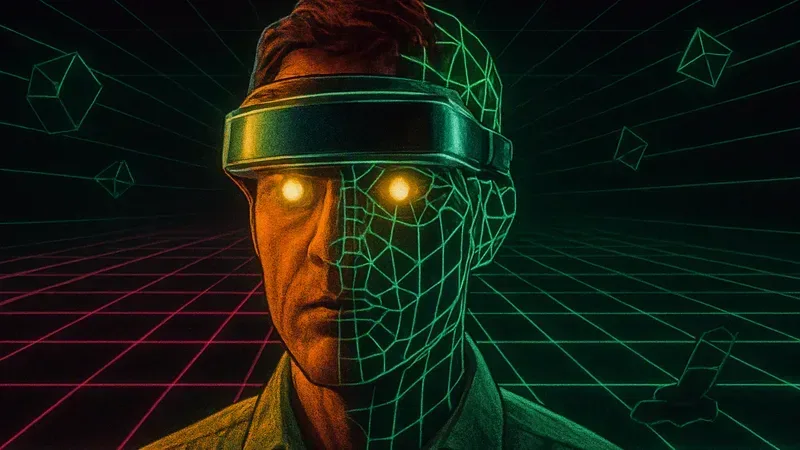
What if you could make someone smarter by plugging them into a computer? That is the dangerous promise at the heart of The Lawnmower Man, a 1992 science fiction horror film that feels like a time capsule from the first cyberspace boom. It is also a surprisingly nasty little fable about what happens when we treat a human brain like software.
📋 At a glance
- Year: 1992
- Director: Brett Leonard
- Country: UK/Japan co-production
- Genre: Science fiction horror
- Main cast: Jeff Fahey, Pierce Brosnan
🧪 The experiment begins
Jobe Smith is a gentle, intellectually disabled gardener. Dr. Lawrence Angelo is a scientist who has been running virtual reality experiments on chimpanzees. When Angelo decides to test his nootropic drugs and VR simulations on Jobe, the results are immediate and spectacular. Jobe's intelligence skyrockets. He learns languages, solves complex problems, and develops a taste for power.
But the same treatments that expand his mind also feed his aggression. The film does not ask whether Jobe will change. It asks what he will become.
🕶️ Virtual reality as a visual playground
The VR sequences in The Lawnmower Man are the film's most distinctive feature. In 1992, they looked like a glimpse of the future. Today they look like early PlayStation graphics. That is not a flaw. It is a window into how the early 1990s imagined cyberspace: flat polygons, neon grids, endless corridors of data.

The film treats VR not as a tool but as a place. Characters step into it, get lost in it, and eventually try to live in it. The visuals are dated, but the idea behind them is not. We still talk about escaping into digital worlds. We just use better screens.
🎭 Jeff Fahey's physical transformation
Jeff Fahey does something difficult here. He plays Jobe before and after the experiments, and he makes the change feel physical, not just intellectual. Early on, his body is loose, his eyes are wide, his movements are unguarded. After the treatments, he becomes still and watchful. The intelligence is in his posture. He does not just sound smarter. He looks like a different animal.

It is a performance that could have been a joke, and Fahey keeps it grounded in something real: a man who has been given a gift he never asked for, and who is starting to enjoy the wrong parts of it.
🕵️ Pierce Brosnan against type
Before Bond, Brosnan was often cast as a charming rogue. Here he plays a scientist who is not evil, exactly, but is definitely not good. Angelo is careless. He experiments on a human being because he can. He tells himself he is helping, but he is also chasing his own breakthroughs.
Brosnan plays him with a quiet, distracted guilt that never quite turns into responsibility. It is a smart piece of casting. The film needs us to believe that Angelo is smart enough to know better, and weak enough to do it anyway.
⚡ The real monster is speed
The film's horror does not come from a monster. It comes from acceleration. Jobe's mind grows faster than his ability to handle it. He becomes addicted to his own evolution. The nootropic drugs and VR sessions are not just tools; they are a kind of drug, and the film treats them that way. Every upgrade makes him less human and more hungry.

That is the film's sharpest idea: intelligence without patience is just another form of appetite. The scariest thing in The Lawnmower Man is not what Jobe can do. It is how much he wants to do it.
✅ What still works
- ✅ The VR sequences have a handmade, experimental energy that modern CGI lacks.
- ✅ Fahey's performance keeps the transformation from becoming silly.
- ✅ The film's central question about ethical science remains uncomfortably relevant.
- ✅ The pacing is tight, moving from experiment to consequence without much filler.
⏳ What aged
The computer graphics look primitive, and the cyberpunk aesthetic — neon grids, floating data, leather jackets — now feels like a costume party. The film also leans on some dated ideas about disability and intelligence. Jobe's initial condition is treated as a problem to be solved, not a life to be respected. That is a product of its time, and it sits awkwardly today.
🏁 Final thought
The Lawnmower Man is not a great film. It is a strange, ambitious, occasionally ridiculous one. But it understood something that many smarter movies missed: the real danger of technology is not that it will destroy us. It is that it will give us exactly what we ask for, faster than we can understand it.
🔗 Source
The Lawnmower Man (film) Wikipedia

Comments (0)
Leave a Comment
Be the first to comment!