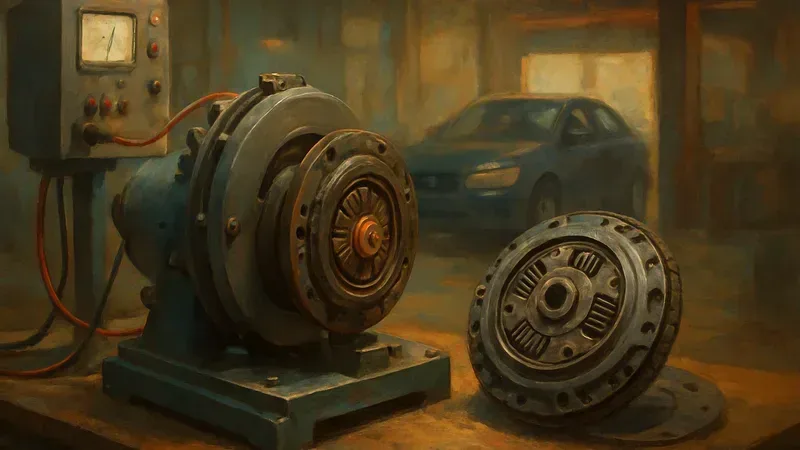
Judder shows up as low-frequency, high-amplitude vibration when the clutch engages, and at sufficient intensity it makes a car unpleasant to drive. Assessing it has always been a vehicle activity. This work asks whether it has to be.
🔧 The problem
The judder test as practised is run in a car selected for being sensitive to judder. It takes a long time, and the reason is mechanical rather than procedural: each test requires assembling the complete clutch set — disc, clutch cover, flywheel. The measurement is quick; the preparation is not.
🎯 The approach
The aim of this work is to develop a methodology for classifying facing sensitivity to judder in a sub-scale bench test. The motivation is stated as two distinct objectives rather than one: reducing test time, and speeding up facing material development.
They are related but not identical — the second is about how many ideas can be tried, not just how fast one can be checked.
📊 What came out of it
The preliminary results are promising, with a good correlation observed between the sub-scale tests and the vehicle. At this stage the claim is deliberately modest: the correlation exists and justifies continuing, which is what a first result from a new test method should establish.
💡 Why it matters
This paper marks the point where judder classification starts moving from a vehicle-bound evaluation to a laboratory one. The work was subsequently extended and reported again with further correlation data, but the framing set out here — sub-scale first, vehicle for confirmation — is what the later work builds on.
📄 Full publication
Gregori, I. R. S.; Domingues, A. — Judder Based on Sub Scale Test Machine Concerning Facing. SAE Technical Papers, October 2012.

Comments (0)
Leave a Comment
Be the first to comment!