Vehicle judder is defined as low-frequency, high-amplitude vibration during clutch engagement. Depending on intensity, it ranges from barely perceptible to genuinely uncomfortable to drive. The industry standard way to assess it is also the slowest one available.
⏱️ The problem
Today the judder test is performed in a car that is known to be sensitive to judder. The test itself is valid, but it is expensive in time: a complete clutch set — disc, clutch cover and flywheel — has to be assembled for every single test.
In a material development programme where dozens of formulations are screened, that assembly time dominates the schedule.
🔬 The approach
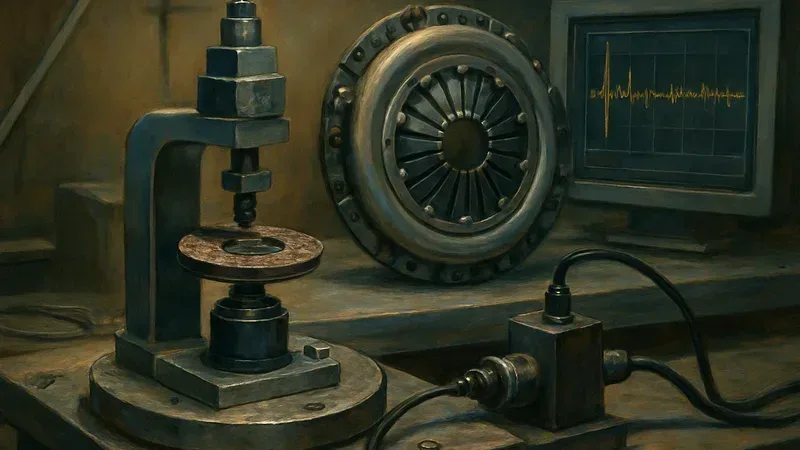
This work develops a methodology to classify facing sensitivity to judder on a sub-scale bench test rather than in the vehicle. The goal is explicitly twofold: cut the time each test takes, and speed up friction material development as a whole by allowing more candidates to be screened.
Sub-scale means the test article is smaller than a production facing, which is what removes the full clutch-set assembly from the loop. The open question is whether a smaller sample, tested on a bench, still ranks materials the same way a car does.
ℹ️Correlation — not the raw numbers — is what determines whether a bench test can genuinely replace vehicle time.
📊 What came out of it
The preliminary results are described as very promising, because of a good correlation between the sub-scale tests and the vehicle. Correlation is the load-bearing word here — a bench test that produces numbers is easy, while a bench test that produces the same ranking as the car is the thing that actually replaces vehicle time.
💡 Why it matters
Screening on a sub-scale machine changes the economics of judder work. Candidates that would never have justified a vehicle test can be evaluated, and the vehicle is reserved for confirming the shortlist rather than discovering it.
📄 Full publication
Gregori, I. R. S.; Haertel Jr., W. — Judder based on Sub Scale Test Machine Concerning Facing. SAE Technical Papers, April 2013.

Kommentare (0)
Kommentar hinterlassen
Schreiben Sie den ersten Kommentar!