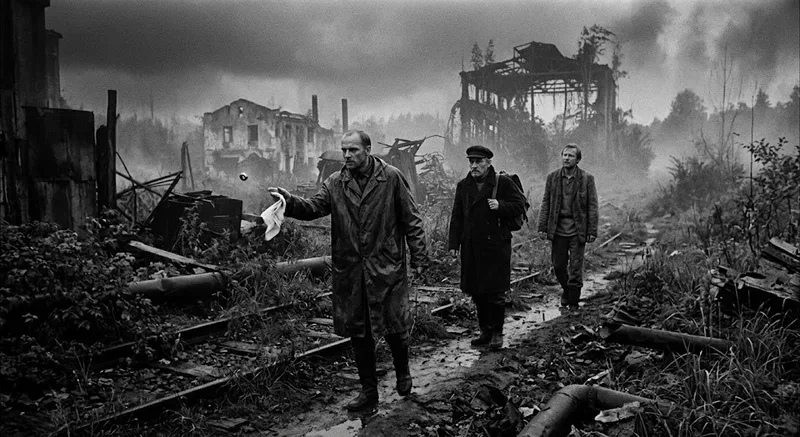
The Power of Ambiguity: Why You Should Watch Andrei Tarkovsky’s Stalker
Andrei Tarkovsky’s Stalker is a film that has captivated audiences and critics for decades. To many, it stands as a cinematic masterpiece a profound, lingering exploration of existential themes. For others, however, it presents a challenging watch. Its lengthy runtime, deliberate pacing, ambiguous conclusion, and complete refusal to offer conventional narrative arcs or neat answers often leave casual viewers unsatisfied.
Yet, it is precisely these demanding qualities that make Stalker such a singular, deeply rewarding work of art.
A Simple Premise Masked in Mystery
At its surface, Stalker relies on a relatively straightforward narrative setup. The plot follows three men the Stalker, the Writer, and the Professor—as they traverse a desolate, post-apocalyptic wasteland known simply as "The Zone," a place where the laws of standard physics no longer seem to apply.
Hidden deep inside The Zone is "The Room," a place rumored to grant the innermost desires of anyone who steps inside.
Despite this clear setup, Tarkovsky deliberately shrouds the mechanics of this world in ambiguity. The origins of The Zone are never fully explained—hinted only to be the result of a nuclear disaster or an alien incursion. More importantly, the film continuously questions whether The Room actually possesses supernatural powers at all. Viewers are forced to rely solely on the word of the Stalker, who serves as both the group’s guide and its primary believer.
The Trio: Archetypes of the Human Condition
The three main characters represent far more than individual figures; they act as symbolic embodiments of distinct philosophical perspectives:
The Stalker (Faith): A spiritual guide driven by unwavering belief and a sense of sacred duty. He dedicates his existence to helping lost souls navigate The Zone, despite never seeking the ultimate rewards of The Room for himself.
The Writer (Art & Passion): A disillusioned figure representing the internal struggles of the artist. Torn between a desire for artistic immortality and the dread of his own creative inadequacy, he ventures into The Zone hoping to reignite his lost inspiration.
The Professor (Reason & Science): The embodiment of pure rationalism and skepticism. While initially claiming a purely scientific curiosity, his journey gradually exposes much deeper, hidden motives.
The True Journey Within
Although the characters navigate a physical landscape, their trek through The Zone is fundamentally a spiritual one. Tarkovsky uses their continuous dialogue to explore heavy questions regarding faith, human desire, and the search for purpose.
The Zone acts as a psychological mirror reflecting each man's internal conflicts and fears. As they draw closer to their goal, the external dangers of The Zone take a backseat to their internal crises: the Stalker's faith is tested, the Writer's cynical disillusionment deepens, and the Professor's skepticism intensifies.
The central horror of The Room is not that it fails to grant wishes, but that it fulfills a person's true subconscious desires rather than what they consciously claim to want. This concept is exemplified by the legend of Porcupine a former Stalker who entered The Room wishing to resurrect his dead brother, only to be given immense wealth instead. Realizing his true core desire was greed rather than love, Porcupine took his own life. This story hangs over the Writer and Professor as a stark warning of what uncomfortable truths The Room might expose about their real selves.
Visual Storytelling: Color, Pacing, and Space
Tarkovsky’s mastery is prominently displayed through his deliberate use of color palettes and contemplative pacing to signal shifting realities:
Outside The Zone: The opening scenes are shot in a drab, desaturated sepia palette filled with browns and grays. This visually reinforces a world drained of vitality, capturing the oppressive, hopeless nature of the characters' everyday lives.
Inside The Zone: Upon entering The Zone, the cinematography suddenly shifts into vibrant, naturalistic color—rich greens, deep blues, and earthy tones. This startling transition immediately establishes that The Zone operates on a completely different plane of existence.
Combined with long, sweeping shots and sparse dialogue, the film's slow pacing is not merely an aesthetic choice; it is designed to physically pull the audience into the characters' meditative state.
Finding Meaning in the Journey
Tarkovsky once described Stalker as a tragedy, but notably "not a hopeless one," suggesting that true spiritual healing can only begin after passing through a crisis of faith.
The film ends without neat resolutions or explicit answers, leaving its characters and audience with unresolved questions. Yet, the journey itself proves deeply transformative. Stalker is an invitation to sit quietly with uncertainty, to embrace ambiguity, and to recognize that true meaning is often found not in the final destination, but in the journey taken to get there.
Improve the html&css for this article

Kommentare (0)
Kommentar hinterlassen
Schreiben Sie den ersten Kommentar!