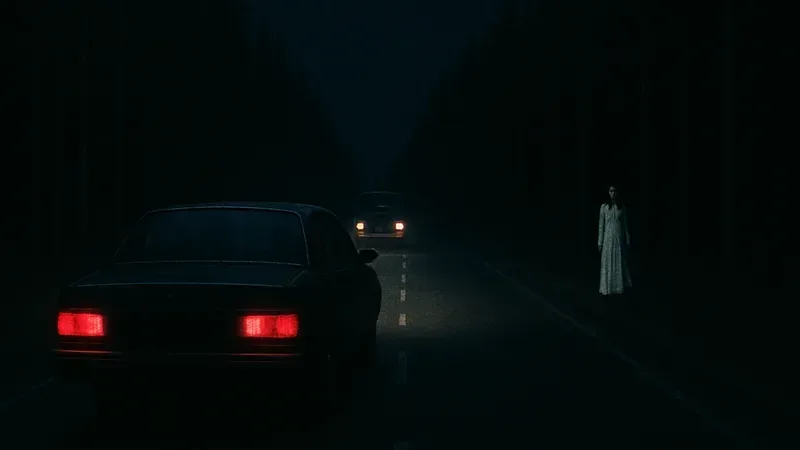
A family drives through a dark forest on Christmas Eve. The road stretches ahead, empty and endless. A mysterious hearse appears behind them. Then a woman in white steps out of the trees. The car keeps moving, but nothing changes. That is the setup of Dead End, a 2003 French horror film that understands the power of a single, inescapable space.
📋 At a Glance
- Year: 2003
- Directors: Jean-Baptiste Andrea, Fabrice Canepa
- Country: France, United States
- Language: English
- Genre: Mystery, Horror, Thriller
- Main cast: Ray Wise, Alexandra Holden, Lin Shaye, Mick Cain
- Runtime: 83 minutes
🚗 The Christmas Eve Drive That Never Ends
The Harrington family packs into their car for a routine trip to visit relatives. Father Frank (Ray Wise) is at the wheel. Mother Laura (Lin Shaye) sits beside him. Their adult children, Richard and Marion, bicker in the back. It is an ordinary, slightly tense family scene.
Then Frank takes a shortcut through the woods, and the road becomes a trap. The family cannot find an exit. The hearse keeps appearing. Something is wrong, and the car offers no escape.
🛣️ One Road, Infinite Pressure
The film uses a single location: the inside of the car and the road ahead. That is it. No houses, no towns, no other people. The camera stays close, often inside the vehicle, so the audience feels the cramped space.
The road outside becomes a loop, repeating the same trees and signs. This repetition creates a quiet dread. The family cannot leave the car without risk, but staying inside means facing each other. The road becomes a pressure cooker for every unresolved conflict.
ℹ️The single-location setup forces creative filmmaking with limited resources. The directors, Jean-Baptiste Andrea and Fabrice Canepa, understood that a limited setting forces creativity. They use the car's interior as a stage, and the darkness outside as a blank canvas for the audience's imagination.
💔 Family Secrets on the Asphalt
The horror does not come from jump scares alone. It comes from the way the family turns on one another. Frank is controlling. Laura is anxious. The children carry old resentments. As the road refuses to end, these tensions boil over.
The film suggests that the real nightmare is not the hearse or the woman in white. It is being trapped with people who know exactly which buttons to push. The supernatural elements work because they force the family to confront what they usually ignore.
🎭 Ray Wise Makes It Work
Ray Wise, known for his role in Twin Peaks, plays Frank with a mix of authority and desperation. He tries to keep the family calm, but his voice tightens. His eyes dart to the rearview mirror. He insists the road will end, even as it becomes clear it will not.
Wise gives Frank a stubbornness that feels real, not cartoonish. The other actors hold their own, but Wise carries the film. His performance anchors the tension when the plot threatens to become repetitive.
🎬 Low-Budget Craft That Pays Off
The film was made on a small budget, and it shows in the right ways. The hearse is a practical vehicle, not a CGI creation. The woman in white appears suddenly, often in the headlights, and her presence feels physical. The sound design uses silence and the hum of the engine to build unease.
📉 The Middle Stretch Loses Steam
The film runs 83 minutes, which is lean, but the middle section drags. The family argues, the hearse appears, someone gets out of the car, and the cycle repeats. The tension dips because the pattern becomes predictable. The characters are not developed enough to make every argument feel new. A few more surprises in the middle would have kept the momentum steady. Still, the film recovers for a strong final act.
✅ What Still Works
- ✅ The practical hearse and the woman in white create real physical menace.
- ✅ Ray Wise's controlled performance keeps the family drama believable.
- ✅ The single-location setup forces creative filmmaking with limited resources.
- ✅ The sound design uses silence and engine noise to build dread.
- ✅ The short runtime respects the audience's patience.
🕰️ What Aged
A few visual effects, particularly some digital shots of the road, look dated. The early 2000s CGI lacks the texture of the practical elements. The film also relies on a few late-90s horror conventions, like sudden loud noises, that feel familiar now. But the core concept and the performances hold up well.
❓ The Question Behind the Movie
What happens when a family is forced to stay together without any distraction? No phones, no exits, no escape. The film asks whether the bonds of family are strong enough to survive pure proximity. It suggests that the worst monsters are not ghosts or hearses, but the grudges we carry in the backseat. The film does not answer the question neatly, and that is part of its power.
🏁 A Road That Stays With You
Dead End is a small film with a big idea. It takes a simple premise, a family trapped on an endless road, and turns it into a study of fear, guilt, and the people we cannot escape. The budget is low, but the ambition is high. For fans of lean, psychological horror, this road is worth traveling.
📖 Sources
Dead End (2003 film) Wikipedia
Facts TMDB
📚 Related Articles
- Stir of Echoes: Hypnosis, Hauntings, and Working-Class Horror - Another family-centered supernatural thriller where a father's visions unravel buried secrets.
- The Mothman Prophecies: A Masterclass in Dread - A slow-burn horror about an endless, inescapable mystery that preys on a community's fears.

Comments (0)
Leave a Comment
Be the first to comment!