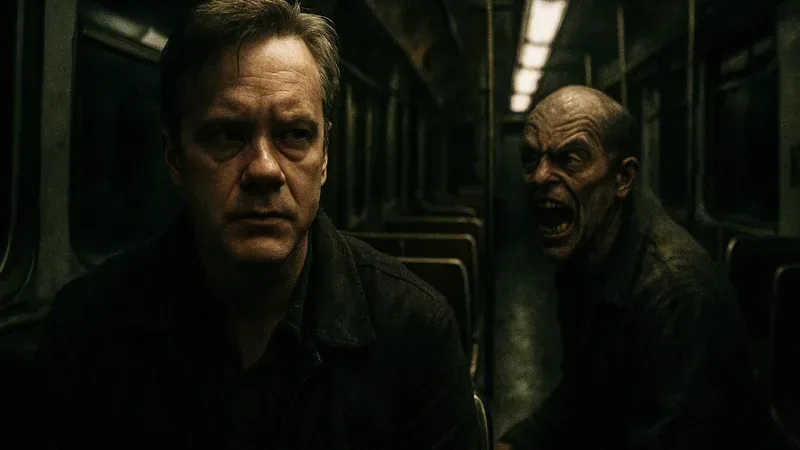
Tim Robbins sits on a subway car. The lights flicker. A fellow passenger turns, face contorted, demonic. The train roars. Then silence. Then a cut to a hospital. This is Jacob's Ladder in its purest form: a world where the rules of reality keep changing, and the only constant is dread.
📋 At a Glance
- Year: 1990
- Director: Adrian Lyne
- Genre: Psychological horror
- Main cast: Tim Robbins, Elizabeth Peña, Danny Aiello, Matt Craven
- Runtime: 113 minutes
🎬 Plot and Premise
Jacob Singer is a Vietnam veteran living in New York. He works as a mailman. He has a girlfriend, a past, and a growing collection of hallucinations. Faces twist. Rooms shift. Time loops. The film follows Jacob as he tries to understand what is happening to him—and whether any of it is real.
🎥 Cinematography
Adrian Lyne uses the camera like a nervous system. Quick pans. Unstable close-ups. Dissolves that melt one scene into the next without warning. The editing does not just show Jacob's confusion—it forces the viewer to feel it. You cannot settle into a scene before it transforms. The effect is not flashy. It is deeply uncomfortable.
⚔️ Vietnam as a Wound
The film does not show combat for long. Instead, it treats the Vietnam War as a source of trauma that keeps bleeding into the present. Jacob's memories arrive as fragments: a flash of jungle, a shout, a body. The war is not recreated. It is felt.
ℹ️The horror comes from what the mind does with the memory, not from the memory itself.
🏥 Production Design That Feels Wrong
The hospital scenes stand out. The walls are too white. The corridors stretch too far. The light is flat and cold. This is not a real hospital. It is a space designed to feel like a nightmare someone else is having.
The contrast with Jacob's ordinary apartment makes the shift more disturbing. The film moves between the familiar and the impossible without warning.
🎭 Tim Robbins as a Man Unraveling
Robbins does not play Jacob as a hero or a victim. He plays him as tired. His voice stays low. His movements slow. Even when the world around him becomes absurd, he reacts with exhaustion rather than shock.
This restraint makes the horror feel earned. If Jacob screamed at every vision, the film would lose its grip. His quiet confusion is what makes the terror land.
✅ What Still Works
- ✅ The subway hallucination sequence remains genuinely unsettling.
- ✅ The editing choices still feel radical, not dated.
- ✅ Robbins' performance anchors the chaos.
- ✅ The sound design—especially the roar of the train and sudden silences—creates tension without music.
⚠️ What Has Aged
A few visual effects look like early 90s compositing. The demon faces, while creepy in concept, sometimes look like rubber masks. The film's middle section repeats the same pattern—hallucination, confusion, recovery—without adding much new information.
🤔 The Central Question
The film asks: What happens when a mind cannot trust its own senses? Jacob's struggle is not against a monster or a villain. It is against perception itself. The film does not answer whether what he sees is real. It only shows what it costs him to keep looking.
🎯 A Film That Refuses to Explain
Jacob's Ladder does not offer a clean resolution. It offers an experience. The film trusts that the viewer will sit with the discomfort, the unanswered questions, the images that do not fit.
That trust is what makes it worth watching—even when the answers never come.
📚 Related Articles
- Stay: A Mind That Refuses to Stay Still - Another psychological thriller where reality bends and a psychiatrist loses his grip on what is real.
- The Forgotten: When Memory Becomes a Battlefield - A mother fights a reality-altering conspiracy, exploring memory and loss of trust in one's own mind.
🔖 Sources
Jacob's Ladder (1990 film) Wikipedia
Facts TMDB

Comments (0)
Leave a Comment
Be the first to comment!