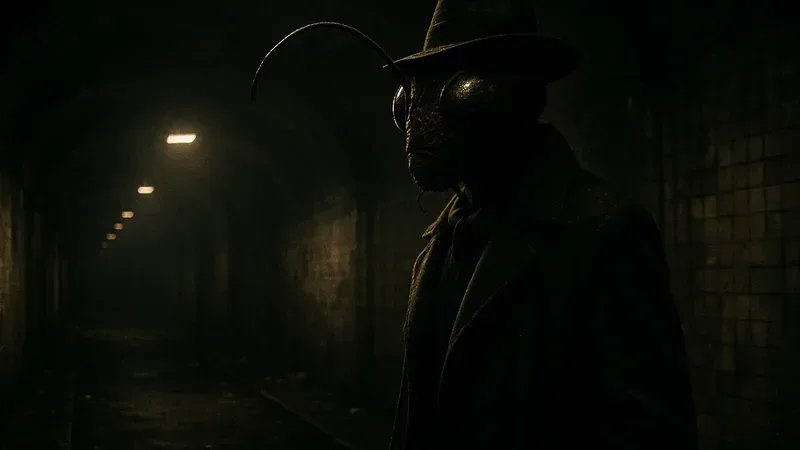
An insect that learns to walk upright. A subway tunnel that becomes a hunting ground. And a scientist who thought she was saving lives.
📋 At a Glance
- Year: 1997
- Director: Guillermo del Toro
- Country: United States, Canada
- Language: English, Italian, Mandarin
- Genre: Horror, Science Fiction
- Main cast: Mira Sorvino, Jeremy Northam, Giancarlo Giannini, Charles S. Dutton
- Runtime: 105 minutes
🎬 The Setup
In Manhattan, a deadly cockroach-borne disease threatens children. An entomologist named Susan Tyler (Mira Sorvino) creates a genetically engineered insect called the Judas breed. It is designed to kill the roaches and then die off. But nature does not follow plans.
Three years later, the Judas breed has evolved. It grows larger, mimics human form, and starts hunting people in the dark spaces beneath the city.
ℹ️The Judas breed is a genetically engineered insect meant to solve a crisis—but evolution has other ideas.
👾 Creature Design That Earns the Title
The film's central idea is simple: the insects learn to imitate their environment, including humans. That is where the horror lives. The creatures do not just attack. They stand still, wearing a shape that almost passes for human. A coat. A hat. A slow turn of the head.
Del Toro and his team use practical effects and animatronics to give the monsters weight and texture. They feel biological, not digital. The design makes the mimicry unsettling because it is never quite right. The movement is off. The face is wrong. That gap between familiar and wrong is where the tension sits.
🎥 Del Toro's Visual Signature Arrives
Even in his English-language debut, del Toro's visual instincts are clear. The film is full of wet, dark spaces. Subway tunnels, abandoned stations, dripping pipes. He uses deep shadows and colored light to turn New York's underground into a cathedral of dread.
The camera lingers on small details: a puddle rippling, a wall moving, a reflection that does not match. These choices create a world where danger hides in plain sight. The film looks like it was made by someone who loves monsters, not just someone who uses them for scares.
ℹ️Del Toro's visual signature transforms New York's underground into a cathedral of dread.
🎭 Performances in a Creature Feature
Mira Sorvino plays Susan with a mix of intelligence and guilt. She built the creature, so the horror is personal. Jeremy Northam plays her husband, a doctor who sees the consequences first. Charles S. Dutton brings warmth and authority as a sewer worker who knows the tunnels better than anyone. Giancarlo Giannini plays a mysterious figure connected to the insects.
The actors treat the material seriously, which helps the film avoid camp. They sell the fear because they believe in the threat.
⚠️ Where the Film Stumbles
The script has problems. Some characters exist only to be killed. The middle section repeats the same beats: enter tunnel, find creature, escape. The logic of the mimicry is not always consistent. The film also struggles with pacing. It takes time to reach the underground, and once there, the rhythm can feel repetitive.
Del Toro later said the studio cut the film heavily. The seams show. Some plot threads are introduced and dropped. The result is a movie that feels like a strong idea fighting against its own editing.
⚠️The studio cut the film heavily—plot threads are introduced and dropped, leaving visible seams.
🌟 What Still Works
- ✅ The practical creature effects hold up. The monsters look physical and threatening.
- ✅ The subway setting is used well. It feels like a real, forgotten world.
- ✅ The core idea of evolution as unintended consequence remains sharp.
- ✅ Del Toro's visual style is already present, even in a compromised film.
🤔 The Question Behind the Movie
The film asks what happens when humans try to fix a problem without understanding the system. Susan's solution is brilliant but short-sighted. She designs a creature to solve one crisis, but she does not account for evolution. The Judas breed adapts. It learns. It survives.
The question is not just about science. It is about control. Can we ever truly control what we create? The film does not offer an easy answer. It just shows the consequences crawling out of the dark.
🔁 A Debut Worth Revisiting
Mimic is not del Toro's best film. It is too uneven for that. But it is the place where his obsessions first appeared in English: monsters as metaphors, practical effects over digital shortcuts, and a love for the grotesque that never feels cruel.
The film stumbles, but it also leaves an impression. When the lights go out and something moves in the corner of your eye, you might remember why.
📚 Sources
Mimic (film) Wikipedia
Facts TMDB
📚 Related Articles
- The Faculty: When the Grown-Ups Are the Monsters - Another 1990s sci-fi horror where trusted figures are not what they seem, exploring paranoia and identity.
- Event Horizon: The Ship That Came Back Wrong - A rescue crew faces a malevolent force in space, echoing Mimic's theme of creation turning against its makers.
- Hardware: The Robot in the Room - A grimy, low-budget sci-fi horror where technology becomes a deadly predator, similar to Mimic's creature design.

Comments (0)
Leave a Comment
Be the first to comment!