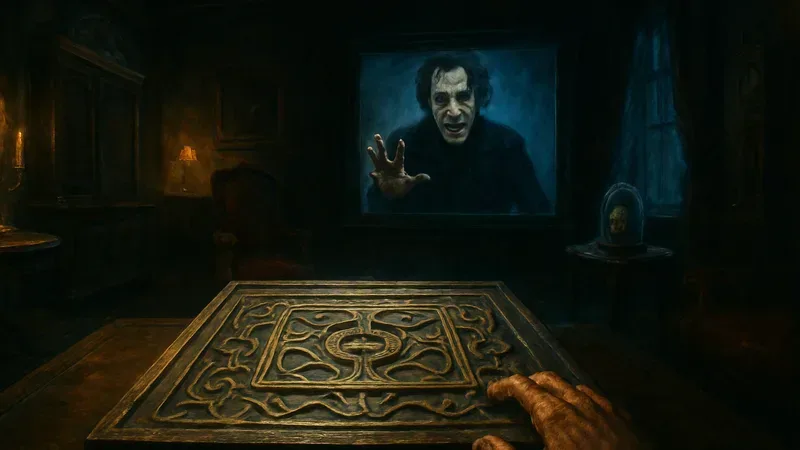
You wake up in a creepy Victorian mansion with no memory. A mysterious host named Stauf challenges you to solve puzzles. This was one of the first games released only on CD-ROM, a big deal in 1993.
📜 About the game
- Release: 1993
- Developer: Trilobyte
- Publisher: Virgin Interactive Entertainment
- Platform: DOS
- Genre: Interactive movie puzzle adventure
👻 The experience
The game feels like stepping into a haunted house. You explore eerie rooms filled with antique furniture and strange objects. Live-action video clips play as Stauf taunts you.
The atmosphere is tense and lonely. You never see other characters, just hear their voices. The puzzles feel like tests from a madman. Every solved puzzle reveals more of the story.
🎮 How it plays
You move through the mansion by clicking on doors and objects. Each room has a puzzle blocking your progress. Puzzles range from sliding tiles to logic challenges.
Solve them to unlock new areas and watch story videos. There is no combat or inventory. The game is pure puzzle-solving with a horror twist. The puzzles get harder as you go deeper into the house.
🌟 What makes it special
- ✅ First major game to use pre-rendered 3D graphics, creating realistic-looking environments for its time.
- ✅ Live-action video integrated into gameplay, making characters feel real and creepy.
- ✅ Puzzles are tied to the story, not just random challenges — each one reveals a piece of the mystery.
- ✅ CD-ROM format allowed for high-quality audio and video, a technical leap in 1993.
- ✅ Adult horror themes were rare in games then, making it stand out as mature entertainment.
ℹ️The game was developed by a small team of just six people. It was one of the first games to use full-motion video, a trend that defined the mid-90s. The mansion's design was inspired by the Winchester Mystery House in California.
📺 The retro charm
The pre-rendered 3D graphics look blocky and low-resolution now, but they were stunning in 1993. The point-and-click interface is simple and dated. The video clips are grainy and compressed.
The mansion's static backgrounds feel like dioramas. It is unmistakably a product of the early CD-ROM era, when every game tried to show off the new medium.
🎵 Sound & atmosphere
The music is eerie and orchestral, setting a spooky mood. Sound effects like creaking doors and footsteps add tension. The voice acting is hammy but effective.
The audio quality was high for its time, thanks to the CD-ROM format. The sound design makes the mansion feel alive and threatening.
⏳ Then vs. now
- The puzzles still work and are satisfying to solve, though some are frustratingly hard.
- The pre-rendered graphics look dated, but the atmosphere remains effective.
- The live-action video feels cheesy by modern standards, but adds charm.
- No save system in some versions means you must finish in one sitting, which is tough.
- The story is simple but engaging, and the horror elements still hold up.
The 7th Guest showed what CD-ROM could do for games.
🏁 Why remember it?
The 7th Guest showed what CD-ROM could do for games. It is a landmark in interactive storytelling and puzzle design. Anyone who loves horror puzzles or retro gaming history should give it a try.
It remains a fascinating time capsule of early multimedia gaming.
Sources
The 7th Guest Wikipedia

Comments (0)
Leave a Comment
Be the first to comment!