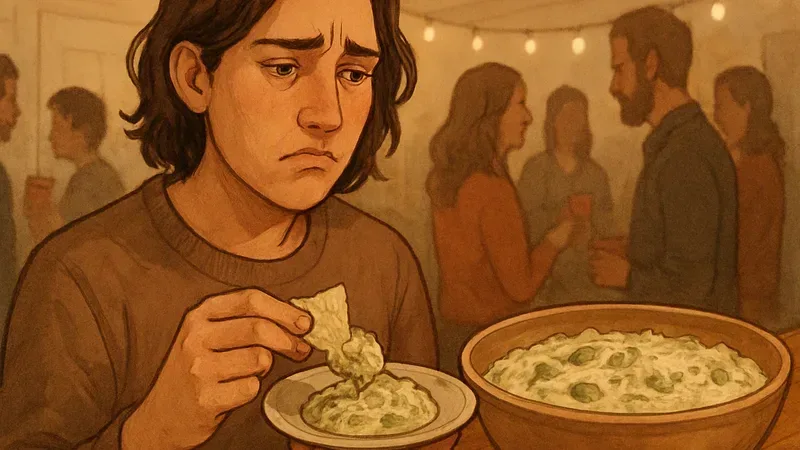
I was at a party last weekend. A friend had spent hours making a dip I have never liked — something with artichokes and too much cream cheese. I stood there, plate in hand, watching other people take a second scoop. I took one myself. I ate it. I did not enjoy it.
🧠 The question nobody asks
Why do we eat things we do not want? Not the things we crave and regret, but the things we never craved at all.
- The dry cake at the office.
- The glass of wine that tastes like obligation.
- The last few bites of a meal that stopped being good ten minutes ago.
We do this all the time, and we almost never stop to ask why.
🤝 The weight of not wanting to be rude
The easiest answer is politeness. Someone made something. Someone brought something. To refuse feels like a small rejection of the person, not just the food.
I ate that artichoke dip because I could see my friend watching the bowl. I wanted her to feel seen. But the dip was still bad. And she never knew I hated it. So who was the politeness for? Her, or the version of myself that cannot bear to disappoint?
ℹ️This tension between being kind and being honest is common in social eating — and often goes unnoticed.
👻 The ghost of the clean-plate rule
There is a deeper habit, too. Many of us were raised to finish what is on our plate. That rule was about gratitude and waste, but it lingers long after childhood.
Now it applies to everything: the stale cookie, the too-sweet coffee, the meal that was a mistake. We finish it because starting something and not finishing it feels wrong. The rule outlived its purpose. But we follow it anyway.
🛋️ The strange comfort of the unwanted
Sometimes the unwanted bite is not about obligation at all. It is about familiarity. I have a drawer of snacks I do not like — those bland crackers, that weird protein bar. But when I am tired or anxious, I reach for them anyway.
They ask nothing of me. They do not excite or disappoint. They are just there. Eating them is not pleasure. It is a kind of maintenance. Like breathing.
🤔 Where this thinking falls short
It is easy to paint this as a problem — a failure of agency, a lack of self-respect. But maybe the unwanted bite is also a small act of generosity.
Maybe the friend who made the dip knew I did not love it, and my bite was a gift we both understood. Maybe the stale cracker is not a failure but a choice to conserve energy.
💡We do not always need to eat for joy. Sometimes we eat to be present, to be kind, to be quiet. That is not a flaw. It is just another reason people share a table.
I still do not like artichoke dip. But I will probably eat it again. Not because I have to. Because sometimes the wanting is not the point.
📚 Related articles
- ✅ Why Someone Else's Leftovers Taste Better — Explores why food made by others feels like a gift, while our own leftovers feel like a chore.
- ✅ The Same Sandwich, Two Different Tastes — Examines how eating alone flattens flavor, connecting to the social dimension of unwanted bites.
- ✅ The Dinner That Was Just for You — Reflects on why eating alone feels like a chore, while sharing a meal transforms it.

Comments (0)
Leave a Comment
Be the first to comment!