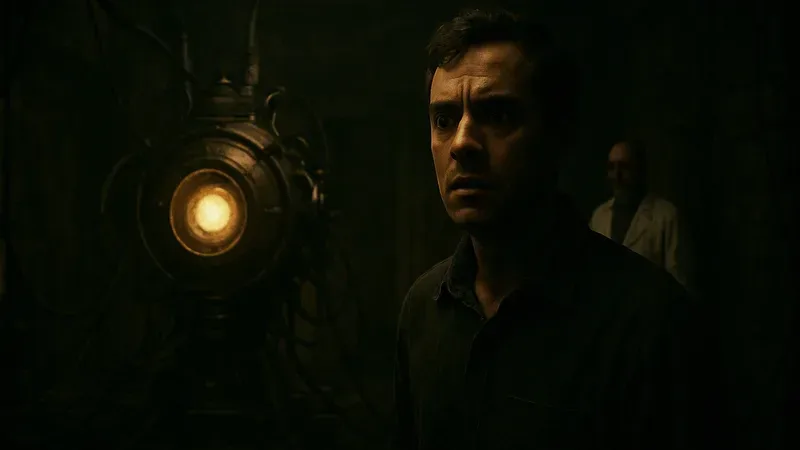
A man steps outside to investigate a noise in the woods. By the time he returns, nothing is the same. Timecrimes does not announce itself with explosions or elaborate machines. It begins quietly, on a sunny afternoon, and then tightens its grip scene by scene until escape feels impossible.
📋 At a Glance
- Year: 2007
- Director: Nacho Vigalondo
- Country: Spain
- Language: Spanish
- Genre: Science Fiction, Thriller
- Main cast: Karra Elejalde, Candela Fernández, Bárbara Goenaga, Nacho Vigalondo
- Runtime: 93 minutes
🔧 The Setup
Héctor (Karra Elejalde) has just moved into a new house in the countryside with his wife. While relaxing in the garden, he notices a woman undressing in the woods. Curious, he goes to investigate.
What he finds is not an affair or a prank. It is a strange laboratory, a scientist, and a machine that sends him back in time by about an hour. The rest of the film follows Héctor as he tries to undo what he has already done.
🔁 The Loop as Trap
Most time-travel stories treat the timeline like a rubber band: stretch it, and it snaps back. Timecrimes treats it like a locked room. Every action Héctor takes to fix his situation only makes it worse.
The film does not explain the science. The machine is just a device. What matters is the growing dread that Héctor cannot escape his own past choices. The loop is not a puzzle to solve. It is a cage.
👤 Ordinary Man, Extraordinary Pressure
Karra Elejalde plays Héctor not as a hero or a genius, but as an average middle-aged man who panics, makes bad decisions, and keeps digging. He is not prepared for time travel. He does not become clever under pressure. He becomes desperate.
That ordinariness is what makes the film work. A slicker protagonist would have defused the tension. Héctor stumbles, hesitates, and makes the kind of mistakes anyone might make when reality stops making sense.
🎯 Less Is More
The film has a tiny cast, a handful of locations, and a runtime under 95 minutes. Director Nacho Vigalondo, who also appears on screen, uses these limitations as strengths. The story never leaves a small patch of countryside. There are no future cities, no special effects beyond a simple machine.
The claustrophobia comes from the situation, not the budget. Every character who appears matters. Every location is reused. The film earns its tension by refusing to expand its world.
💡Good practice: Timecrimes shows how limiting scope can heighten suspense — a lesson for any filmmaker working with a small budget.
🌀 Inevitability and Free Will
Timecrimes asks a question without ever stating it: if you could go back and change things, would you really have a choice? Héctor keeps trying to act differently, but the loop keeps pulling him back to the same moments.
The film suggests that knowing what will happen does not mean you can avoid it. The tension comes from watching someone struggle against a trap that has already closed.
✅ What Still Works
- ✅ The structure is tight. Every scene feeds the next. No moment is wasted.
- ✅ Elejalde's performance stays grounded even as the plot becomes absurd.
- ✅ The film respects the audience. It does not over-explain the time travel.
- ✅ The pacing is relentless once the loop begins. There are no slow stretches.
⚙️ A Machine That Does Not Need Explaining
The time machine itself is a simple metal tank with a control panel. No flashing lights. No dramatic sound effects. The film treats it like a piece of industrial equipment. That choice matters.
By making the machine ordinary, the film focuses attention on what really matters: the human reaction to being trapped in time. The device is not the story. The consequences are.
⚠️ One Bad Decision After Another
If there is a weakness, it is that Héctor's choices sometimes feel too convenient for the plot. He makes decisions that a smarter person might avoid. But that is also the point. The film is about a man who is not prepared.
His mistakes are believable, even if they occasionally strain credibility. The film asks the audience to accept that panic makes people act irrationally. That is a fair trade.
🔚 The Final Turn of the Screw
Timecrimes ends not with a solution, but with a quiet acceptance. Héctor does not defeat the loop. He survives it. The final image stays with you because it refuses to offer comfort. The loop is still there. It always will be.
That is the real horror of the film: not the machine, but the knowledge that some mistakes cannot be unmade.
The loop is still there. It always will be.
📚 Sources
Timecrimes Wikipedia
Facts TMDB
📚 Related Articles
- Dark City: A City That Rewrites Itself - Another film where reality bends and the protagonist is trapped in a system beyond his control.
- Sphere: The Ocean Floor Has Nothing on the Human Mind - A contained setting and psychological tension make this a natural next watch for fans of claustrophobic sci-fi.

Comments (0)
Leave a Comment
Be the first to comment!