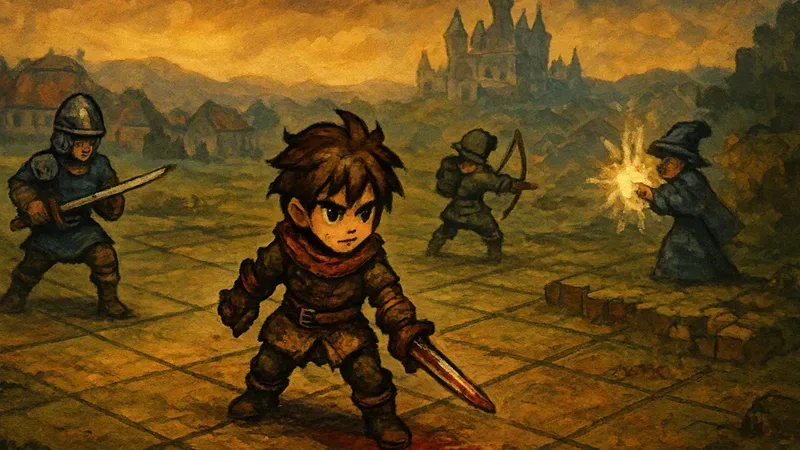
🎮 About the Game
- Release: 1996
- Developer: Konami Computer Entertainment Tokyo
- Publisher: Konami
- Platform: PlayStation, Sega Saturn, Windows
- Genre: Turn-based tactical RPG
Vandal Hearts arrived when console RPGs were booming and strategy games were still niche. Konami's take stood out by blending grid-based combat with a story about rebellion, corruption, and a young soldier caught between duty and conscience.
⚔️ The Experience
Vandal Hearts feels like a war story told through tiny, expressive sprites. You guide a small band of rebels across battlefields where positioning matters and every move is permanent.
The mood shifts from hopeful to grim as the plot unfolds, and the game isn't afraid to kill characters you've grown attached to. Battles are tense but rarely punishing, with a pace that keeps you thinking without overwhelming you.
The world feels lived-in, from dusty villages to grand castles, and the stakes rise steadily.
🕹️ How It Plays
Combat unfolds on grid-based maps where you move units, attack, and use magic. Each class has distinct strengths: swordsmen hold lines, archers pick off distant foes, mages unleash area spells. Terrain affects movement and defense, so elevation and chokepoints matter.
Between battles, you manage equipment and promote characters to advanced classes, unlocking new abilities. The campaign follows a linear path with occasional branching choices that affect which recruits join you.
✨ What Makes It Special
- Blood spurts from defeated enemies in a fountain — a small but unforgettable detail that gives combat a visceral punch.
- Class promotion changes a character's sprite and skills, making growth feel tangible rather than just stat boosts.
- The story tackles political betrayal and religious corruption, with a tone that grows surprisingly dark for its colorful look.
- Hidden items and secret characters reward exploration of battle maps, encouraging you to poke at every corner.
🎨 The Retro Charm
Vandal Hearts is pure mid-90s PlayStation: 2D sprites on 3D-ish backgrounds, chunky menus, and a color palette that pops. The isometric battlefields have a hand-crafted feel, and the interface is simple enough to learn in minutes.
It's the kind of game that fit on a single CD and didn't need more.
🔊 Sound & Atmosphere
The soundtrack leans on orchestral synth, with rousing battle themes and quieter town melodies. Sound effects are crisp — the clang of steel, the whoosh of magic, and that distinctive blood spurt. The audio sells the drama without overpowering the tactical thinking.
⏳ Then vs. Now
- Still works: the tight map design and class system hold up well for strategy fans.
- Feels dated: no mid-battle save, so a lost fight can cost you an hour.
- Modern players may find the linear campaign and limited customization restrictive compared to later tactics games.
- The blood fountains read as campy now, but they still make victory feel earned.
🔍 Curiosities
- The Japanese title translates to "Vandal Hearts: The Lost Ancient Civilization," hinting at lore that's barely touched in the game.
- A Sega Saturn port stayed in Japan, and a Windows version appeared only in Japan and South Korea.
- The Windows release supported both software rendering and Direct3D, a rare option for a console port at the time.
💭 Why Remember It?
Vandal Hearts is a compact, focused tactics game that tells a complete story without padding. It's worth remembering for its willingness to go dark, its satisfying class system, and that ridiculous blood fountain. If you like strategy RPGs with a bite, this one still has teeth.
📖 Source
Vandal Hearts Wikipedia
📚 Related Articles
- Koudelka: The Haunted Monastery RPG You Probably Missed - Another PS1 tactical RPG with grid combat and a dark, atmospheric story that subverts genre expectations.
- Carnage Heart: Program Your Own War Machines - A different take on PlayStation tactics: instead of commanding units, you program mechs to fight autonomously.
- Jade Cocoon: The Monster RPG That Let You Merge Your Creatures - Another late-90s PlayStation RPG with monster collection and merging, offering a different flavor of strategic depth.

Comments (0)
Leave a Comment
Be the first to comment!