A data-driven learning system that reads the torque signal of a dry clutch, tells six friction materials apart, and predicts judder in the vehicle from a laboratory bench test.
Materials, Signals & Reliability
Articles on friction materials, signal processing, and reliability engineering.
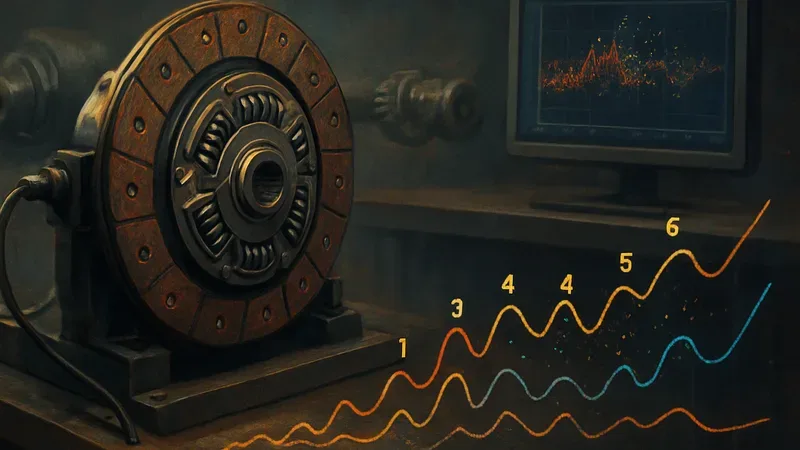
Multivariate statistics applied to real bench-test torque signals separates clutch facings by judder performance and manufacturing characteristics, and establishes a reference torque behaviour for material development.
Finite element analysis is used to predict when a clutch facing bursts, with numerical results showing clear agreement with experimental burst tests.
A methodology for classifying clutch facing judder sensitivity on a sub-scale bench test instead of a full vehicle, with preliminary results showing good correlation to the car.
The original proposal for moving clutch facing judder classification off the vehicle and onto a sub-scale bench machine, motivated by test time and material development speed.
A two-part methodology for characterising facing judder sensitivity: numerical simulation of the judder bench test to save time, validated against an experimental judder test in a passenger car.
Multivariate exploratory analysis of eight process variables identified two that correlate with burst resistance — one positively, one negatively — and process changes based on that finding raised both burst resistance and reliability.
Design of experiments and Weibull analysis are used to correlate friction facing wear on a bench test with vehicle mileage, making it possible to estimate field durability from bench results.
The original presentation of a bench test procedure built to contain the full range of vehicle operating conditions, so that friction facing durability can be studied without depending on uncontrolled field data.