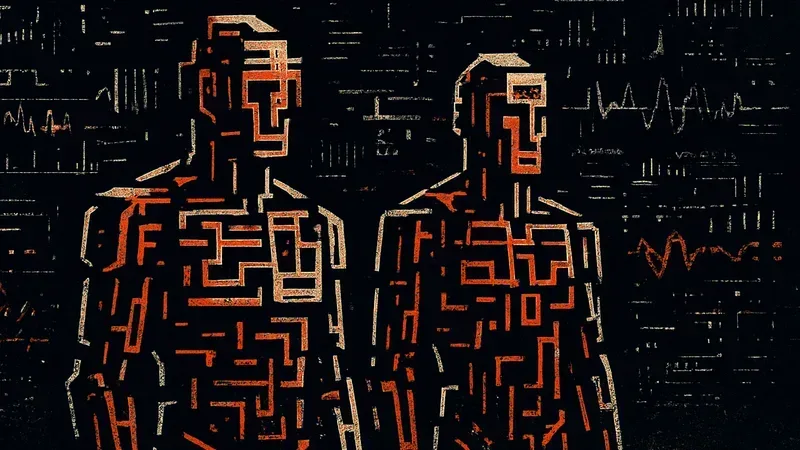
On Tri Repetae, the kick drum does not land where you expect it. The hi-hats flutter like a machine correcting itself. This is not a bug. This is Autechre's entire project: making rhythm feel like a language you almost understand but cannot speak.
📋 At a glance
- Style: IDM, glitch, abstract electronic
- Years active: 1991–present
- Origin: Rochdale, England
- Core lineup: Rob Brown and Sean Booth
- Key era: 1995–2001 (Tri Repetae through Confield)
- Label: Warp Records
🎯 The pitch
Autechre make electronic music that sounds like it was composed by a machine that learned to feel but still thinks in data. They started with warm, beat-driven tracks on Warp's Artificial Intelligence compilation, then spent three decades stripping away everything human: no vocals, no melodies you can hum, no grooves you can follow. What remains is pure structure, rhythm as abstract sculpture.
📜 History
Rob Brown and Sean Booth met at a youth club in Rochdale in 1987. By 1991 they were Autechre, and by 1993 Warp had released Incunabula, an album that fit neatly into the emerging IDM scene. Each subsequent record pushed further from danceability: Amber was ambient and spacious; Tri Repetae hardened the beats; Confield abandoned them almost entirely. Since then, the duo has released long-form works like elseq 1–5 and the NTS Sessions, each more abstract than the last.
⚖️ The case against them
Autechre's post-2001 work is often described as impenetrable. The rhythms are too fractured to follow, the structures too formless to remember. Listeners looking for hooks or emotional payoff will find neither. The duo's willingness to abandon accessibility entirely means large stretches of their catalogue feel like homework. For many, that is not a feature—it is a wall.
💃 Dance music that cannot be danced to
Autechre emerged from a scene built around club tracks and DJ sets. Warp's Artificial Intelligence compilation was marketed as "electronic listening music." But Autechre took that idea further than anyone else. Their beats are too erratic to mix, too fast to move to, too unpredictable to anticipate. The paradox is central: they make rhythm music that refuses to serve the body. The brain gets the dance floor instead.
👽 Rhythm as alien language
From Tri Repetae onward, percussion became Autechre's primary instrument. Not drums in the traditional sense—sounds that function as drums: clicks, pops, metallic scrapes, digital stutters. These sounds are arranged in patterns that shift without warning, as if the machine is improvising its own logic. The result is not groove but conversation, one where you catch every word but miss the meaning.
❄️ Coldness as a choice
Autechre rarely use warmth. Reverb is minimal. Bass tones are dry and percussive rather than resonant. Melodies, when they appear, are short and quickly abandoned. This is not a limitation of equipment—it is a deliberate aesthetic. The coldness makes the rare moments of beauty hit harder, like a sudden patch of sunlight in a concrete building.
🌟 Why they matter
Autechre expanded what electronic music could do with rhythm. Before them, IDM was largely about glitchy textures and gentle beats. After Confield, the genre had a new pole: music that treated the listener as a puzzle to be solved, not a body to be moved. Their influence is less about direct imitation—few have the patience to copy them—and more about permission. They proved that electronic music could be as intellectually demanding as contemporary classical, without abandoning its machine origins.
🧐 Curiosities
- ✅ Brown and Booth met at a youth club in Rochdale in 1987, bonding over hip-hop and electro.
- ✅ They were featured on Warp's 1992 compilation Artificial Intelligence, which helped define the IDM genre.
- ✅ For years, Autechre refused to perform live, citing the difficulty of recreating their studio work. Their first live shows came in the early 2000s.
🤖 The machine's voice
Autechre's music does not get easier with time. It stays strange, stays cold, stays incomplete. That is the point. They built a sound that resists familiarity, and thirty years in, it still works. The machine has not learned to be human. It learned to be itself.
🎧 Essential tracks
Bike (1993 - Incunabula)
An early example of Autechre's beat-driven side: a steady kick, warm pads, and a melody that almost sounds like a hook. It shows where they started before the abstraction.
Listen: Spotify · Apple Music · YouTube
Slip (1994 - Amber)
A study in restraint. The beat is minimal, the atmosphere is deep and spacious. It demonstrates how the duo could create tension without rhythmic complexity.
Listen: Spotify · Apple Music · YouTube
Clipper (1995 - Tri Repetae)
The track where Autechre's rhythmic language begins to break apart. The beat stutters and shifts, refusing to settle into a predictable pattern, marking a clear pivot from their earlier work.
Listen: Spotify · Apple Music · YouTube
Cichli (1997 - Chiastic Slide)
Glitch textures and fractured percussion dominate. The track feels like a machine repairing itself in real time, showcasing the duo's move toward abstract, non-repetitive structures.
Listen: Spotify · Apple Music · YouTube
Gantz Graf (1998 - LP5)
A single that pushed their sound to a wider audience. The beat is relentless and hyper-detailed, with rapid-fire percussion that feels both chaotic and precisely calculated.
Listen: Spotify · Apple Music · YouTube
Fleure (2010 - Oversteps)
A rare moment of melodic clarity in their later catalogue. The track uses soft synth tones and a slower tempo, proving the duo could still be beautiful without abandoning their abstract instincts.
Listen: Spotify · Apple Music · YouTube
📚 Sources
Autechre Wikipedia
Discography MusicBrainz
🔗 Related articles
- My Bloody Valentine: The Band That Made Guitars Sound Like Weather — Like Autechre, they bury the familiar under texture; a parallel in how sound can feel like atmosphere.
- Swans: The Band That Made Volume a Weapon — Another duo that weaponizes sonic extremes; volume as Autechre use rhythm—to push past comfort.
- Shellac: The Band That Made Restraint Sound Like a Threat — Minimalist precision and coldness as aesthetic; a rock parallel to Autechre's machine-like control.

Comments (0)
Leave a Comment
Be the first to comment!