🔍 Introduction
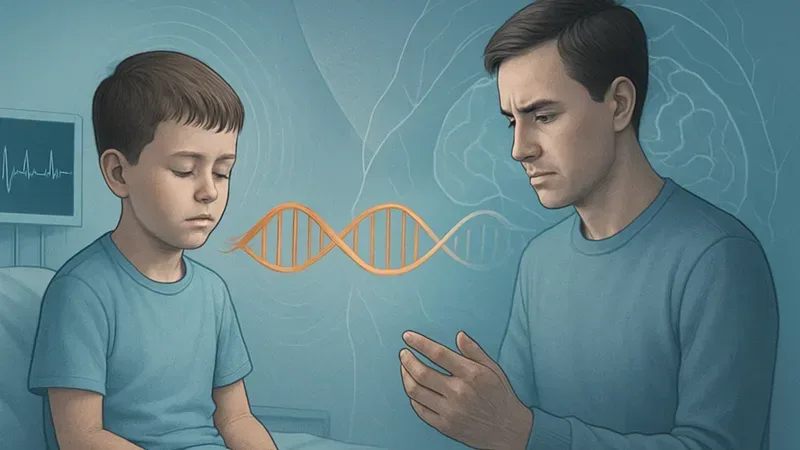
This review looked at whether childhood epilepsy, particularly severe forms with developmental problems, can be followed by Parkinsonism (a movement disorder) later in life. The question matters because early detection might help those at risk.
📚 What the study did
Researchers reviewed medical literature on genetic conditions that cause both epilepsy in childhood and Parkinsonism in adolescence or early adulthood. They examined patterns of epilepsy, developmental issues, and movement disorders. The study is a review of existing human case reports and studies.
📊 What it found
- Up to 10–15% of people with early-onset Parkinsonism also had epilepsy.
- Several patterns were identified: Parkinsonism after severe childhood epilepsy with developmental problems, after syndromic conditions with seizures, or after brain iron accumulation.
- In some cases, childhood epilepsy was mild and well-controlled before Parkinsonism appeared between ages 10 and 30.
- Intellectual disability or developmental delay was common in those who later developed Parkinsonism.
💡 What it means
This review suggests that in certain genetic conditions, childhood epilepsy may be an early sign of a broader disorder that later includes Parkinsonism. The link is based on observed patterns, not proven cause. The study does not establish how common this progression is overall.
⚖️ Study vs. claim
The study reviewed associations between childhood epilepsy and later Parkinsonism in specific genetic conditions. It does not claim that all childhood epilepsy leads to Parkinsonism.
🚫 What it does NOT show
- It does not prove that epilepsy causes Parkinsonism.
- It did not test whether treatment of epilepsy prevents Parkinsonism.
- It does not apply to most children with epilepsy.
- Long-term outcomes were not measured in a controlled way.
ℹ️Evidence level: A review of observational human studies.
📉 Confidence indicator
Confidence: Low to moderate — based on a review of case reports and associations.
🔒 How much to trust it
Trust tier: Moderate. This is an observational human study — it shows association, not proof of cause. The findings are based on published cases, not a controlled experiment.
⚠️ Limitations
- It is a review, not a new study with its own data.
- It relies on published cases, which may not represent all patients.
- It cannot establish cause and effect.
- The number of cases reviewed is not specified.
❓ Open questions
- How often does childhood epilepsy lead to Parkinsonism in the general population?
- Can early intervention change the risk?
- What specific genetic tests could identify at-risk children?
💡Tip: If you or a child has epilepsy with developmental delays, discuss long-term monitoring with a neurologist.
✅ Your action plan
- ✅ If you or a child has epilepsy with developmental delays, discuss long-term monitoring with a neurologist.
- ✅ Ask about genetic testing if there is a family history of movement disorders.
- ✅ Stay informed about new research on this link.
- ✅ Do not assume that childhood epilepsy will lead to Parkinsonism — most cases do not.
🏁 Takeaway
In some genetic conditions, childhood epilepsy may be an early marker for later Parkinsonism, but this is not common and requires further study.
This summary is for general information only and is not medical advice. Talk to a qualified professional before changing anything about your health.
📄 Source
Pediatric-Onset Epilepsy and Developmental Epileptic Encephalopathies Followed by Early-Onset Parkinsonism.. International journal of molecular sciences. 2023 PubMed

Comments (0)
Leave a Comment
Be the first to comment!