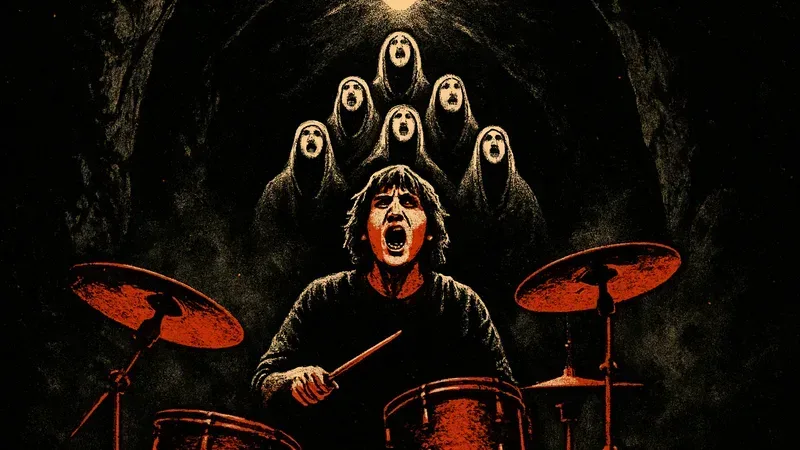
Christian Vander built a drum kit and a whole mythology around it. The French drummer founded Magma in 1969 after a vision of humanity's collapse. He responded by inventing a language, Kobaïan, and a style—Zeuhl—that sounds like nothing else in progressive rock. The music moves on repetition, massed voices, and a rhythm section that never loosens its grip.
📋 At a Glance
- Style: Zeuhl (invented progressive rock)
- Years active: 1969–present
- Origin: Paris, France
- Core lineup: Christian Vander (drums, vocals, piano), Klaus Blasquiz (vocals), Jannick Top (bass)
- Key era: 1970–1976
- Label: A&M, Seventh, RCA, Le Chant du Monde
🎵 What Is Zeuhl?
Zeuhl is not a genre you can name by listening to one track. It is a system. The bass often leads the melody while the drums lock into a march. The choir—Magma uses multiple vocalists—sings in Kobaïan, a language Vander built from Slavic, Germanic, and onomatopoeic roots. The piano and organ stay dissonant. The result is ceremonial, heavy, and completely self-contained.
Magma does not sound like a band borrowing from other bands. They sound like they are performing a ritual that already existed somewhere else.
📖 History
Vander formed Magma in Paris after leaving earlier groups. The first album, Kobaïa (1970), established the fictional planet and the language. The breakthrough came with Mëkanïk Dëstruktïẁ Kömmandöh (1973), a single 40-minute piece that became the band's signature. They released five more studio albums through 1976, then slowed. After a quiet 1980s and 1990s, Magma revived in the 2000s with new material and live activity. The band continues to perform and record.
⚠️ The Case Against Them
Magma is difficult to enter. The invented language means no immediate lyrical hook. The tracks are long, the mood is relentlessly serious, and the vocal style—operatic, choral, often frantic—can feel overwhelming. The 1980s albums Merci and Attahk softened the sound but lost some of the tension that made the early work compelling. For listeners who want verse-chorus structure or emotional warmth, Magma offers neither.
⚠️The price of entry is high, but the experience inside is unlike anything else in rock.
🎯 Vision vs. Access
Vander's ambition is the whole point. He did not want to be understood easily. He wanted to create a complete world. That world is what makes Magma unique, but it also keeps them small. The band has never courted a broad audience. The 1970s albums reward patience: the repetition builds, the choir locks into patterns, the bass and drums become a single machine.
🥁 The Rhythm Engine
Vander is a self-taught drummer with a jazz background, but Magma does not swing. The drumming is precise, repetitive, and often martial. Tracks like "Mëkanïk Dëstruktïẁ Kömmandöh" are built on a single rhythmic figure that never breaks. The bass, especially when Jannick Top played it, carries melodic weight while the drums hold the pulse. The two instruments create a locked groove that the choir and piano either reinforce or push against.
💡 Why They Matter
Magma created a musical language that other bands have adopted. The term Zeuhl now describes a small but persistent tradition in French and Japanese progressive rock. More importantly, Magma proved that a band could build an entire aesthetic—language, mythology, vocal style, rhythmic system—from one person's vision. Their 1970s run remains one of the most singular achievements in progressive music.
No one sounds like them because no one else tried to build the same thing.
🧐 Curiosities
- ✅ Kobaïan is a constructed language with its own grammar and vocabulary. Vander invented it before writing most of the music.
- ✅ The album Mëkanïk Dëstruktïẁ Kömmandöh was originally intended as a single 40-minute piece split across two sides.
- ✅ Vander was deeply influenced by John Coltrane's spiritual jazz, especially the album A Love Supreme.
- ✅ The band's live performances often include theatrical lighting and choreographed movement, reinforcing the ritualistic feel.
🎧 One Track to Start
If you try one thing, make it "Mëkanïk Dëstruktïẁ Kömmandöh." The full 40-minute piece is the clearest statement of what Zeuhl is: a choir chanting in a made-up language, a drum pattern that never relents, a bass line that walks the edge of melody and rhythm, and a structure that builds to a climax without ever breaking character. It is not easy. But it is complete.
📀 Essential Tracks
Mëkanïk Dëstruktïẁ Kömmandöh (1973 - Mëkanïk Dëstruktïẁ Kömmandöh)
The definitive Zeuhl piece. A 40-minute single track built on a relentless drum pattern, choral repetition in Kobaïan, and a bass line that drives the entire structure. It is the purest expression of Vander's vision.
Listen: Spotify · Apple Music · YouTube
Theusz Hamtaahk (1974 - Ẁurdah Ïtah)
A shorter, more direct piece that showcases the choir's ability to shift between delicate harmonies and aggressive unison. The rhythm section stays locked while the vocals create tension.
Listen: Spotify · Apple Music · YouTube
Köhntarkösz (1974 - Köhntarkösz)
The title track from the 1974 album. It features a more spacious arrangement, with piano and organ taking melodic lead while the drums remain steady. Shows Magma's quieter side without losing intensity.
Listen: Spotify · Apple Music · YouTube
Üdü Ẁüdü (1976 - Üdü Ẁüdü)
The album's opening track is a masterclass in rhythmic build. The bass and drums lock into a hypnotic groove while the choir enters in layers. It demonstrates how repetition creates momentum rather than monotony.
Listen: Spotify · Apple Music · YouTube
Dëhndë (1976 - Üdü Ẁüdü)
A shorter, almost pop-influenced piece by Magma's standards. The vocal melody is more accessible, but the rhythm section still drives with precision. Shows the band's ability to compress their ideas without losing identity.
Listen: Spotify · Apple Music · YouTube
🔗 Sources
Magma (band) Wikipedia
Discography MusicBrainz
📚 Related Articles
- Swans: The Band That Made Volume a Weapon - Another band that builds ritualistic, punishing sound worlds — Swans share Magma's intensity and patience.
- Godspeed You! Black Emperor: The Band That Waits - Like Magma, Godspeed builds long, repetitive pieces that demand patience and reward with catharsis.

Comments (0)
Leave a Comment
Be the first to comment!