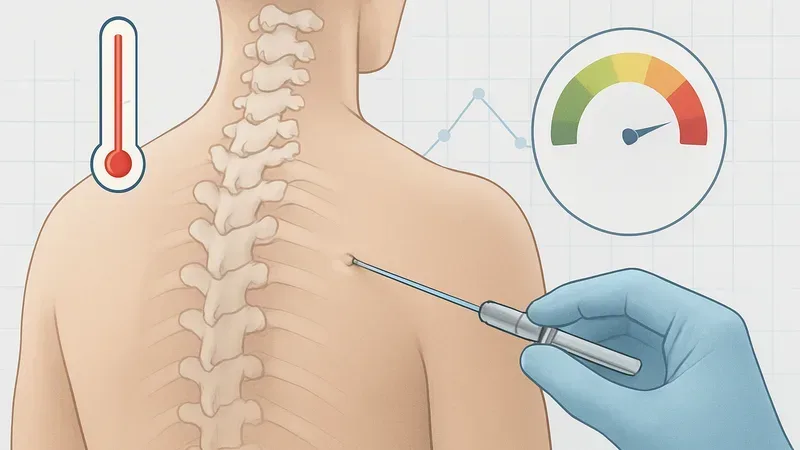
This study looked at a procedure called a thoracic sympathetic ganglion block (TSGB) for chronic upper extremity pain. Researchers wanted to know if the procedure's technical success (a temperature increase) was linked to pain relief in real patients.
🔬 Study design
Researchers reviewed medical records of 207 patients who had TSGB between 2004 and 2020. Technical success was defined as a temperature increase of at least 1.5°C 20 minutes after the block. A positive outcome was a pain reduction of at least 2 points on an 11-point scale at 2 weeks. They looked for correlations and factors linked to outcomes.
📊 Key findings
- 115 out of 207 patients (55.5%) had a positive pain response at 2 weeks.
- 139 out of 207 patients (67.1%) achieved technical success (temperature increase).
- No significant link was found between temperature increase and pain reduction (R=0.013, p=0.855).
- Diabetes (odds ratio 4.200) and taking other pain medications (odds ratio 3.451) were linked to better outcomes.
- Psychiatric conditions (odds ratio 0.327) and longer pain duration (odds ratio 0.973) were linked to worse outcomes.
The temperature increase often used to confirm a successful nerve block did not predict pain relief. Other factors like diabetes or mental health may matter more.
🔍 What the study tested
The study tested whether a temperature change after a nerve block predicts pain reduction. It did not test whether the block is effective for all types of chronic pain or leads to long-term improvement.
❌ What it does NOT show
- It does not prove the nerve block causes pain relief.
- It does not show results for other types of pain.
- It does not establish long-term safety or effectiveness.
- It does not apply to people without chronic upper extremity pain.
📝 Evidence level
An observational study in people.
ℹ️Confidence: Low to moderate — observational design limits certainty.
⚖️ How much to trust it
Trust tier: Moderate. This is an observational human study — it shows associations, not proof of cause. The findings are useful but not definitive.
⚠️ Limitations
- ✅ Retrospective design — data was not collected for research.
- ✅ Single center — results may not apply elsewhere.
- ✅ No control group — cannot rule out natural recovery.
- ✅ Short follow-up — only 2 weeks.
❓ Open questions
- Does the block provide lasting pain relief beyond 2 weeks?
- Why did diabetes and psychiatric conditions affect outcomes?
- Would results differ in a controlled trial?
📋 Your action plan
- ✅ If you have chronic arm pain, discuss nerve blocks with a pain specialist.
- ✅ Understand that temperature change may not guarantee pain relief.
- ✅ Ask about factors like diabetes or mental health that might influence results.
- ✅ Do not assume this procedure works for all types of pain.
💡 Takeaway
This observational study found that a temperature increase after a nerve block did not predict pain relief in 207 patients.
The study measured pain scores, not long-term function or cure.
This summary is for general information only and is not medical advice. Talk to a qualified professional before changing anything about your health.
📖 Source
Thoracic sympathetic ganglion blocks: real-world outcomes in 207 chronic pain patients.. Regional anesthesia and pain medicine. 2024 PubMed
📚 Related Articles
- Pain Perception Mismatch Linked to Depression in Fibromyalgia Couples - Explores how pain perception disagreements affect mental health, a factor linked to nerve block outcomes.
- Sauna therapy may ease pain and stiffness in rheumatic diseases - Reviews a non-invasive pain management option for chronic pain conditions.

Comments (0)
Leave a Comment
Be the first to comment!