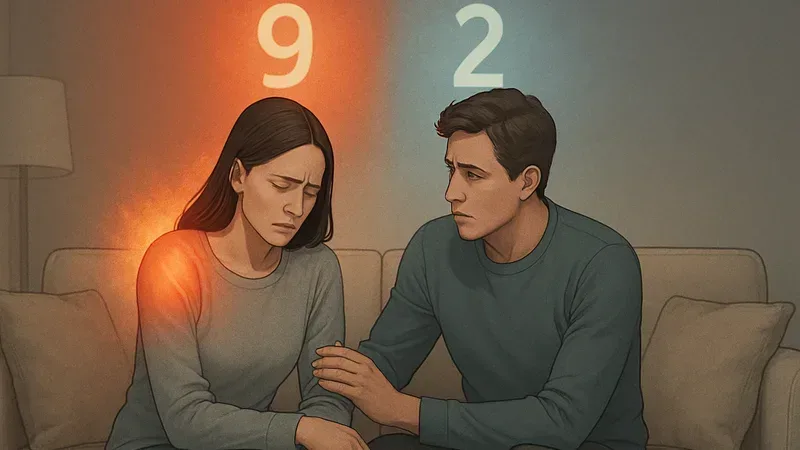
This study looked at whether differences in how a person with fibromyalgia and their partner perceive pain are linked to depression and anxiety in both people.
🔬 What the study did
Researchers studied 204 couples where one adult had fibromyalgia. They measured each person's view of the patient's pain interference and severity. They then created variables for how much the couple agreed, their average view, and who thought pain was higher. They tested if these were linked to depression and anxiety symptoms.
📊 What it found
- Higher average pain perception within the couple was linked to more depression and anxiety in both partners.
- Patients had more depression when their own pain view was higher than their partner's.
- Pain perception mismatch was not linked to anxiety symptoms in either partner.
- Results were similar for pain severity as for pain interference.
🧠 What it means
When couples disagree about pain, the person with fibromyalgia may feel more depressed. But this study only shows an association, not that disagreement causes depression. It does not prove that changing communication would help.
ℹ️The study tested whether pain perception mismatch is linked to mental health symptoms. It does not claim that resolving disagreement would improve depression or anxiety.
❌ What it does NOT show
- It does not prove that disagreement causes depression or anxiety.
- It did not test whether communication training improves outcomes.
- It did not measure long-term effects on mental health.
📈 Evidence level
An observational study in people.
🎯 Confidence indicator
Confidence: Low to moderate — an observational study shows association, not causation.
🤔 How much to trust it
The trust tier is Moderate. This is an observational human study, so it shows links but cannot prove that one factor causes another. The results are suggestive but not definitive.
⚠️ Limitations
- Observational design cannot establish cause and effect.
- All measures were self-reported, which may be biased.
- The sample may not represent all couples with fibromyalgia.
❓ Open questions
- Would improving communication reduce depression symptoms?
- Do these findings apply to other chronic pain conditions?
- What other factors might explain the link between disagreement and depression?
💡If you have fibromyalgia, consider discussing pain experiences openly with your partner. If you are a partner, ask how the person's pain affects them, rather than assuming. Talk to a therapist or social worker about couple-based approaches to chronic pain. Do not assume that disagreement is the cause of any mental health symptoms.
📝 Takeaway
Disagreement about pain severity in couples with fibromyalgia is linked to more depression in the person with pain, but this is not proof of cause.
This summary is for general information only and is not medical advice. Talk to a qualified professional before changing anything about your health.
📎 Source
Incongruence in Perceptions of Pain: Associations with Mental Health in Couples Living with Fibromyalgia.. Social work. 2024 PubMed

Comments (0)
Leave a Comment
Be the first to comment!