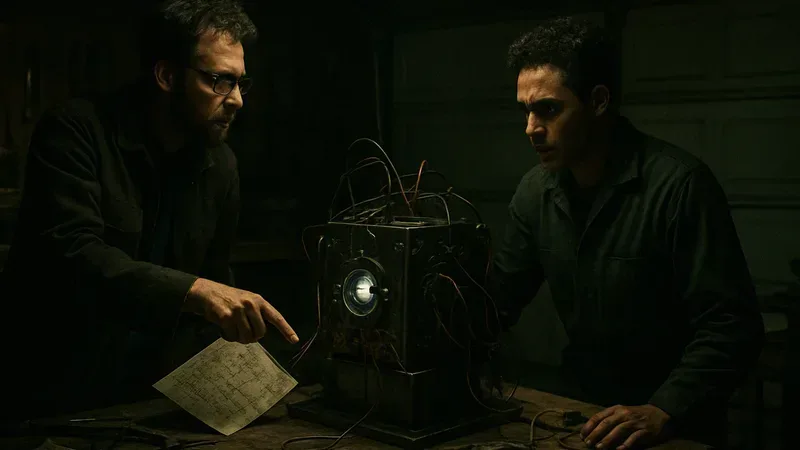
Two engineers in a garage. A strange machine. And a conversation so dense with technical jargon that you feel like you are eavesdropping on something real. Primer does not announce itself as a time travel movie. It earns that label slowly, through overheard fragments and half-explained diagrams.
📋 At a Glance
- Year: 2004
- Director: Shane Carruth
- Country: United States
- Language: English, French
- Genre: Science Fiction, Drama, Thriller
- Main cast: Shane Carruth, David Sullivan
- Runtime: 77 minutes
🔧 The Setup: Two Guys in a Garage
Aaron and Abe, two engineers, spend their weekends tinkering in a garage. They are not trying to build a time machine. They are trying to build a device that reduces the weight of objects. Something goes wrong during a test. A strange effect appears. The two men realize they have accidentally created something far stranger than they intended.
The film does not pause to explain. It keeps moving, forcing the viewer to catch up.
🗣️ The Language of Real Engineers
Primer sounds like a recording of actual engineers at work. The dialogue is fast, mumbled, and full of technical terms that are never defined. Carruth does not translate for the audience. He trusts that the rhythm and urgency of the conversation will carry meaning even when the specifics do not.
This choice creates a rare effect: the science feels real because it is not explained. The viewer is placed inside the confusion of discovery, not outside it.
📦 No Flash, All Function
The film has almost no visual effects. Time travel is not shown as a tunnel of light or a swirling vortex. It is a heavy metal box that hums. The machine looks like something you could build in a workshop.
The lack of spectacle is the point. Primer argues that real discovery looks boring. It is a room with a machine and two tired men staring at data sheets. That is where the tension lives.
🤝 Trust as the Real Machine
The story is not about the technology. It is about what happens when two smart people share a secret that changes everything. Aaron and Abe start as partners. The machine forces them to become competitors. The film watches their cooperation break down, quietly and without dramatic music. The threat is not a villain. It is the slow realization that you cannot trust the person who knows exactly what you have done.
✅ What Still Works
- ✅ The dialogue feels like overheard conversation, not scripted exposition.
- ✅ The machine looks practical and unglamorous, which makes it believable.
- ✅ The pacing refuses to slow down for the viewer, which rewards attention.
- ✅ The central relationship shifts from collaboration to suspicion without a single raised voice.
⏳ What Aged
The first twenty minutes are almost impenetrable. The rapid-fire technical talk, combined with low-budget sound mixing, can make it hard to follow who is saying what. Some viewers may feel lost before the story begins. That is not a flaw for everyone, but it is a barrier.
❓ The Question Behind the Movie
What happens when intelligence solves a problem that intelligence was not meant to solve? Aaron and Abe are smart enough to build the machine. They are not smart enough to handle what it does to their friendship. Primer asks whether knowledge without wisdom is just another kind of danger. It does not answer the question. It lets the machine run.
🎬 A Film That Does Not Explain Itself
Primer is not a puzzle to be solved. It is a record of two people making a terrible discovery and not knowing what to do with it. The film trusts that you can follow the shape of the story even when the details blur. That trust is rare. So is the film.
📚 Sources
📚 Related Articles
- The Arrival: A Quiet Sci-Fi That Trusts Your Intelligence – Another low-budget sci-fi that trusts the viewer to piece together the threat from fragments.

Comments (0)
Leave a Comment
Be the first to comment!