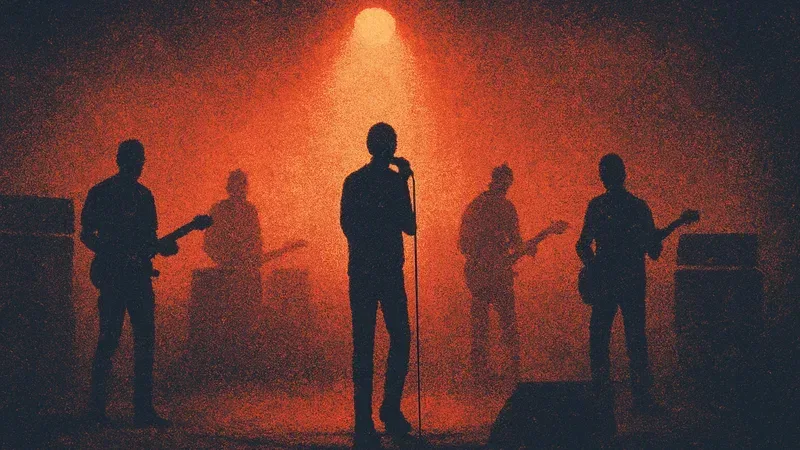
The first thing you hear on Souvlaki is not a wall of guitars. It is a single clean figure, slightly behind the beat, with Rachel Goswell's voice floating somewhere above it. Slowdive are often filed under 'shoegaze' and pictured as a wall of noise. The records do not work that way. They work by holding back.
📋 At a Glance
- Subgenre: Shoegaze, dream pop
- Years active: 1989–1995, 2014–present
- Origin: Reading, Berkshire, England
- Core lineup: Neil Halstead, Rachel Goswell, Christian Savill, Nick Chaplin, Simon Scott
- Songwriter: Neil Halstead
⭐ Why They Matter
Slowdive are the band that proved shoegaze did not have to be loud to be heavy. They came out of the Thames Valley scene in the late eighties, signed to Creation, and made records that sounded like weather rather than riffs. Their cultural footprint is smaller than the bands they are compared to, and more durable. When people rediscover this sound every few years, they usually find Slowdive first.
📖 History
Slowdive formed in Reading in 1989 around Neil Halstead and Rachel Goswell, who had been friends since childhood. The early EPs and the first album, Just for a Day, established the template: layered guitars, hushed vocals, a rhythm section that rarely raises its voice. Souvlaki followed and became the record people still argue about.

By the mid-nineties the band had splintered, and Halstead and Goswell moved on to Mojave 3. They reunited in 2014, and have since released new music that stands beside the old rather than behind it.
⚖️ The Case Against Them
The first album is thin. The early EPs drift. Slowdive have a formula — clean arpeggios, reverb, a vocal buried just deep enough to make you lean in — and they have leaned on it for a long time.
The reunion records are good, but they are not a reinvention; they are a band returning to a room they never really left. If you want a band that tore up the blueprint, this is not it.
💡 The Flaws Are the Point
That formula is also the reason the best songs land. Slowdive are not trying to surprise you with a new direction. They are trying to get one specific feeling exactly right: the moment a chord hangs in the air a beat longer than you expect. When they hit it, the restraint reads as confidence. When they miss, it reads as drift. The misses make the hits feel earned.
🎧 The Sound of Holding Back
Halstead writes suspended chords that refuse to resolve, and melodies that circle rather than climb. Goswell's voice is not a harmony line; it is a second lead instrument, often carrying the tune while Halstead's guitar carries the tension. The drums are mixed low and played soft. The result is music that feels close and distant at once, like a conversation heard through a wall.

🎛️ Machines and Space
Slowdive were never purists. Drum machines and synth pads sit under several of their best-known songs, and those textures are part of why the records still sound modern. Souvlaki Space Station is the clearest example: a dub-influenced groove, a guitar line that seems to be dissolving, and a mix that treats silence as an instrument. It is the least conventional thing they ever recorded, and one of the most copied.

🔁 Why They Last
Slowdive's influence runs through dream pop, ambient guitar music and a lot of bands who use reverb as a personality. But the real reason people keep coming back is simpler: Halstead knows how to write a hook and then hide it. The payoff after the bridge in When the Sun Hits is a structural trick — delay the release, then give it to you all at once. That is a songwriting mechanic, not a mood.
🧩 Curiosities
- The band name comes from a dream Halstead had, which is a better origin story than most.
- After Slowdive split, Halstead and Goswell formed Mojave 3, a quieter, more country-leaning project that confused people who wanted Souvlaki again.
- Goswell has spoken about living with hearing loss, which adds a strange weight to a band whose music depends on very quiet details.
- They were signed to Creation Records, a label whose roster also included some of the biggest names in British indie at the time.
💭 A Last Thought
Most bands in this genre turn the guitars up until the song disappears. Slowdive turn them down until you have to listen. That is a harder trick, and it is why a record made in the early nineties still sounds like it was made for headphones and a dark room.
🎵 Essential Tracks
Catch the Breeze 1991 - Just for a Day
The early template in one song: a guitar figure that repeats without resolving, Goswell's voice low in the mix, and a rhythm section that refuses to push. It is the sound of a band deciding what they are.
Listen: Spotify · Apple Music · YouTube
Alison 1993 - Souvlaki
The opening guitar line is clean, trebly and slightly behind the beat, and it never gets louder. The whole song is built on that restraint. It is the best argument for Slowdive as a band of small decisions.
Listen: Spotify · Apple Music · YouTube
When the Sun Hits 1993 - Souvlaki
The payoff after the bridge is the point. Slowdive delay the release for most of the song, then give it to you in one move. It is a structural trick, not a mood, and it still works.
Listen: Spotify · Apple Music · YouTube
Souvlaki Space Station 1993 - Souvlaki
A dub-influenced groove, a dissolving guitar line and a mix that treats silence as an instrument. The least conventional thing they recorded, and the one that sounds most like the future.
Listen: Spotify · Apple Music · YouTube
Machine Gun 1993 - Souvlaki
A drum machine sets the tension and the guitars never quite release it. It shows how much Slowdive got from machines and space, not just reverb and volume.
Listen: Spotify · Apple Music · YouTube
Sugar for the Pill 2017 - Slowdive
The reunion record's best song, and proof the formula still holds. Halstead's melody circles rather than climbs, and the band plays it as if no time has passed.
Listen: Spotify · Apple Music · YouTube
🔗 Source
Slowdive Wikipedia

Comments (0)
Leave a Comment
Be the first to comment!