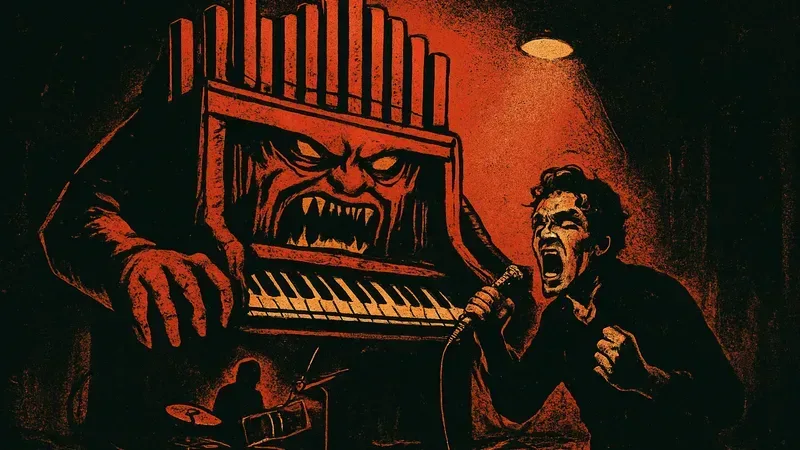
There is no guitar. That is the first thing to understand about Van der Graaf Generator. What remains is Peter Hammill's voice—a thing that can go from a whisper to a theatrical snarl in the space of a syllable—Hugh Banton's Hammond organ, and Guy Evans's drums. The organ is not background. It is the lead instrument, the rhythm section, and the texture all at once. The drums do not keep a steady beat so much as wrestle it.
📋 At a Glance
- Style: Progressive rock, art rock
- Years active: 1967–1978, 2005–present
- Origin: Manchester, England
- Core lineup: Peter Hammill, Hugh Banton, Guy Evans
- Key era: 1970–1977
- Label: Charisma Records
🎭 Not a Band, a Contradiction
Van der Graaf Generator is a progressive rock band that never quite fit the genre's polite ambitions. Their music is dense, often dissonant, and built around Hammill's lyrics—personal, literary, and frequently uncomfortable.
The organ does the work of a hundred guitarists. The drums sound like they are trying to escape the song. It is not easy listening. It is not meant to be.
📖 History
Formed in Manchester in 1967 by Peter Hammill and Chris Judge Smith, the band became Charisma Records' first signing. They never troubled the UK charts but found an unlikely home in Italy, where they became a cult phenomenon.
After a 1978 breakup, Hammill pursued a prolific solo career. The band reformed in 2005 with the core trio of Hammill, Banton, and Evans, and have released several albums since, though the later work is noticeably more restrained.
⚠️ The Case Against Them
The music can feel impenetrable. Hammill's vocals are an acquired taste—theatrical, strained, and often melodramatic. The organ-heavy arrangements, especially on earlier records, can become exhausting. The later reunion albums, while competent, lack the manic energy of the 1970s work.
There is no entry point for casual listening. You either climb the wall or you do not.
ℹ️Hammill's solo career, which spans over 40 albums, often overshadows the band's output, but the two are deeply connected.
⚡ Controlled Chaos
The central tension in Van der Graaf Generator is between structure and collapse. The songs are carefully composed—odd time signatures, shifting sections, literary lyrics—but they sound like they might fall apart at any moment.
Evans's drumming is the key: he plays around the beat, not on it. Banton's organ can be both a drone and a lead line. Hammill's voice teeters between control and breakdown. The result is music that feels alive, unpredictable, and dangerous.
The Organ as a Weapon
Without a guitarist, the Hammond organ becomes everything. Banton uses it for bass lines, chords, and solos, often simultaneously. The sound is thick, dark, and slightly distorted.
On tracks like "Killer" from H to He, Who Am the Only One, the organ drives the tension, while on "Lemmings" from Pawn Hearts, it creates a swirling, almost claustrophobic atmosphere. The absence of guitar is not a limitation—it is the entire point.
The best way to hear Van der Graaf Generator is to put on Pawn Hearts and let the side-long "A Plague of Lighthouse Keepers" happen to you. It is not a song. It is a 23-minute argument between organ, drums, and a man who sounds like he is drowning. You will either turn it off or never forget it.
🎯 Why They Still Matter
Van der Graaf Generator proved that progressive rock did not need virtuosic guitar solos or pastoral themes. Their music is urban, anxious, and intellectually serious without being pretentious. The interplay between Hammill's voice and Banton's organ remains unique.
Later progressive acts—from the darker edges of the genre to modern experimental rock—owe something to the path they cleared. Their best work still sounds like nothing else.
💡The band's name comes from a Van de Graaff generator, a device that produces static electricity—a nod to the high-voltage nature of their sound. They were the first band signed to Charisma Records, a label that later became home to Genesis and Peter Gabriel.
🎵 Essential Tracks
Darkness (11/11) 1975 - Godbluff
The opening track of Godbluff sets the tone for the band's mid-1970s sound: tighter, darker, and more aggressive. The organ riff is relentless, and Hammill's vocal performance is one of his most controlled yet desperate.
Listen: Spotify · Apple Music · YouTube
Killer 1970 - H to He, Who Am the Only One
A perfect example of the organ-driven tension. Banton's bass pedals and chords create a sense of impending violence, while Evans's drumming is loose and unpredictable. The song builds and releases without ever settling.
Listen: Spotify · Apple Music · YouTube
Lemmings 1971 - Pawn Hearts
The centerpiece of Pawn Hearts, this track showcases the band's ability to combine complex composition with raw emotion. The organ swirls around Hammill's increasingly frantic vocal, creating a claustrophobic atmosphere.
Listen: Spotify · Apple Music · YouTube
Refugees 1970 - The Least We Can Do Is Wave to Each Other
A rare moment of relative calm. The song features a more melodic vocal line and a gentler organ arrangement, showing that the band could do tenderness without losing their edge.
Listen: Spotify · Apple Music · YouTube
The Aerosol Grey Machine 1969 - The Aerosol Grey Machine
The title track from their debut is a raw, early example of their sound. The organ is already central, but the production is thinner, and Hammill's voice is less refined. It is a fascinating starting point.
Listen: Spotify · Apple Music · YouTube
🔍 Curiosities
- ✅ The band's name comes from a Van de Graaff generator, a device that produces static electricity—a nod to the high-voltage nature of their sound.
- ✅ They were the first band signed to Charisma Records, a label that later became home to Genesis and Peter Gabriel.
- ✅ Peter Hammill's solo career, which spans over 40 albums, often overshadows the band's output, but the two are deeply connected.
📚 Related Articles
- The Fall: Where the Voice Is the Instrument - Another band where the frontman's voice is the defining instrument, built on repetition and spite.
- Sonic Youth: Guitars That Refused to Behave - Like VdGG's organ, Sonic Youth's guitars refuse standard roles, making noise the point.
- Swans: The Band That Made Volume a Weapon - A band that weaponizes sound and intensity, similar to VdGG's dense, confrontational approach.
📄 Sources
Van der Graaf Generator Wikipedia
Discography MusicBrainz

Comments (0)
Leave a Comment
Be the first to comment!