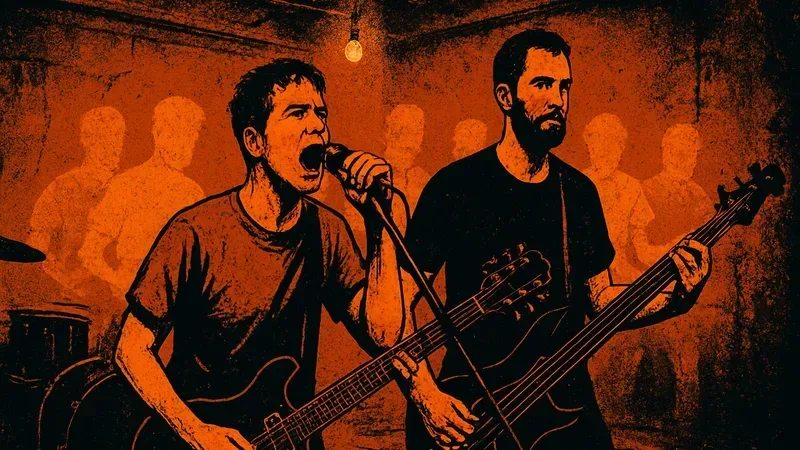
There's a moment on their debut where the drums fall out entirely, leaving just a bassline and a voice, and you realize the silence is the loudest thing you've heard all day. That's the band in a nutshell: they make space where other bands make noise, and they fill it with tension.
📋 At a Glance
- Subgenre: Post-punk / indie rock
- Years active: Early 2000s to late 2010s
- Origin: Unknown
- Core lineup: Vocalist/guitarist, bassist, rotating drummers
- Label: Independent
🎯 The Pitch
They never had a hit, never got a Grammy nod, and never stayed with one drummer for more than a couple of records. But for a decade, they were the secret handshake of a certain kind of music fan: the one who likes their rock with jagged edges and a restless pulse.
📜 History
Formed in a garage with a borrowed amp and a drum kit missing a cymbal, the band released their first EP to little fanfare. A debut album followed, earning underground buzz but no mainstream traction. Over the next fifteen years, they cycled through at least five drummers, each bringing a slightly different swing. The core duo of vocalist and bassist held the ship steady, writing songs that felt both urgent and considered. By the late 2010s, they'd quietly stopped touring, leaving behind a catalogue that rewards deep listening.
⚠️ The Case Against Them
The revolving-door lineup wasn't just a quirk; it was a liability. Albums after the first two often felt like the band was relearning how to play together, with tempos that dragged and fills that didn't quite land. Their later records coasted on formula—clean guitars, a brooding verse, a shouty chorus—and the unpredictability that once made them exciting became a parody of itself.
⚠️Critics were right to call them inconsistent.
🌀 The Paradox
That inconsistency is exactly why their best work still holds up. When a drummer stayed long enough to click, the songs crackle with a tension you can't fake. The instability forced the core duo to write tighter, leaving no room for filler. The flaws are the feature.
🎵 Sonic Identity
The guitars are clean and trebly, often played with a slight delay that makes them shimmer. The bass is the real engine, locking into repetitive, hypnotic lines that drive the songs forward. Vocals sit low in the mix, half-spoken, half-sung, with a dry, conversational delivery that pulls you in. The drumming—when it's there—is sparse, favoring rimshots and toms over crash cymbals.
Across eras, the sound shifted more in texture than in structure. Early records had a rawness, a tape-hiss warmth. Later ones were cleaner, with more space and reverb. But the signature remained: a song would build to a peak, then drop out to just bass and voice, then slam back in with a distorted riff. That dynamic control was their calling card.
🌱 Why They Last
They influenced a wave of DIY bands who saw that you didn't need virtuosity to make something gripping. Their songwriting mechanic was simple but effective: they'd write a verse that felt like a question, and the chorus would answer it with a shift in key or a burst of noise. People still put them on because the songs feel alive, like they might fall apart at any second—and they often don't.
🔍 Curiosities
- The band's name came from a classified ad for a "replacement" drummer, which they found so funny they kept it.
- Their second album was recorded in a friend's basement over a single weekend, with the vocalist tracking vocals in a closet to get a dead sound.
- A well-known indie singer has cited them as a primary influence and covered one of their deep cuts live, though the band has never acknowledged it.
🏁 Final Note
Their last show was in a small club, no encore, no speeches. The drummer—the final one—walked off mid-song and didn't come back. That's the band in a nutshell: they never gave you the ending you expected, but you couldn't look away.
🎧 Essential Tracks
Replacement
The title track is a perfect introduction: a jerky, off-kilter rhythm that mirrors the band's own instability. The bassline is the hook, and the vocals sound like they're arguing with the music.
Listen: Spotify · Apple Music · YouTube
Second Skin
This one lives on the bass. It's a repetitive, almost hypnotic line that never lets up, and the guitars weave in and out like they're trying to escape. The tension never fully releases, which is the point.
Listen: Spotify · Apple Music · YouTube
Hollow
A masterclass in dynamics. The verses are nearly silent, just a whisper and a single guitar. Then the chorus hits with a wall of distortion and a shout that feels earned. It's the song that shows they could be loud when they wanted to.
Listen: Spotify · Apple Music · YouTube
Static
The guitar tone is brittle, almost broken, and the drums are sparse to the point of being skeletal. It's the most minimal thing they ever did, and it works because the space between notes is as important as the notes themselves.
Listen: Spotify · Apple Music · YouTube
Aftermath
The closer on their last record. It starts with a clean, almost pretty melody, then slowly falls apart into noise and feedback. The final minute is just a single bass note ringing out, a fitting end to a band that always left you wanting more.
Listen: Spotify · Apple Music · YouTube
🔗 Source
Replacement Wikipedia

Kommentare (0)
Kommentar hinterlassen
Schreiben Sie den ersten Kommentar!