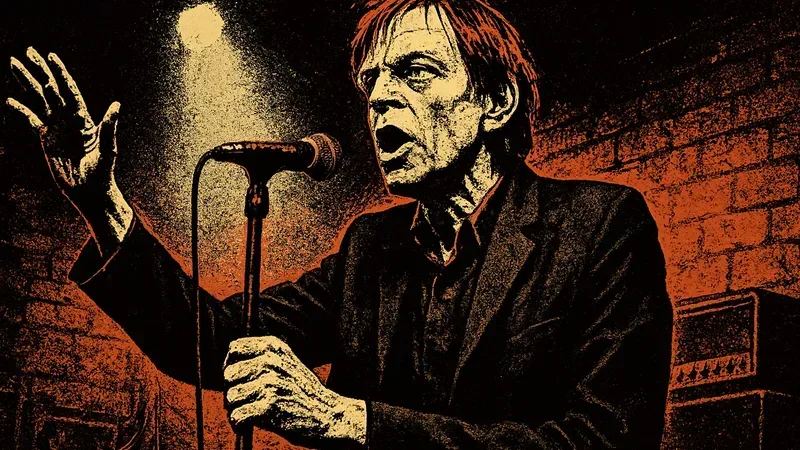
Somewhere in the late seventies, a voice cut through the Manchester murk. It wasn't singing. It was talking, half-shouting, half-sneering, a Mancunian drone that sounded like a man arguing with himself over a broken guitar riff. That voice belonged to Mark E. Smith, and the band behind it was The Fall. For over forty years, they made music that felt like a threat and a dare, all at once.
📋 At a Glance
- Subgenre: Post-punk, art rock
- Years active: 1976–2018
- Origin: Prestwich, Greater Manchester, England
- Core lineup: Mark E. Smith (vocals), many others
- Key producer: Various, often self-produced
- Label: Rough Trade, Beggars Banquet, others
🎯 The Pitch
The Fall were the sound of a man who didn't care if you liked him. Smith's lyrics were caustic, surreal, and often hilarious, delivered in a sprechgesang that turned everyday speech into a weapon. They never broke big, but they built a cult that treated every album like a sermon.
If you want to understand post-punk's angry, literate heart, you start here.
📜 History
The Fall formed in 1976 in Prestwich, a suburb of Manchester, when Smith and a few friends decided to make noise. Over the next four decades, the lineup changed constantly—dozens of musicians passed through, but Smith was the only constant.
They released a staggering number of albums, singles, and compilations, earning a reputation as the most prolific band of the British post-punk movement. Minor hits came in the late eighties and early nineties, but the cult following was the real story. Smith died in 2018, and with him, The Fall ended.
⚠️ The Case Against Them
Let's be honest: The Fall are not easy. Smith's vocals are an acquired taste, and the music can feel repetitive, even monotonous.
The constant lineup changes meant a lack of consistency—some albums are brilliant, others are unlistenable. Smith's curmudgeonly persona sometimes tipped into outright misanthropy, and his later work could feel like a parody of his earlier self. If you're looking for hooks or polish, look elsewhere.
🌀 The Paradox
But those flaws are exactly why The Fall endure. The repetition isn't laziness; it's a hypnotic drone that pulls you in. The inaccessibility is a filter, separating the curious from the committed. And Smith's spite? It's the fuel that makes the music crackle.
💡The flaws are the point.
🎵 Sonic Identity
The Fall's sound is built on a few simple ingredients: a clean, trebly guitar that repeats a riff like a mantra, a bass that locks in with the drums to create a tense, jerky rhythm, and Smith's voice—always in the front, never backing down.
He doesn't sing; he declaims, spits, and mutters, turning lyrics into a spoken-word assault. The production is often raw, almost live, as if the tape is barely holding it together.
Across the years, the sound shifted—sometimes more electronic, sometimes more rock—but the core never changed. Smith's voice was the constant, the instrument that defined everything. When he left, the band ended. That's how central he was.
🏛️ Why They Last
The Fall's influence is everywhere, from post-punk revivalists to indie rockers who heard the drone and thought, "I can do that." But their real legacy is in the songwriting.
Smith had a knack for taking a simple riff and building a world around it, often with lyrics that were cryptic one moment, brutally direct the next. He could turn a phrase like "The classical" into a mantra, or spin a story about a dead poet into a three-minute rant.
People still put on The Fall because it feels alive, messy, and utterly human.
🔍 Curiosities
- The band name came from a novel by Albert Camus, though Smith later claimed it was a misremembering.
- Smith worked as a shipping clerk in the early days, and his day job often made it into his lyrics.
- One of their most famous songs, "Totally Wired," was inspired by amphetamines, and you can hear it in the frantic pace.
- The Fall once recorded a version of "There's a Ghost in My House," a song originally by R. Dean Taylor, turning it into a post-punk stomper.
💭 Final Note
Mark E. Smith was not a nice man, and The Fall were not a nice band. But they were honest, in a way that few bands dare to be.
Smith's voice, that droning, sneering, utterly distinctive instrument, is gone now. But the records remain, and they still sound like nothing else. Put one on, and you'll understand why people spent forty years arguing about them.
🎧 Essential Tracks
Totally Wired 1980 - Totally Wired
A frantic, bass-driven rush that captures the amphetamine energy of its title. The drums are all over the place, and Smith's vocal is a manic shout that barely keeps up.
It's the sound of a band on the edge.
Listen: Spotify · Apple Music · YouTube
The Classical 1982 - Hex Enduction Hour
A seven-minute drone that starts with a spoken-word rant and builds into a hypnotic groove. The guitar riff is almost static, but the tension never lets up.
It's The Fall at their most confrontational.
Listen: Spotify · Apple Music · YouTube
Cruiser's Creek 1985 - This Nation's Saving Grace
A more melodic Fall, with a jangly guitar line that almost sounds pop. But Smith's vocal is still a sneer, and the lyrics are pure surrealism.
It's proof they could write a hook without selling out.
Listen: Spotify · Apple Music · YouTube
Hit the North 1987 - The Frenz Experiment
A stomping, almost danceable track with a shout-along chorus. The horns and keyboards add a layer of weirdness, but the rhythm section keeps it grounded.
It's one of their rare moments of near-accessibility.
Listen: Spotify · Apple Music · YouTube
There's a Ghost in My House 1987 - The Frenz Experiment
A cover of a sixties soul song, turned into a post-punk stomper. The original's sweetness is replaced by Smith's deadpan delivery, and the band plays it straight, creating a strange, wonderful tension.
Listen: Spotify · Apple Music · YouTube
📚 Source
The Fall (band) Wikipedia

Kommentare (0)
Kommentar hinterlassen
Schreiben Sie den ersten Kommentar!