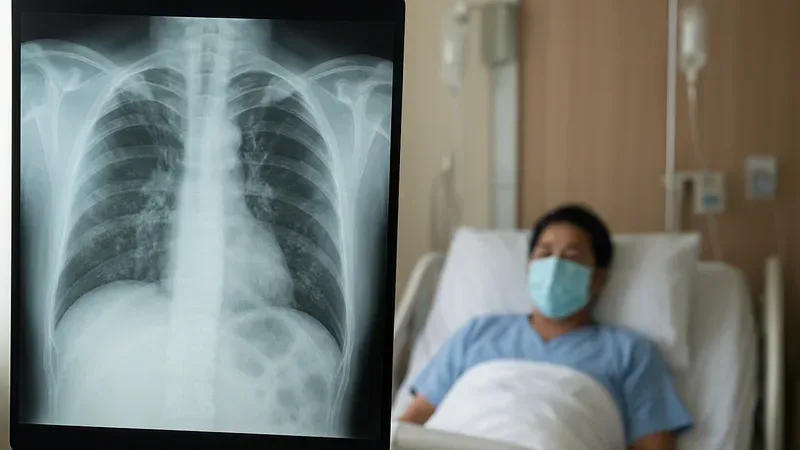
This study looked at COVID-19 patients treated in "hospitels"—hotels turned into healthcare facilities—in Thailand. It compared those with normal and abnormal chest X-rays to see if X-ray findings were linked to outcomes and costs.
📋 Study overview
The study analyzed records of 1,729 adult COVID-19 patients admitted to two Bangkok hospitels between July and October 2021. It compared patients with normal versus abnormal chest X-rays at admission. Researchers tracked demographics, symptoms, vaccination, disease severity, hospital referrals, and costs.
🔍 Key findings
- ✅ 644 patients (37.2%) had abnormal chest X-rays at admission.
- ✅ Patients with abnormal X-rays were older (49.2 vs. 42.2 years) and had higher body weight and BMI.
- ✅ They had more comorbidities and lower full vaccination rates.
- ✅ Abnormal X-ray patients had a higher risk of severe COVID-19 and more hospital referrals.
- ✅ Cough and fatigue were the only symptoms significantly different between groups.
- ✅ Total costs for referred patients were six times higher than for discharged patients (70,545 vs. 12,010 Thai Baht).
🧠 Interpretation
Abnormal chest X-rays at admission were linked to worse outcomes and higher costs. The study measured associations, not direct cause and effect. It does not establish whether the X-ray finding itself caused the worse outcomes or was just a marker of other risk factors.
ℹ️The study tested whether abnormal chest X-rays were associated with worse COVID-19 outcomes and higher costs. It does not make a broader health claim about preventing severe disease.
⚠️ What it does NOT show
- It does not prove that abnormal X-rays cause worse outcomes.
- It did not test treatments or interventions.
- It only studied Thai patients in a specific period.
- Long-term outcomes after discharge were not assessed.
📊 Evidence level
An observational study in people.
Confidence: Low to moderate — observational study with associations, not causation.
Trust tier: Moderate. This is an observational human study—it shows association, not proof of cause. The findings are useful for identifying risk factors but should not be used to make causal claims.
🔬 Limitations
- Retrospective design—cannot establish cause and effect.
- Single-country study in Thailand.
- Data from 2021 may not reflect current variants or treatments.
- No randomization or control group.
❓ Open questions
- Would similar patterns hold for newer COVID-19 variants?
- Do abnormal X-rays predict outcomes in other healthcare settings?
- What specific interventions could reduce referrals and costs?
✅ Your action plan
- Understand that chest X-ray findings can help identify higher-risk patients.
- If you have COVID-19, discuss with a doctor whether imaging is needed.
- Vaccination may reduce risk—check your status.
- This study does not recommend any specific treatment or action.
📝 Takeaway
Abnormal chest X-rays in COVID-19 patients admitted to hospitels were linked to higher risks and costs, but this does not prove causation.
This summary is for general information only and is not medical advice. Talk to a qualified professional before changing anything about your health.
📚 Source
Clinical characteristics, outcomes, and costs of COVID-19 patients in Thai hospitels: a comparative analysis based on chest X-ray findings. BMC Infectious Diseases. 2025 PubMed

Comments (0)
Leave a Comment
Be the first to comment!