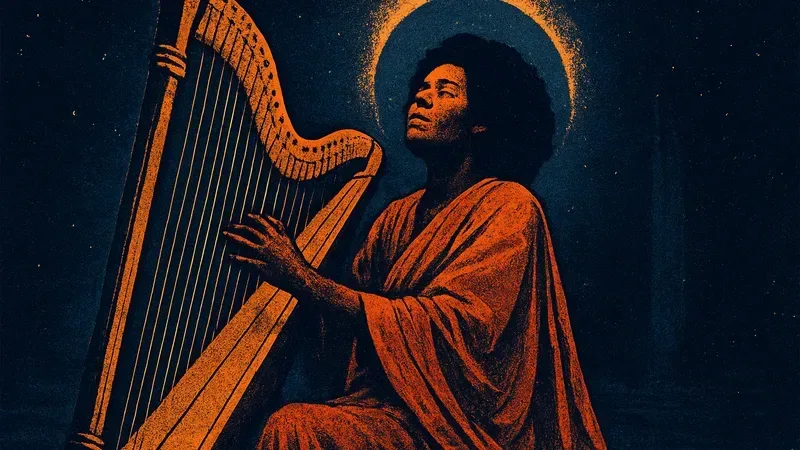
Alice Coltrane took the harp—a rare instrument in jazz—and made it sound like prayer. Her music sits at the intersection of modal jazz, Indian classical drone, and free improvisation. She did not just play notes. She built spaces where rhythm thins out, melody floats, and the listener is asked to sit still.
🎹 Early life and career
Born in 1937, Alice Coltrane began as a bebop pianist. She married John Coltrane in 1965 and played in his final band. After his death in 1967, she launched her own career with A Monastic Trio (1968). By 1970 she had adopted the harp and turned toward Hindu spirituality. She founded an ashram in California in the 1980s and recorded devotional music under the name Turiyasangitananda until her death in 2007.
ℹ️Key facts: Alice Coltrane was active from 1968 to 2007. Her key era was 1968–1972, and she recorded primarily on the Impulse! label. She played a unique style of spiritual jazz and devotional music.
⚖️ The case for and against
Why she matters
Alice Coltrane showed that jazz could absorb devotional music without losing its edge. Her influence reaches beyond jazz into ambient, electronic, and experimental rock. Artists like Flying Lotus and Kamasi Washington cite her directly. But her real legacy is the sound itself: a music that refuses to hurry, that trusts the drone, and that treats the harp as a voice for the divine.
The case against
Her later devotional albums—Eternity, Transcendence, Infinite Chants—sacrifice tension for repetition. The drone becomes a crutch. The improvisational spark that made her early work crackle dims under layers of chant and synth. Fans of her Impulse! period may find these records formless.
🎵 Her musical world
Avant-garde and ashram
The real tension in Alice Coltrane's work is between chaos and calm. Her early albums like Ptah, the El Daoud are knotty, rhythmically complex, and full of sharp edges. Her later work strips away everything except a single chord and a voice. Both approaches come from the same impulse: to reach something beyond the music itself. The earlier records push outward. The later ones pull inward.
The harp and the drone
The harp is the key. Alice Coltrane taught herself the instrument and used it not for delicate arpeggios but as a percussive, modal voice. On Journey in Satchidananda, the harp rings out over a tamboura drone and Pharoah Sanders' soprano saxophone. The effect is not jazz as conversation. It is jazz as meditation. The harp becomes a bell that keeps ringing.
🌀 Curiosities
- ✅ She played harp without formal training, learning the instrument after John Coltrane's death.
- ✅ She founded the Sai Anantam Ashram in California in 1983, where she was known as Swamini Turiyasangitananda.
- ✅ Her album Universal Consciousness features string arrangements that she wrote and conducted herself.
🎧 End on the drone
The best way into Alice Coltrane is Journey in Satchidananda. Put it on, let the tamboura drone settle, and listen to how the harp and saxophone move around it. The music does not need to go anywhere. It is already there.
🎧 Essential tracks
Journey in Satchidananda 1971 - Journey in Satchidananda
The harp and tamboura drone create a static, meditative field. Pharoah Sanders' soprano saxophone floats above it. This is the sound of Alice Coltrane fully realized.
Listen: Spotify · Apple Music · YouTube
Ptah, the El Daoud 1970 - Ptah, the El Daoud
A two-part suite with Pharoah Sanders and Joe Henderson on saxophones. The rhythm section pushes hard, and Coltrane's piano cuts through with sharp, modal lines.
Listen: Spotify · Apple Music · YouTube
Universal Consciousness 1971 - Universal Consciousness
Coltrane wrote string arrangements that weave around her organ. The strings do not sweeten the music. They add weight and dissonance.
Listen: Spotify · Apple Music · YouTube
A Monastic Trio 1968 - A Monastic Trio
Her debut as a leader. The piano work is still rooted in post-bop, but the compositions already lean toward the spiritual and open-ended.
Listen: Spotify · Apple Music · YouTube
Turiya Sings 1982 - Turiya Sings
A devotional album with voice and harmonium. The simplicity is deliberate. The repetition becomes a form of surrender.
Listen: Spotify · Apple Music · YouTube
📚 Sources
Alice Coltrane Wikipedia
Discography MusicBrainz

Comments (0)
Leave a Comment
Be the first to comment!