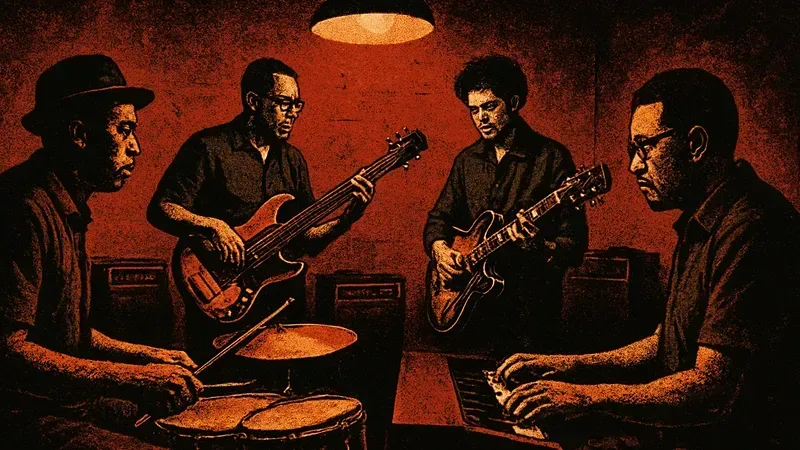
Leo Nocentelli's guitar enters on "Cissy Strut" with a single-note line that sounds almost cautious. Then the bass and drums drop in, and the whole thing locks so tight it barely breathes. That is the Meters in 1969: four musicians who understood that funk lives in what you leave out.
📊 At a Glance
- Style: New Orleans funk
- Years active: 1965–1977
- Origin: New Orleans, Louisiana
- Core lineup: Zigaboo Modeliste, George Porter Jr., Leo Nocentelli, Art Neville
- Key era: 1969–1974
- Label: Josie, Reprise
🧱 Four Parts, One Machine
The Meters were a rhythm section first and a band second. They built songs from the drums up. Modeliste played with a loose, conversational style that never rushed. Porter Jr. locked into the pocket with melodic bass lines that could carry a track alone. Nocentelli's guitar stayed clean and trebly, filling space with short, repeated phrases rather than chords. Art Neville's organ added warmth without crowding. The result was music that sounded simple until you tried to play it.
ℹ️The Meters' approach to rhythm section playing became a template for funk, hip-hop, and dance music. Their records were sampled heavily. More importantly, they proved that virtuosity could be quiet. Every member could play circles around most musicians, but they chose to serve the song. That discipline is rarer than speed.
📜 History
Formed in 1965 in New Orleans, the Meters began as the house band for Allen Toussaint's recording sessions. They backed Lee Dorsey, Dr. John, and others before releasing their own instrumentals. Their first singles—"Cissy Strut" and "Sophisticated Cissy"—became regional hits and defined their sound.
Over eight studio albums, they moved from stripped-down funk toward more arranged, vocal-driven material. The band dissolved in 1977. Later incarnations and reunions followed, but the original lineup never recorded together again.
⚠️ The Case Against Them
The later albums, especially Trick Bag and New Directions, lost the tension that made the early records work. Vocals became more prominent, arrangements grew busier, and the rhythm section sounded less dangerous. The self-titled debut and Look-Ka Py Py remain the purest statement of what they did best. After that, the formula diluted.
⚠️Warning: The later albums, especially Trick Bag and New Directions, lost the tension that made the early records work. Vocals became more prominent, arrangements grew busier, and the rhythm section sounded less dangerous. Stick to the first two albums for the purest sound.
🎤 Backing Band vs. Front Act
The Meters spent years supporting other artists before becoming a headlining act. That apprenticeship gave them a discipline most funk bands lacked: they knew when to stay out of the way. But it also created a tension. Their own records were built on the same restraint that made them great sidemen. The music never showed off. That humility is why their best work still sounds modern, but it also kept them from the spotlight their peers enjoyed.
🔁 The Pocket Philosophy
Listen to "Look-Ka Py Py." The bass and drums play the same rhythmic figure for the entire track. The guitar adds a single-note line that repeats. The organ comps softly underneath. Nothing changes. Nothing needs to. The Meters understood that funk is not about variation. It is about finding a groove and trusting it. Most bands would add a bridge or a solo. The Meters just stayed in the pocket until the song ended.
🎯 Why They Still Matter
The Meters' approach to rhythm section playing became a template for funk, hip-hop, and dance music. Their records were sampled heavily, though the evidence does not specify which tracks. More importantly, they proved that virtuosity could be quiet. Every member could play circles around most musicians, but they chose to serve the song. That discipline is rarer than speed.
🧐 Curiosities
- ✅ The band's name came from the New Orleans rhythm-and-blues term for "the groove."
- ✅ "Cissy Strut" was named after a neighborhood woman's walk, not a dance step.
- ✅ Art Neville later co-founded the Neville Brothers, but the Meters never fully merged with that project.
💿 One Record to Start
If you hear only one Meters record, make it the 1969 self-titled debut. It is short, instrumental, and nearly perfect. Every track is a masterclass in leaving space. After that, Rejuvenation shows the band stretching out without losing the center. The rest is worth hearing, but those two albums contain everything that made them essential.
🎶 Essential Tracks
Cissy Strut 1969 - The Meters
The defining track. Single-note guitar line, locked bass-and-drums pocket, organ that stays in the background. Everything the Meters did well in under three minutes.
Listen: Spotify · Apple Music · YouTube
Look-Ka Py Py
A masterclass in repetition. The rhythm section plays the same figure throughout, proving that funk needs variation less than it needs commitment.
Listen: Spotify · Apple Music · YouTube
People Say 1974 - Rejuvenation
The best example of the Meters adding vocals without losing the groove. The arrangement opens up for the chorus, then tightens back down.
Listen: Spotify · Apple Music · YouTube
Fire on the Bayou 1975 - Fire on the Bayou
A later track that keeps the pocket intact while introducing more space and a darker feel. Shows the band could stretch without breaking.
Listen: Spotify · Apple Music · YouTube
Trick Bag 1976 - Trick Bag
The title track from the album where the formula started to weaken. Still has moments, but the arrangement is busier and the rhythm section sounds less locked.
Listen: Spotify · Apple Music · YouTube
📚 Sources
- The Meters Wikipedia
- Discography MusicBrainz
📚 Related Articles
- The Blue Nile: The Sound of Deliberate Silence - Another band that built a sound from restraint and space, not flash.
- Shellac: The Band That Made Restraint Sound Like a Threat - Minimalist rock that, like the Meters, proves less is more.

Comments (0)
Leave a Comment
Be the first to comment!