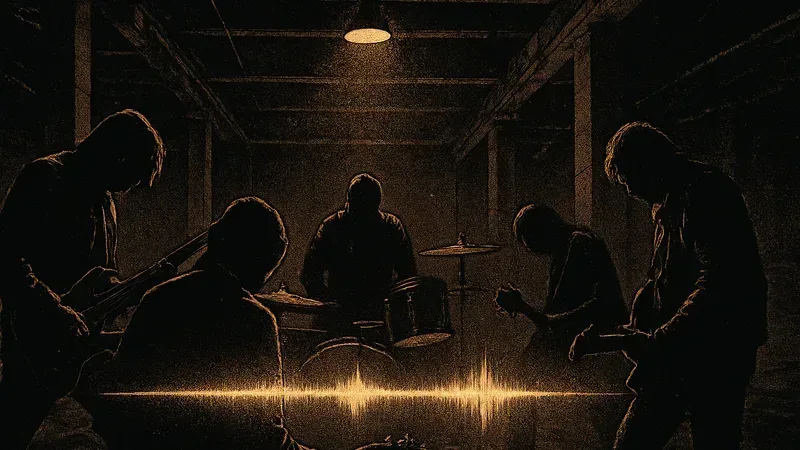
There is a moment on Souls at Zero where the guitars stop moving and the bass holds a single note while the drums circle the same pattern. The tension does not break. It just stays there, pressing against the listener. That is Neurosis in miniature: music that does not resolve so much as endure.
ℹ️At a Glance
- Style: Post-metal, sludge metal, experimental metal
- Years active: 1985–present
- Origin: Oakland, California
- Core lineup: Scott Kelly, Steve Von Till, Dave Edwardson, Jason Roeder
- Key era: 1992–2004
🎸 Where the Weight Sits
Neurosis started as a crust punk band in 1985, playing fast and angry. By 1992, they had abandoned speed for something slower and more deliberate. Their sound became a dense, layered wall of guitars, droning bass, and vocals that alternated between a raw shout and a clean, weary melody. Keyboards and tape loops added atmosphere.
The rhythm section did not drive the songs so much as anchor them, letting the guitars and vocals build tension over long stretches. The result was music that felt both heavy and spacious, like a building collapsing in slow motion.
📖 History
Formed in Oakland in 1985, Neurosis began as a crust punk band. Their early work was fast and raw. In 1989, Steve Von Till replaced guitarist Chad Salter, and the band began to slow down and expand their sound. By 1992, they had added a keyboardist and a visual artist, and their music shifted toward what would later be called post-metal.
The band continued to refine this approach through the 1990s and 2000s, releasing a series of albums that became touchstones for the genre. They remain active, though with reduced output.
⚠️ The Case Against Them
Neurosis records can be punishing in the wrong sense. The later albums, in particular, sometimes stretch a single idea across too many minutes, losing the dynamic contrast that made the earlier work compelling. The band's commitment to heaviness and repetition can feel like a limitation rather than a choice.
⚠️For listeners who do not share their patience, the music can become exhausting before it becomes rewarding.
⛓️ Heaviness Without Release
The central tension in Neurosis is that their music builds toward something that never quite arrives. The crescendos are real, but they often lead to another section of equal weight rather than a cathartic release. This is not a flaw for everyone, but it defines the band's relationship with the listener.
They offer immersion, not payoff. The songs work like rituals: you stay in the room until they end, and the meaning is in the duration, not the climax.
🥁 The Rhythm Section as Foundation
Dave Edwardson's bass and Jason Roeder's drums form the backbone of the Neurosis sound. The bass often carries the root note while the drums lock into a slow, repeating pattern. The guitars, played by Scott Kelly and Steve Von Till, layer dissonant chords and single-note lines over the top, but they rarely dominate.
The vocals sit somewhere between the two: shouted or sung, but always mixed so that they become another instrument rather than the focus. The result is a sound where no single element stands out, but the whole is unmistakable.
🌫️ Atmosphere Over Technique
Neurosis never relied on technical skill. The guitar parts are often simple, the drum patterns repetitive. The power comes from the arrangement: the way a keyboard drone enters halfway through a song, or how the vocals shift from a scream to a clean melody without warning.
The band used tape loops, film projections, and live visuals to reinforce the atmosphere. The music was designed to be felt in a room, not analyzed on headphones. That intention shaped every recording.
🌟 Why They Matter
Neurosis did not invent post-metal, but they gave it a blueprint. Their approach to dynamics, repetition, and atmosphere influenced a generation of bands that followed, from Isis to Cult of Luna. More importantly, they proved that heavy music could be slow, patient, and intellectually serious without losing its physical impact.
💡Their best records reward attention, but they also work as pure sensation. That combination is rare.
🔍 Curiosities
- ✅ The band has included a dedicated visual artist in their lineup since 1992, responsible for live projections and album artwork.
- ✅ Neurosis controlled their own production and recording process, often working with the same engineer for decades.
- ✅ The band's name was taken from a scientific term, not a psychological one, though the music often explores mental states.
🎯 What Remains
Neurosis made music that asked for something from the listener: time, attention, a tolerance for discomfort. The best of it still delivers on that demand. The records from the 1990s and early 2000s hold up because they were built from the ground up, not assembled from hooks.
They sound like a band that knew exactly what they wanted and refused to compromise. That kind of clarity is worth hearing, even if it is not easy.
🎵 Essential Tracks
Souls at Zero
The title track marks the band's shift from crust punk to their mature sound. The slow, repeating bass line and layered guitars create a hypnotic tension that became their signature.
Listen: Spotify · Apple Music · YouTube
Through Silver in Blood
The album's opening track is a masterclass in controlled aggression. The drums drive a relentless pattern while the guitars add dissonant chords, and the vocals alternate between a raw shout and a cleaner, more desperate tone.
Listen: Spotify · Apple Music · YouTube
Times of Grace
This track shows the band's ability to build atmosphere without sacrificing heaviness. The clean vocal section in the middle provides a rare moment of respite before the weight returns.
Listen: Spotify · Apple Music · YouTube
The Eye of Every Storm
The title track is slower and more restrained than earlier work, with a focus on texture and space. It demonstrates the band's willingness to let silence and repetition carry the song.
Listen: Spotify · Apple Music · YouTube
Given to the Rising
A later track that returns to a more aggressive approach while retaining the atmospheric elements. The interplay between the two vocalists becomes more pronounced, adding a new layer of tension.
Listen: Spotify · Apple Music · YouTube
📚 Sources
Neurosis (band) Wikipedia
📚 Related Articles
- Shellac: The Band That Made Restraint Sound Like a Threat - Another band that builds tension through minimalism and deliberate restraint, with a similarly punishing, repetitive approach.
- The Fall: Where the Voice Is the Instrument - A post-punk institution built on repetition and a singular voice, sharing Neurosis's commitment to endurance over payoff.

Comments (0)
Leave a Comment
Be the first to comment!