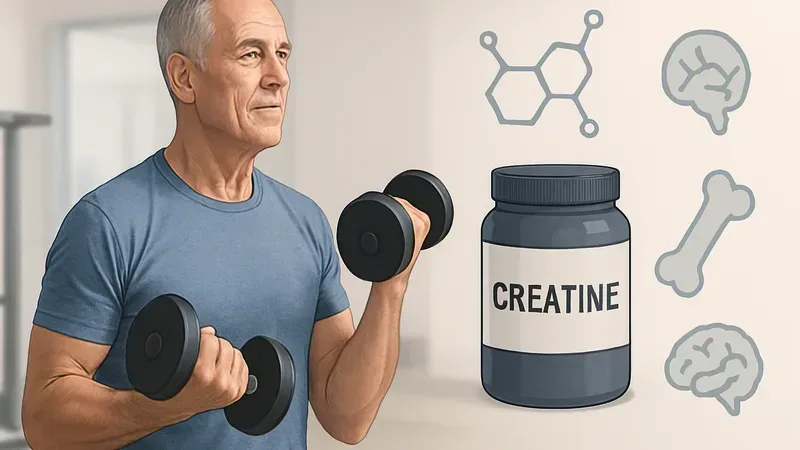
This review looked at whether adding creatine supplements to exercise helps older adults more than exercise alone. Creatine is a common sports supplement. The goal was to see if it also improves muscle, bone, and mental health in aging people.
🔍 Study overview
Researchers searched medical databases for randomized controlled trials—studies where people are randomly assigned to groups. They found 17 studies that tested creatine plus exercise in healthy older adults. They compared these to exercise alone, looking at strength, endurance, daily function, body composition, thinking, and safety.
📊 Key findings
- ✅ Creatine plus resistance training for at least 12 weeks may improve upper and lower body strength more than exercise alone.
- ✅ Daily low-dose creatine combined with exercise may increase lean muscle mass in older adults.
- ✅ Creatine might boost bone density in the thigh bone, but only after a year of use with training.
- ✅ No clear added benefit of creatine on mental health measures was found.
- ✅ Benefits were more consistent in older women than in men.
💡 What it means
These findings suggest that creatine, when paired with regular strength training, could help older adults build and keep muscle. The effect on bone is less certain and may take longer. The review does not show that creatine helps thinking or mood.
ℹ️The study tested whether creatine plus exercise improves muscle, bone, and mental health in older adults. It does not claim that creatine alone works without exercise, nor that it helps younger people or athletes in the same way.
🚫 What it does NOT show
- Creatine does not improve mental health in older adults based on limited data.
- Creatine does not improve bone density within a year; longer use may be needed.
- Creatine is not effective without exercise; benefits appear only when combined with training.
📈 Evidence assessment
A systematic review of randomized controlled trials in humans.
Confidence: High — This is a systematic review pooling many studies, which is strong evidence.
This is a Strong tier review because it combines results from 17 randomized controlled trials, which is the most reliable type of evidence.
⚠️ Limitations
- The review included only 17 studies, which may not cover all relevant research.
- Studies varied in creatine dose, exercise type, and duration, making comparisons difficult.
- Most studies were short-term, so long-term effects are unclear.
❓ Open questions
- What is the best creatine dose and how long should it be used for bone benefits?
- Does creatine help thinking or mood in older adults? More research is needed.
- Why do benefits appear more in women than men? The reason is unknown.
📋 Your action plan
- ✅ If you are an older adult, consider discussing creatine supplementation with a healthcare professional to see if it might suit you.
- ✅ Combine any supplement use with regular resistance training, as the study shows benefits only with exercise.
- ✅ Be patient: muscle benefits may appear after about 12 weeks, but bone changes may take a year or more.
- ✅ Do not expect creatine to improve your mood or thinking based on current evidence.
🏁 Takeaway
Creatine plus resistance training may help older adults gain strength and muscle, but more research is needed for bone and brain effects.
This summary is for general information only and is not medical advice. Talk to a qualified professional before changing anything about your health.
📚 Source
The Additive Effects of Creatine Supplementation and Exercise Training in an Aging Population: A Systematic Review of Randomized Controlled Trials. Journal of geriatric physical therapy (2001). 2020 PubMed

Comments (0)
Leave a Comment
Be the first to comment!