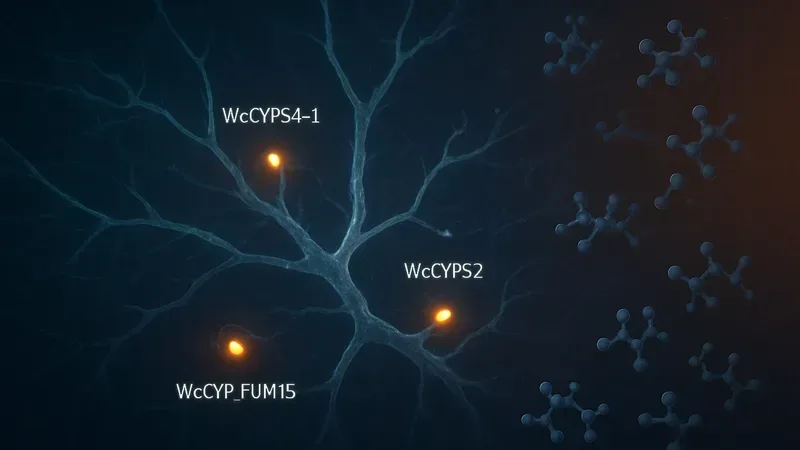
This study looked at a medicinal mushroom called Wolfiporia cocos. It produces pachymic acid, a compound linked to possible health benefits. The researchers wanted to find which genes control its production.
🧬 Study design
The researchers sequenced the genome of the mushroom and analyzed its gene activity. They identified several candidate genes and tested four specific ones by either increasing or decreasing their activity in the mushroom's mycelia (the root-like part). They also tested how temperature affects these genes.
🔑 Key findings
Genes that affect pachymic acid
- Overexpressing three genes (
WcCYP64-1,WcCYP52,WcCYP_FUM15) increased levels of pachymic acid and three related compounds. - Silencing (turning off) each of these three genes decreased levels of those compounds.
- One gene (
WcCYP64-2) had no effect on compound levels when overexpressed or silenced. - Different temperatures changed how these genes were expressed and how much pachymic acid formed.
🎯 What the results mean
Three specific genes in this mushroom help produce pachymic acid. This knowledge could be used to grow mushrooms with higher amounts of this compound. The study measured compound levels, not health effects in humans.
The study identified genes involved in making a mushroom compound. It did not test whether this compound has any health effects in people.
⚠️ What the study does NOT show
- It did not test pachymic acid in humans or animals.
- It did not measure any health outcomes.
- It did not establish safety or effectiveness for any use.
📊 Evidence level and confidence
A laboratory study in mushroom cells (mycelia).
Confidence: Low to moderate — the study is well-designed for a lab experiment, but it's in a mushroom, not humans.
🔍 How much to trust it
The trust tier is Moderate. This means the findings are based on solid lab work, but they come from a single study in a mushroom, so human evidence is not established.
🧪 Limitations and open questions
Limitations
- The study was done only in mushroom mycelia, not in whole mushrooms or humans.
- Only four genes were tested out of many possible candidates.
- The study did not test whether the compound has any biological effect in animals.
Open questions
- Do these same genes work in whole mushrooms grown naturally?
- Can this knowledge be used to increase pachymic acid in edible mushrooms?
- Does pachymic acid have any proven health benefits in humans?
📝 Your action plan
- ✅ Understand that this is early lab research in a mushroom, not a human health study.
- ✅ Do not take pachymic acid or Wolfiporia cocos supplements based on this study alone.
- ✅ If interested in medicinal mushrooms, discuss with a healthcare professional.
- ✅ A proven human plan does not exist yet.
🏁 Takeaway
This lab study found three mushroom genes that boost a compound, but it provides no evidence for human health effects.
This summary is for general information only and is not medical advice. Talk to a qualified professional before changing anything about your health.
📖 Source
An omics-based characterization of Wolfiporia cocos reveals three CYP450 members involved in the biosynthetic pathway of pachymic acid.. Communications biology. 2024 PubMed

Comments (0)
Leave a Comment
Be the first to comment!