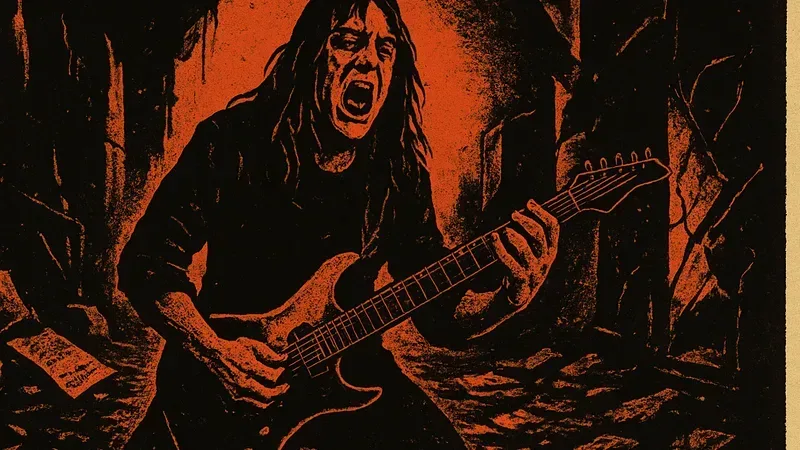
The guitars don't quite lock. The vocals sound like someone choking on gravel. The tempo shifts feel less like arrangement and more like the band changed its mind mid-song. Celtic Frost never made music that moved smoothly. That awkwardness became their signature.
📊 At a Glance
- ✅ Style: Extreme metal with avant-garde leanings
- ✅ Years active: 1984–2008
- ✅ Origin: Zürich, Switzerland
- ✅ Key era: 1984–1987
- ✅ Label: Noise Records
🎯 The Pitch
Celtic Frost took the raw aggression of early extreme metal and pushed it into strange territory. They borrowed from classical, industrial, and pop without ever sounding comfortable in any of it. Their best records feel like a band figuring out how to be heavy by breaking the rules.
📜 History
The band formed in 1984 from the ashes of Hellhammer, a primitive Swiss death-metal project. Their early EPs and albums—Morbid Tales, To Mega Therion, Into the Pandemonium—expanded what extreme metal could contain.
A disastrous stylistic shift on Cold Lake (1988) nearly ended them. After a brief reunion in the 1990s, they returned with the crushing Monotheist in 2006 before disbanding permanently in 2008.
⚖️ The Case Against Them
The catalogue is wildly uneven. Cold Lake abandoned everything that made the band distinctive for thin glam-metal posturing. Vanity / Nemesis tried to split the difference and satisfied no one.
Even the classic records have moments where ambition outruns execution—songs that meander, riffs that don't land, production that buries the vocals.
⚠️Warning: Cold Lake was so poorly received that the band's original label dropped them shortly after its release.
🌀 Chaos as Method
Celtic Frost's real tension sits between their reach and their grasp. They wanted to make art-metal before anyone had a name for it. But they lacked the technical polish of later bands who would work similar territory.
The result is music that feels genuinely unstable—not because the players couldn't play, but because they refused to make the easy choice. That instability is what makes the best work still sound dangerous.
Their best records feel like a band figuring out how to be heavy by breaking the rules.
🎸 The Riff That Refuses to Sit Still
Tom G. Warrior's guitar playing avoids the usual metal patterns. Riffs often start and stop abruptly, or shift into unexpected intervals. The rhythms don't lock into a comfortable groove.
On To Mega Therion, songs like 'Circle of the Tyrants' move through sections that feel almost disjointed. The effect is deliberate: the music never settles, and the listener never relaxes.
🎤 Vocals That Don't Perform
Warrior's vocal delivery is a grunt, not a growl—flat, rhythmic, almost percussive. He doesn't use range or melody. The voice sits in the same mid-range as the guitars, adding texture rather than melody.
On Into the Pandemonium, this approach makes even the cover of 'Mexican Radio' sound like a threat. The voice is an instrument of atmosphere, not expression.
ℹ️Did you know? Tom G. Warrior's signature grunt was partly inspired by the sound of a dying animal he heard as a child.
💡 Why They Matter
Celtic Frost showed that extreme metal could be weird without being self-indulgent. Their willingness to interrupt a blast beat with a clean guitar, or to let a song fall apart before rebuilding it, opened a path that later bands like Neurosis and Godspeed You! Black Emperor would widen.
They never became a household name, but their best records still sound like no one else.
🧐 Curiosities
- The band's name was taken from a line in a song by the British rock band Jethro Tull.
- Tom G. Warrior's signature grunt was partly inspired by the sound of a dying animal he heard as a child.
- Cold Lake was so poorly received that the band's original label dropped them shortly after its release.
🏁 What Remains
Celtic Frost made albums that feel like they could fall apart at any moment. That tension—between ambition and execution, between heaviness and awkwardness—is what keeps their best work alive.
They didn't perfect extreme metal. They made it stranger, and that turned out to be more valuable.
🎵 Essential Tracks
Into the Crypts of Rays (1984 – Morbid Tales)
The template for everything that followed: a single riff repeated into hypnosis, a vocal that sounds like a command, and a structure that refuses to resolve. It establishes the band's core approach in under four minutes.
Listen: Spotify · Apple Music · YouTube
Progeny (1985 – To Mega Therion)
Shows how Celtic Frost used tempo shifts to create tension. The verses grind at a slow march; the chorus opens into something almost melodic. The contrast is stark and effective.
Listen: Spotify · Apple Music · YouTube
Circle of the Tyrants (1985 – To Mega Therion)
A masterclass in awkward riffing. The main guitar line moves in unexpected intervals, and the song's structure feels pieced together rather than written. It shouldn't work, but it does.
Listen: Spotify · Apple Music · YouTube
Mexican Radio (1987 – Into the Pandemonium)
A cover of Wall of Voodoo's new-wave hit. Celtic Frost drains the irony and replaces it with menace. The flat vocal delivery and grinding guitars turn a pop song into something genuinely unsettling.
Listen: Spotify · Apple Music · YouTube
A Dying God Coming into Human Flesh (2006 – Monotheist)
The late-era return to form. Slower, heavier, and more deliberate than anything before it. The production is thick and oppressive, and the vocal has aged into something that sounds like genuine exhaustion.
Listen: Spotify · Apple Music · YouTube
📚 Related Articles
- Tortoise: The Band That Made Post-Rock a Verb — Like Celtic Frost, Tortoise uses the studio as a tool to disrupt genre expectations and build unstable, atmospheric sound.
- Godspeed You! Black Emperor: The Band That Waits — Both bands build tension through patience and structural risk, making music that feels dangerous because it refuses easy resolution.
- Scott Walker: The Baritone Who Left Pop Behind — Scott Walker's shift from pop to avant-garde mirrors Celtic Frost's own journey from extreme metal to experimental ambition.
📖 Sources
- Celtic Frost Wikipedia
- Discography MusicBrainz

Comments (0)
Leave a Comment
Be the first to comment!