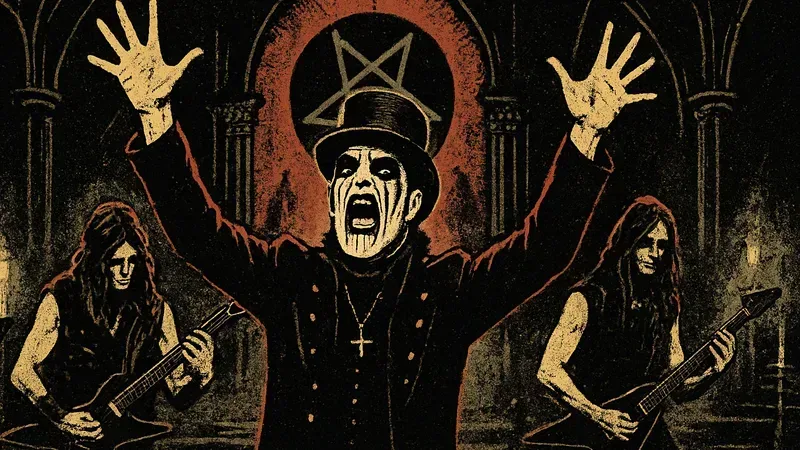
King Diamond's voice enters the room before the riffs do. A high, theatrical falsetto that could belong to a different species of music entirely. Then the guitars arrive — two of them, weaving melodies that sound like they were written by someone who learned harmony from horror movie soundtracks. Mercyful Fate never quite fit the metal scene they helped create.
📋 At a Glance
- Style: Heavy metal / first-wave black metal
- Years active: 1981–1985, 1992–1999
- Origin: Copenhagen, Denmark
- Core lineup: King Diamond (vocals), Hank Shermann (guitar)
- Key era: 1983–1984
- Label: Roadrunner, Metal Blade
🎵 What They Did
Mercyful Fate played heavy metal with progressive leanings and a theatrical edge. The riffs were intricate, the song structures often stretched past six minutes, and the lyrics drew from LaVeyan Satanism and the occult. They were part of the first wave of black metal alongside Venom and Bathory, but their sound owed more to progressive rock and hard rock than to punk. The result was something that felt both older and stranger than what their peers were doing.
ℹ️Despite being lumped with early black metal, Mercyful Fate's core influences were progressive rock and heavy metal — not punk. This made them an oddity in their own scene.
⏳ History
Formed in 1981 by vocalist King Diamond and guitarist Hank Shermann, Mercyful Fate released two studio albums in the early 1980s: Melissa (1983) and Don't Break the Oath (1984). Internal tensions led to a breakup in 1985. King Diamond launched a solo career, and the band reformed in 1992, releasing five more albums through the 1990s before disbanding again in 1999. The early records remain the most celebrated.
⚖️ The Case Against Them
The 1990s reunion albums never matched the tension of the 1980s work. The production was cleaner, the songwriting less focused, and the theatricality sometimes felt like a routine rather than a genuine artistic choice. The band's commitment to occult imagery also made them easy to dismiss as cartoonish by those who preferred their metal more grounded. The later records have moments, but not the sustained momentum of the early years.
⚠️Even fans admit the reunion material lacks the raw energy of the classic albums. If you are new to Mercyful Fate, start with the 80s output first.
🎭 The Seriousness of the Show
Mercyful Fate's central tension is between the material and the delivery. The lyrics are about Satan, witches, and ancient curses — the kind of thing that could easily slide into parody. But the musicianship is dead serious. The twin-guitar harmonies are precise. The song structures are deliberate. King Diamond's vocals, while extreme, are controlled and musical.
The band never winked. They committed to the bit completely, and that commitment is what made it work. When the music is good, the imagery feels earned. When it isn't, the whole thing can feel like a costume.
"The band never winked. They committed to the bit completely, and that commitment is what made it work."
🎸 The Twin-Guitar Engine
The guitars are the center of Mercyful Fate's sound. Hank Shermann and the other guitarist (Michael Denner on the early records) played interlocking melodies rather than simple rhythm-and-lead splits. The riffs moved in counterpoint, creating a dense, almost orchestral texture. The rhythm section stayed steady, rarely stepping forward, giving the guitars room to breathe. The result was a sound that felt both busy and controlled — a lot of notes, but every one in its place.
🎤 The Voice as Instrument
King Diamond's vocal approach is the band's most distinctive feature. He sang in a high, clear falsetto that could shift into a guttural snarl or a spoken-word whisper. He treated his voice as another melodic instrument, often mirroring or answering the guitar lines. The theatrical delivery — complete with character voices and dramatic pauses — gave the songs a narrative quality that set Mercyful Fate apart from other metal bands of the era. It was not subtle, but it was effective.
💡Listen for how King Diamond's falsetto interacts with the guitar melodies. The two are often in conversation, which gives the music a unique dramatic tension.
🌟 Why They Still Matter
Mercyful Fate's influence on extreme metal is difficult to overstate. The early records were cited as formative by bands in the thrash, death, and Norwegian black metal scenes. The twin-guitar approach and the theatrical vocals became templates for later acts. But the band's real legacy is narrower and more specific: they showed that metal could be both technically ambitious and unapologetically weird. The best of their work still sounds like no one else.
🧐 Curiosities
- ✅ King Diamond's real name is Kim Bendix Petersen. He adopted the stage name early in his career.
- ✅ The band's name came from a dream one of the members had about a mercy-killing fate.
- ✅ Several venues refused to book Mercyful Fate due to the satanic content of their lyrics, forcing them to play in unconventional spaces.
💿 Where to Start
The early records are the ones that matter. Melissa and Don't Break the Oath contain the band's strongest writing and most focused performances. The 1990s material is worth hearing for curiosity, but it does not reach the same heights. Start with 'Evil' and 'Curse of the Pharaohs' from Melissa, then move to 'Come to the Sabbath' and 'The Oath' from Don't Break the Oath. That is the core of what Mercyful Fate was.
Essential Tracks
Evil 1983 - Melissa
Opens with a clean guitar line that builds into a galloping riff. The track shows how the band balanced melody with aggression, and King Diamond's vocal enters with a controlled snarl that sets the album's tone.
Listen: Spotify · Apple Music · YouTube
Curse of the Pharaohs 1983 - Melissa
A narrative-driven song with a slow, ominous verse that accelerates into a faster chorus. The twin guitars trade lead lines, and the vocal delivery shifts between spoken-word and falsetto, demonstrating the band's theatrical range.
Listen: Spotify · Apple Music · YouTube
Come to the Sabbath
The band's most overtly theatrical track. A slow, heavy riff underpins the verses, while the chorus opens into a faster, more melodic section. King Diamond's vocal performance is at its most exaggerated and effective.
Listen: Spotify · Apple Music · YouTube
The Oath
A seven-minute epic built on a single, repeating riff that gradually intensifies. The structure is patient, with long instrumental passages and a spoken-word section that builds to a dramatic climax. It is the band's most ambitious early song.
Listen: Spotify · Apple Music · YouTube
Gypsy 1993 - In the Shadows
The strongest track from the reunion era. The riff is simpler than the early work, but the song retains the band's signature twin-guitar harmonies and theatrical vocal delivery. It shows the formula still worked, even if the edge had dulled.
Listen: Spotify · Apple Music · YouTube
📚 Sources
Mercyful Fate Wikipedia
Discography MusicBrainz
📚 Related Articles
- King Crimson: The Band That Reinvented Itself by Staying the Same — Another theatrical, progressive band that evolved without losing its core identity.
- Sparks: The Art of Controlled Chaos in Pop — Like Mercyful Fate, Sparks built a career on theatricality and intricate music without irony.

Comments (0)
Leave a Comment
Be the first to comment!