📋 What the study did
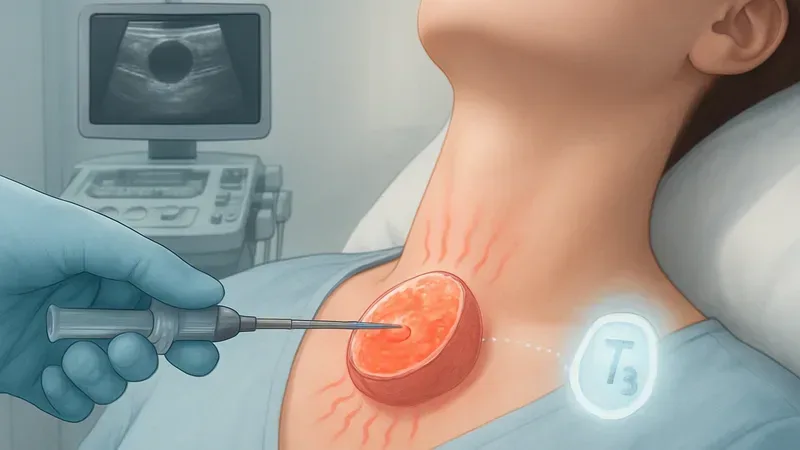
This study tested radiofrequency ablation, a heat-based procedure, for treating toxic thyroid nodules that cause hyperthyroidism. The study involved 41 human patients.
Forty-one patients with symptomatic hyperthyroidism from toxic nodules received ultrasound-guided radiofrequency ablation in an office setting. Nodule volume was tracked by ultrasound at 1, 3, 6, and 12 months after the procedure. The study also measured symptom improvement and complications.
🔍 What it found
- ✅ Mean nodule volume reduction was 80.57% by 12 months after the procedure.
- ✅ 35 of 41 patients achieved remission from the hyperthyroid state.
- ✅ Patients reported significant improvement in cosmetic and clinical symptoms.
- ✅ Pain was the most frequently reported complication but did not stop any procedure or affect outcomes.
💡 What it means
Radiofrequency ablation substantially shrank toxic thyroid nodules and helped most patients stop being hyperthyroid. The study measured nodule volume and symptom relief, not long-term health outcomes like survival or disease recurrence.
ℹ️This study tested whether radiofrequency ablation reduces nodule volume and improves symptoms. It did not test whether this procedure prevents future thyroid disease or extends lifespan.
⚠️ What it does NOT show
- Long-term outcomes beyond 12 months were not assessed.
- The study did not compare RFA to surgery or other treatments.
- Safety was not fully established beyond the short follow-up.
📊 Evidence level
An observational study in people.
🔬 Confidence indicator
Confidence: Low to moderate — observational design limits causal conclusions.
🤔 How much to trust it
Trust tier: Moderate. This is an observational human study — it shows association, not proof of cause. The results are promising but need confirmation in larger, controlled trials.
🚧 Limitations
- Small sample size of 41 patients.
- No comparison group (e.g., surgery or no treatment).
- Follow-up limited to 12 months.
- Single institution, which may limit generalizability.
❓ Open questions
- How does RFA compare to surgery in long-term outcomes?
- Will nodule regrowth or hyperthyroidism recur after 12 months?
- Is the procedure safe for patients with other health conditions?
📝 Your action plan
- ✅ If you have a toxic thyroid nodule, discuss RFA with your endocrinologist as a potential option.
- ✅ Understand that this study does not prove RFA is better than surgery or medication.
- ✅ Ask about the risks, including pain and the need for follow-up imaging.
🏁 Takeaway
Radiofrequency ablation shrank toxic thyroid nodules and helped most patients achieve remission, but longer and larger studies are needed.
⚠️This summary is for general information only and is not medical advice. Talk to a qualified professional before changing anything about your health.
📄 Source
Radiofrequency Ablation of Toxic Thyroid Nodules: An Early Experience of a Single Institution in the United States.. Endocrine practice : official journal of the American College of Endocrinology and the American Association of Clinical Endocrinologists. 2025 PubMed

Comments (0)
Leave a Comment
Be the first to comment!