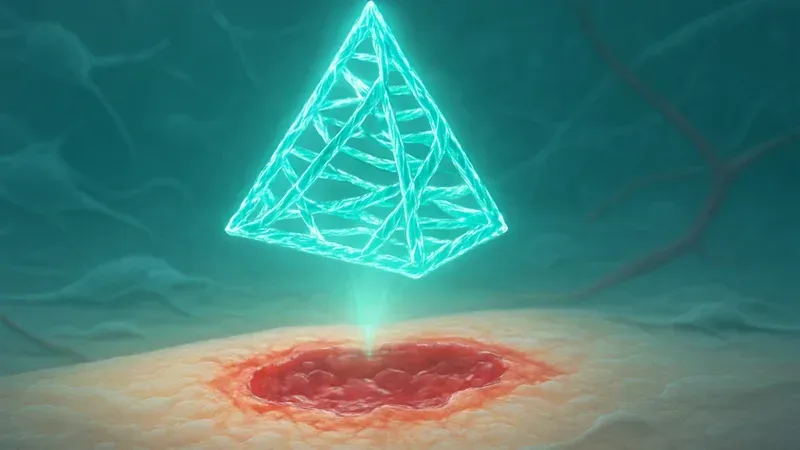
This review article summarizes research on tetrahedral framework nucleic acids (tFNAs) for wound healing. tFNAs are tiny, pyramid-shaped DNA structures. The review discusses how they might help wounds heal, but it does not present new experimental results.
📚 What the study did
This is a review article, not a new experiment. It summarizes existing studies on tFNAs in wound healing. The review covers possible mechanisms, such as cell growth and blood vessel formation. It also discusses targeted delivery of drugs and biocompatibility. The subjects of the original studies are not clearly specified in this review.
🔬 What it found
- ✅ The review describes tFNAs as having unique structural and functional properties for wound healing.
- ✅ tFNAs may help with cell proliferation, migration, and tissue regeneration.
- ✅ They may also aid in angiogenesis, or new blood vessel growth.
- ✅ tFNAs offer potential for localized and sustained drug delivery to wounds.
- ✅ The review discusses biocompatibility and biosafety of tFNAs, but specific data are not provided.
🧠 What it means
This review suggests that tFNAs show promise in laboratory and animal studies for wound healing. However, it does not provide new data or confirm effectiveness in humans. The findings are based on summarizing other research, not on a controlled experiment.
This study reviews potential applications of tFNAs in wound healing. It does not test or claim that tFNAs are effective for wound healing in humans.
⚠️ What it does NOT show
- It does not provide new experimental results.
- It does not show that tFNAs work in humans.
- It does not establish safety or effectiveness for wound care.
- It does not compare tFNAs to standard treatments.
📊 Evidence level
A review article summarizing existing studies, with subjects not clearly specified.
🔎 Confidence indicator
Confidence: Low to moderate — because the study type is not clearly specified and no new data are presented.
🛡️ How much to trust it
The trust tier is Moderate. This means the findings should be treated with healthy caution. The review summarizes other research, but without clear details on the original studies, it is hard to assess reliability.
⚠️Key limitation: The study type is not clearly specified. Subjects of the original studies are not reported. No new experimental data are provided. The review may not include all relevant research.
❓ Open questions
- Do tFNAs actually improve wound healing in humans?
- What are the long-term safety and side effects?
- How do tFNAs compare to existing wound treatments?
📋 Your action plan
- ✅ Understand that this is a review, not a human trial.
- ✅ Do not use tFNAs for wound care based on this review alone.
- ✅ Discuss any wound healing concerns with a healthcare professional.
- ✅ Follow standard wound care advice from your doctor.
🏁 Takeaway
This review highlights potential of tFNAs for wound healing, but human evidence is lacking and no conclusions can be drawn.
This summary is for general information only and is not medical advice. Talk to a qualified professional before changing anything about your health.
📖 Source
Tetrahedral framework nucleic acids for improving wound healing. Journal of nanobiotechnology. 2024 PubMed

Comments (0)
Leave a Comment
Be the first to comment!