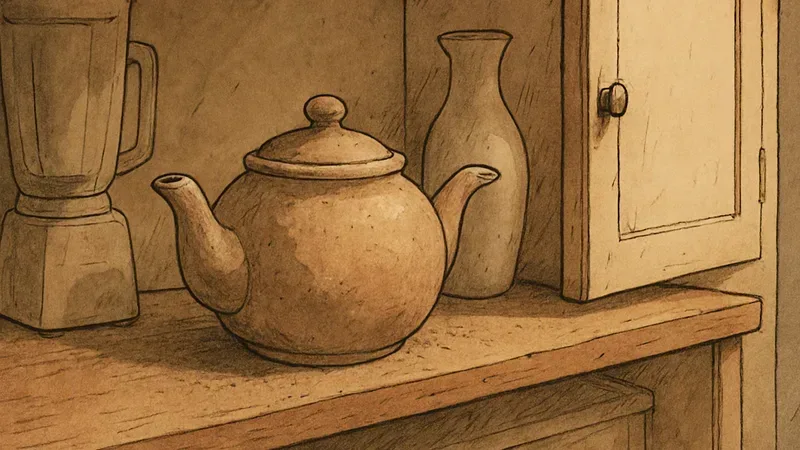
There is a shelf in my kitchen where a ceramic teapot sits. It has not been used in three years. I dust it every few weeks, and I think about moving it to the back of a cabinet, but I never do. It is not ugly. It is not broken. It is just not needed.
🧠 The Question We Avoid
Why do we keep things we never touch? Not the sentimental things—the baby shoes, the wedding dress, the ticket stub from a first date. Those have a clear reason. I mean the neutral objects. The extra blender that works fine but we already have a better one. The books we will never read again but cannot donate. The vase someone gave us that does not fit any room in the house.
These objects take up space, both physical and mental. Every time I open that cabinet, I see the teapot and feel a small, quiet tug. Not guilt, exactly. More like a loose thread I keep meaning to pull.
ℹ️The teapot is not ugly. It is not broken. It is just not needed. This describes a class of objects we might call neutral objects — things with no strong emotional weight, yet we still cannot let go.
📖 The Story We Tell
When I think about getting rid of the teapot, a story appears. The story says: maybe one day I will have guests who love tea. Maybe I will host a proper afternoon tea, with scones and jam. Maybe I will become the kind of person who does that.
The story is not about the teapot. It is about a future version of me who has more time, more energy, more interest in hosting. Keeping the teapot is a way of keeping that possibility alive. To throw it away would be to admit that I am not that person, and probably never will be.
🧘 The Ritual of Keeping
There is also something soothing about the act of keeping itself. Dusting the teapot, straightening it, making sure it is still there. It is a small ritual with no stakes. You cannot fail at dusting a teapot. In a life full of decisions that matter, this one does not. So we leave it untouched, and the shelf becomes a quiet museum of our indecision.
🔄 What If We Are Wrong
But maybe the opposite is also true. Maybe keeping the teapot is not about fear of letting go. Maybe it is a kind of loyalty. We keep it because someone gave it to us, or because we bought it during a good year, or because we remember the morning we first used it. The object is a witness. To discard it feels like erasing a small piece of evidence that we were there, that we lived that day.
And sometimes, on a quiet Sunday, I do make tea in a different pot, and I look at the teapot on the shelf and think: you are fine where you are. You do not have to earn your place.
The shelf will still be there tomorrow. So will the teapot. And I will probably dust it again, and think about what it means, and then not decide anything at all.
💡Perhaps the quiet act of dusting is its own form of mindfulness — a reminder that not every object needs a purpose to earn its space in our lives.
📚 Related Articles
- ✅ The Shirt That Hangs in the Closet — A parallel reflection on clothes we keep but never wear, exploring the same quiet indecision.
- ✅ The Good Glasses Nobody Drinks From — Another take on objects saved for a special occasion that never arrives, mirroring the teapot's story.
- ✅ The Tiny Pencil You Kept From the Furniture Store — Examines small, purposeless keepsakes and why we hold onto them long after their use is gone.

Comments (0)
Leave a Comment
Be the first to comment!