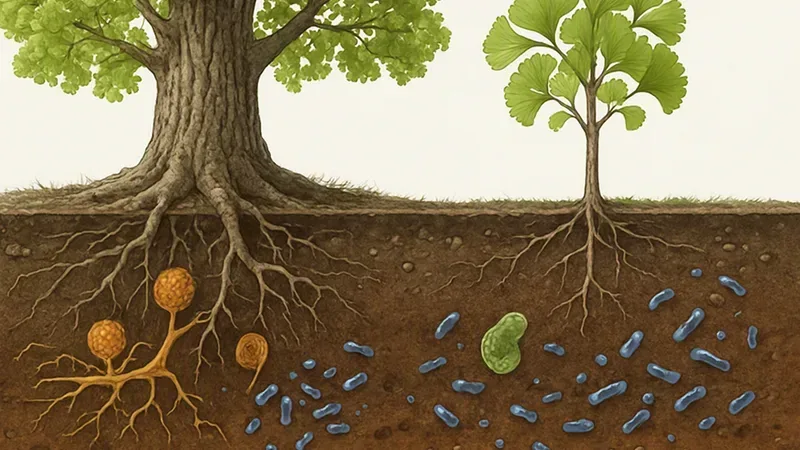
This study looked at the tiny organisms living in the soil around ancient ginkgo trees in Shanghai. It compared the microbes near 200-year-old trees with those near 50-year-old trees. The goal was to understand how these communities differ.
🔬 Study overview
The researchers collected soil and root samples from ancient ginkgo trees (about 200 years old) and adult ginkgo trees (about 50 years old) in Shanghai. They used two methods to identify the microbes: phospholipid fatty acid (PLFA) analysis and high-throughput sequencing. The study measured microbial biomass and diversity.
📊 Key findings
- ✅ Total microbial biomass in the soil was lower around ancient ginkgo trees than around adult trees.
- ✅ Biomass of Gram-negative bacteria, arbuscular mycorrhizal fungi (AMF), and protozoans was significantly different between the two groups.
- ✅ In the roots and soil of ancient ginkgo, 224 virtual taxa of AMF were found, belonging to 4 orders, 10 families, and 19 genera.
- ✅ The most common AMF genera were Glomus and Paraglomus.
- ✅ Live AMF were significantly more abundant in ancient ginkgo trees than in adult trees.
- ✅ Total phosphorus, organic matter, and soil pH may influence the microbial community around ancient ginkgo.
Ancient ginkgo trees host a different set of soil microbes than younger trees. They have less total microbial life but more live beneficial fungi. This suggests that the soil environment changes as trees age, which might affect tree health.
⚖️ Study vs. claim
The study measured microbial differences in soil and roots. It did not test whether these differences cause the trees to live longer or be healthier.
What it does NOT show
- It does not show that these microbes improve tree lifespan.
- It does not show the same patterns apply to other tree species.
- It does not establish cause and effect between soil factors and microbes.
📈 Evidence level
An observational study in trees.
Confidence indicator
Confidence: Low to moderate — the study type is not clearly specified.
How much to trust it
Trust tier: Moderate. Because the study type is not clearly specified, treat the findings with healthy caution. This is a single observational study in trees, not a controlled experiment.
⚠️Limitations: Study type is not clearly specified. Only one tree species and location were studied. No direct health outcomes for the trees were measured.
Open questions
- Do these microbial differences affect tree health or longevity?
- Would similar patterns appear in other ancient trees?
- Can changing soil conditions alter the microbial community?
✅ Your action plan
- ✅ Understand that this study describes a natural pattern, not a proven intervention.
- ✅ If you care for old trees, consider soil testing for phosphorus and pH.
- ✅ Do not attempt to replicate the study's findings without expert guidance.
- ✅ Discuss any tree care changes with a professional arborist.
💡Takeaway: Ancient ginkgo trees have distinct soil microbes compared to younger trees, but whether this matters for tree health is unknown.
This summary is for general information only and is not medical advice. Talk to a qualified professional before changing anything about your health.
📚 Source
A Treasure Trove of Urban Microbial Diversity: Community and Diversity Characteristics of Urban Ancient Ginkgo biloba Rhizosphere Microorganisms in Shanghai.. Journal of fungi (Basel, Switzerland). 2024 PubMed

Comments (0)
Leave a Comment
Be the first to comment!