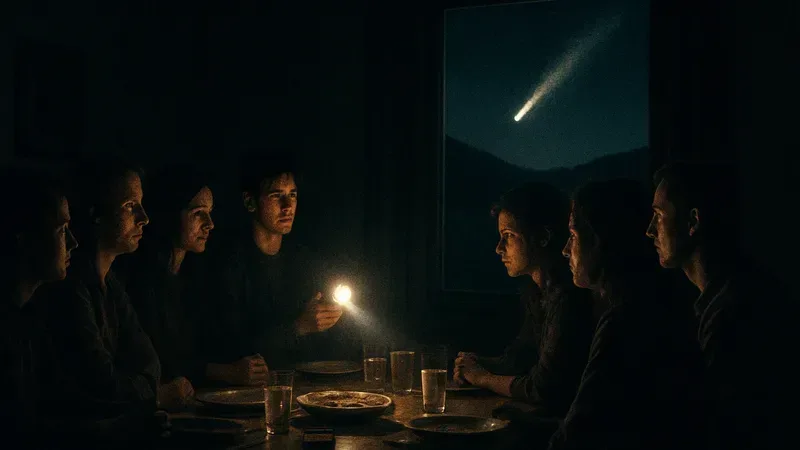
A dinner party. Eight friends. A comet passing overhead. That is all the setup Coherence needs to turn a quiet evening into something deeply unsettling. The film does not need spaceships or explosions. It needs only a house, a few actors, and the creeping suspicion that the people around the table are not quite who they seem.
📋 At a Glance
- Year: 2014
- Director: James Ward Byrkit
- Country: United Kingdom, United States
- Language: English
- Genre: Thriller, Science Fiction
- Main cast: Emily Baldoni, Maury Sterling, Nicholas Brendon, Lorene Scafaria
- Runtime: 89 minutes
🍽 The Setup
Eight friends gather for dinner at a house in the hills. The conversation is casual at first — relationships, work, the usual small talk. Then the power goes out. A neighbor returns from outside with a strange story: the comet passing overhead seems to be doing something to the neighborhood. One house is still lit, but it looks exactly like the house they are in. The friends decide to investigate. That decision cracks open the evening.
🔗 Constraint as Strength
Coherence was made for about $50,000. The entire film takes place in one house. The crew was tiny. The script was loose enough that actors improvised much of the dialogue. These limitations could have produced a flat, stagey film. Instead, they become the reason the film works. Every conversation feels real because the actors were not reading lines — they were reacting. The single location traps the audience inside the same space the characters cannot leave. There is no escape to another set, no relief from the tension. The budget forced the filmmakers to rely on what matters: performance, pacing, and the slow burn of paranoia.
ℹ️Budget limitation as creative fuel. Coherence was shot over five nights with a skeleton crew. The handheld camera and natural lighting were born from necessity, not aesthetic choice, but they became the film's signature.
👥 The Ensemble Tightrope
Eight characters is a lot for a low-budget thriller. Most of them are not fully developed. That is fine. The film does not need deep backstories because the situation itself does the work. What matters is how each person reacts under pressure. Some stay calm. Some crack immediately. Some try to lead. Some follow.
The actors, many of them friends in real life, bring a natural chemistry that makes the unraveling feel earned. Nicholas Brendon, known for lighter roles, brings a nervous energy that fits the tone. Emily Baldoni carries the film as the character who sees the cracks first. The ensemble does not need to be memorable as individuals. They need to feel like a group that could fall apart. They do.
☄️ The Comet as a Device
The comet is not explained. The film never pauses for a science lecture. Characters mention quantum mechanics and Schrödinger's cat, but only as nervous conversation, not exposition. This restraint is smart. The comet works as a trigger, not a subject. It makes the rules of reality bend without ever stating what the new rules are. The audience learns alongside the characters, through observation and mistake. The mystery stays alive because no one — not the film, not the characters — pretends to have answers. That uncertainty is the source of the tension, not the comet itself.
The comet is not a plot point. It is an excuse for chaos.
✨ What Still Works
The handheld camera places the viewer inside the room. The naturalistic dialogue avoids the polished rhythm of most sci-fi. The pacing lets tension build slowly, then accelerate without warning. The film trusts the audience to notice details — a slightly different sweater, a changed story — without pointing them out. And the ending refuses to offer comfort. The questions linger.
⚠️ An Honest Weakness
The handheld camera, while immersive, can feel disorienting. Some viewers may find the constant movement distracting rather than effective. The middle stretch repeats the same kind of discovery — someone notices something off, the group argues, they check another house — without adding much new information. The film could lose ten minutes without losing its impact.
🤔 The Question Behind the Movie
What happens when the people you trust most become the people you cannot trust at all? Coherence asks this question not through dramatic betrayal but through small, accumulating doubts. A friend says something she should not know. Another remembers an event differently. The film suggests that identity is fragile, held together by shared stories. When those stories stop matching, the group does not just lose trust. It loses the ground beneath its feet.
💡Key takeaway: Great sci-fi doesn't need expensive effects. It needs a smart premise, a confined space, and the willingness to let uncertainty do the work.
🏁 Final Thought
Coherence proves that a good science fiction film does not need a big budget. It needs a smart premise, a confined space, and the willingness to let uncertainty do the work. The comet passes. The questions stay.
📚 Sources
Coherence (film) Wikipedia
Facts TMDB
📚 Related Articles
- ✅ The Man from Earth: A Mind-Bending Farewell Party — Another low-budget film where a single conversation unravels reality, perfect for fans of talky sci-fi.
- ✅ Stay: A Mind That Refuses to Stay Still — A psychological thriller where reality bends and trust dissolves, similar to Coherence's paranoid atmosphere.
- ✅ Session 9: The Horror of Empty Halls and Broken Tapes — A slow-burn horror that builds dread through atmosphere and character tension, like Coherence.

Comments (0)
Leave a Comment
Be the first to comment!